
Three hundred million deaths in a century. That is the toll of smallpox in the 20th century, more than all the wars of the same period combined. And yet, this disease has an official end point: on May 8, 1980, the World Health Organization declares its complete eradication. An absolute first in the history of medicine, never repeated since for any other human disease.
The last natural case occurred in October 1977, in Somalia, in a man named Ali Maow Maalin. A year later, in September 1978, a woman died of smallpox in Birmingham, England. Her name was Janet Parker. Her infection did not come from a wild spillover of the virus, but from a laboratory leak located right beneath her office. Ironically chilling: the final victim of smallpox was not killed by nature, but by the science thought to have defeated it.
- Smallpox caused 300 million deaths in the 20th century before its official eradication on May 8, 1980.
- Two official stocks of the virus remain at the CDC in Atlanta and at the VECTOR center in Siberia, kept deliberately alive.
- Destruction planned for 1993 has been postponed thirty times, the absence of diplomatic consensus serving as a permanent pretext.
- In 2014, six forgotten vials containing viable virus were discovered in an American laboratory after 40 years.
Two Freezers, and the Virus That Refuses to Disappear
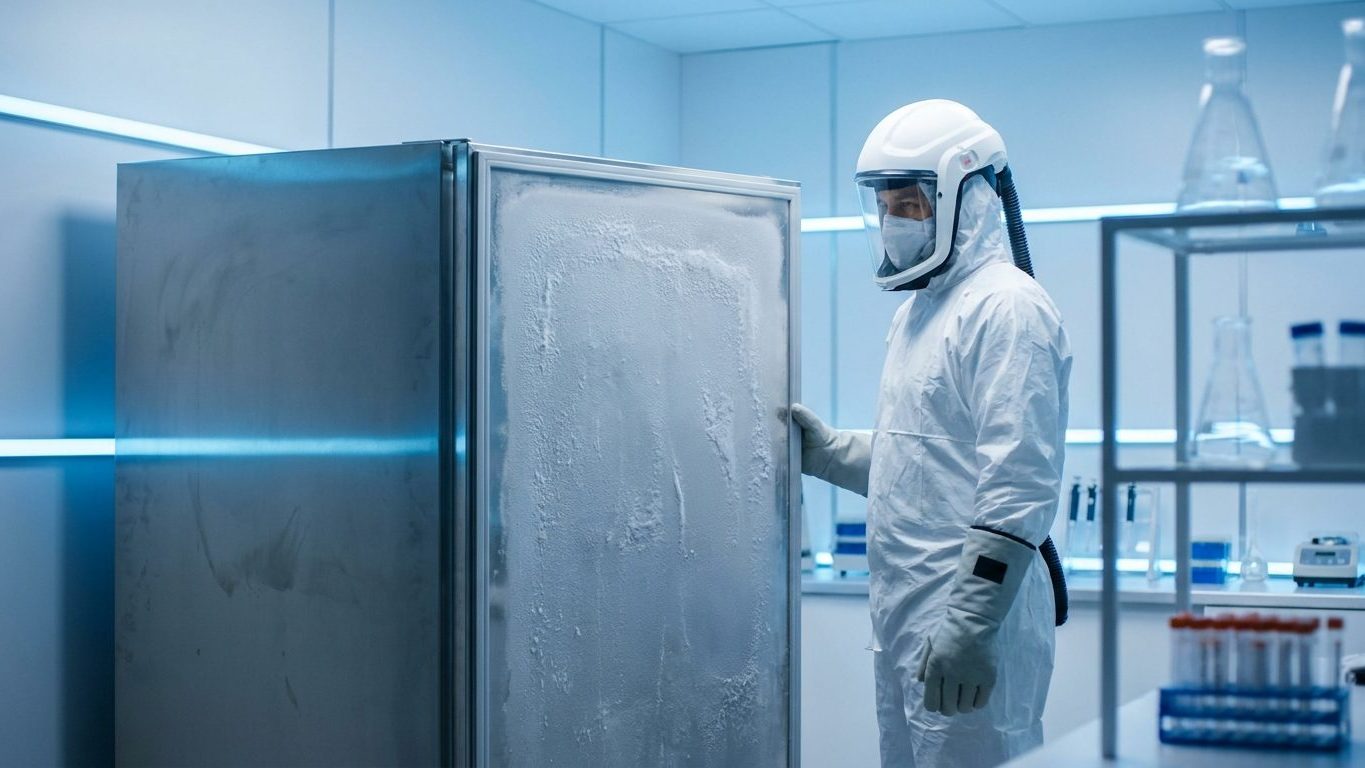
After 1980, the logic would have dictated destroying every trace of the virus. That did not happen. Two official stocks were allowed to persist, under tight surveillance: one at the CDC in Atlanta, United States, the other at the VECTOR research center in Koltsovo, Siberia. Smallpox, which had killed hundreds of millions before being declared eradicated in 1980 following a global vaccination campaign, is legally preserved in only two sites, in the United States and in Russia.
The principle of their destruction had been decided early. The decision to destroy had already been set for 1993, and since then it has been repeatedly postponed: 1995, 1999, 2002. The same pattern recurred in 2002: by WHA55.15, the World Health Assembly again authorized temporary maintenance of existing live variola virus stocks to continue international research. The word “temporary” stuck, the deadline disappeared.
The scientific debate has never reached a definitive conclusion. The advent of synthetic biology technologies, enabling creation of the variola virus from publicly available information and common laboratory procedures, led the WHO assembly to urge the Advisory Committee on Variola Virus Research to examine current needs for live variola virus. Even destroying the two stocks would no longer suffice to guarantee that the virus could never reappear. That argument has been used to justify every postponement.
Forty Years Later, Forgotten Vials Resurface
In July 2014, the story takes an almost absurd turn. Employees at the National Institutes of Health discovered six vials of smallpox in an unused storage room on the Bethesda campus in Maryland, while they were preparing to move a laboratory. The laboratory in question had actually changed hands long before: it had been among those transferred from the NIH to the FDA in 1972, at the same time as responsibilities for the regulation of biological products.
The vials dated from before the eradication campaign. They were created on February 10, 1954, well before the eradication campaign began. Two of them were not mere inert relics. A CDC investigation documented the presence of viable virus in two of the discovered vials, subjected to a culture test. Forty years of silence, two glass tubes forgotten in a corner, and the virus still capable of infecting.
The response was swift. On the evening of July 7, the vials were transported safely to the high-security containment facility at the CDC in Atlanta, where overnight PCR tests confirmed the presence of variola DNA. Their destruction occurred only several months later. These vials were ultimately destroyed at the CDC, under the supervision of WHO officials, on February 24, 2015.
The incident revealed a problem far broader than mere forgetfulness. A commission of inquiry listed the failures that sparked the affair. The panel identified a lack of individual accountability for infectious materials within the FDA space where the vials were found, as well as many missed opportunities to locate the samples before 2014, notably in the 1980s when all remaining variola virus samples were to be destroyed or sent to the CDC. Six vials lost, two official stocks safeguarded: the accounting had never really been in good standing.
A Threat That Is Deliberately Maintained
The paradox is complete. Since 1980, humanity has celebrated the only outright victory against an infectious disease, and at the same time, we continue to knowingly keep the agent responsible for three hundred million deaths alive. Proponents of maintaining the stocks always put forth the same argument: without live virus, it is impossible to test new antivirals or to understand certain biological mechanisms. Some American researchers, including a CDC virologist, even published an op-ed in PLOS Pathogens opposing any destruction, just weeks before a World Health Assembly dedicated to the issue.
Each meeting ends the same way for more than thirty years: an absence of consensus, and a referral to the next session. The Secretariat acknowledges the lack of agreement among Member States on the proposed new date for the destruction of the variola virus stocks. The formula, recycled year after year, has become a diplomatic ritual. It is no accident that Geneva regularly inspects the two sites: every two years, WHO biosafety inspection teams visit the facilities in question.
One question remains the loudest in the corridors of the UN assemblies: if vials can wander for forty years in a single American laboratory reserve, what about the archives of older, less well-documented Soviet military programs, of which VECTOR is the direct heir? The official answer remains elusive, and the two freezers continue to operate.
Sources: pubmed.ncbi.nlm.nih.gov | apps.who.int | science.org
