
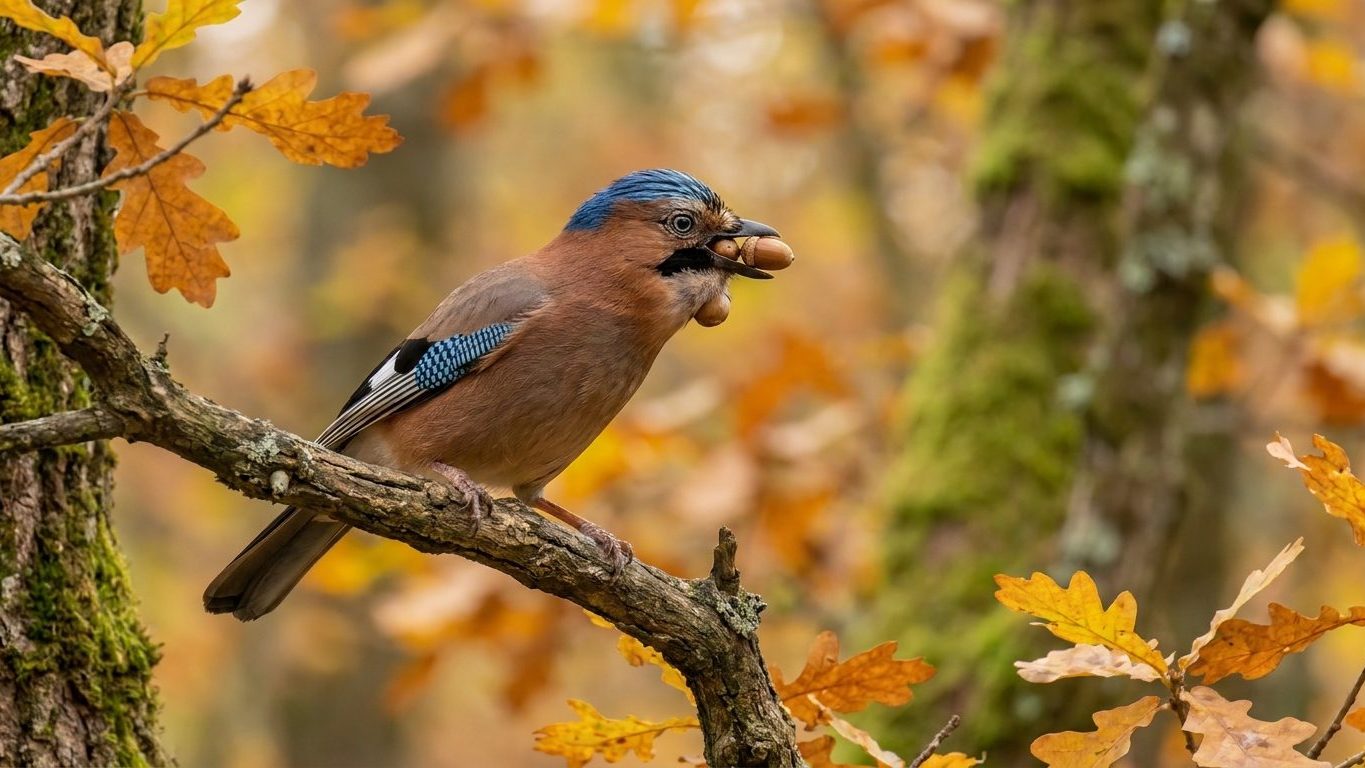
Each autumn, a single jay of oaks buries nearly 4,600 acorns. This figure is not a vague estimate: it comes from a German study cited by naturalists, where 65 jays transported about 300,000 acorns in two months, averaging 4,615 per bird. And it isn’t the national forest service sowing these seeds, but a blue-and-russet bird the size of a pigeon.
The oak provides its food, and the jay ensures the tree’s genetic survival.
The secret lies in its anatomy. The bird has a pouch beneath its beak that lets it stash acorns, and it can carry up to six at a time in its beak, with the rest hidden at the back of its throat. It doesn’t swallow them: it regurgitates them one by one, at a distance from the place where it gathered them.
- A jay burying about 4,600 acorns each autumn in strategically chosen areas.
- At least 59% of young plants arising from natural regeneration come from acorns planted by the jay.
- French jays collectively plant nearly 2 billion acorns each autumn, ensuring the survival of national oak woodlands.
A Meticulously Calibrated Behavior
The jay does not stash its reserves anywhere at random. It seeks open spaces, a clearing at the edge of thorny shrubs such as hawthorn, blackthorn, and brambles, and stores each acorn separately, spacing them 50 centimeters to 1 meter apart and burying them deep with its beak into the ground. This choice is far from arbitrary: a clear habitat, away from the tree’s crown, provides the light a young oak would never get under its own foliage. Distances traveled vary greatly depending on the study, ranging from 1 to 6 kilometers from the seed population, and for some individuals tracked, several tens of kilometers.
A jay that guards its cache of acorns needs this resource all year round, not just in winter.
What the Bird Forgetting Becomes a Forest
The spatial memory of the jay is impressive but imperfect. It recovers a large portion of its caches by probing them throughout the winter, but a fraction remains buried, forgotten, and germinates in the following spring. It is precisely this imperfection, this failure rate in recall, that transforms a simple food-storage habit into a engine for forest regeneration.
Result: at least 59% of the young plants arising from naturally regenerated stock come from acorns planted by the oak jay.
The relationship between the two species has been built over millennia of reciprocal coevolution. The oak produces a carbohydrate-rich fruit that accounts for up to 50% of its annual diet and nearly 90% of its winter intake. In return, the bird becomes the principal long-distance dispersal vector for a species whose acorns, left to themselves, fall at the base of the tree and rarely germinate due to lack of light. Scientists openly call this mechanism a symbiosis, a term usually reserved for the closest living partnerships.
The Speed That Acorns Alone Do Not Explain
After the last ice age, oaks persisted only at the southern fringe of Europe. The British paleobotanist Clement Reid had calculated that natural seed dispersal alone would have required several hundred thousand years to repopulate the European continent after the glaciations. Yet recolonization happened in a few millennia, an interval known as Reid’s paradox.
To explain it, researchers at INRA proposed a mechanism of very long-distance dispersal: acorns transported far beyond the main migration front, creating pioneer islands that then accelerate the entire reconquest. Jays, capable of carrying an acorn several kilometers and occasionally up to about twenty kilometers for a tracked individual, fit the exact profile sought.
This recolonization occurred at about 500 meters per year, over nearly six thousand years.
This Act Is Taking Place Right Now
There is nothing theoretical about all this: it is autumn, and every jay in France is currently building its winter stash for the coming cold. The oak grove you pass on Sundays, that coppice that has reclaimed an old clearing, that isolated young oak in the middle of a field far from any forest—each bears the signature of a bird that forgot where it hid its meal. The natural regeneration of France’s oak forests, which account for a substantial share of the standing national timber, continues to depend today on this repeated failure of memory, repeated millions of times each year. No one programmed this system: it has imposed itself, acorn after acorn, for ten thousand years.
Some forest inventories estimate that French jays collectively plant nearly 2 billion acorns each autumn, with only a portion eventually sprouting into trees. It is within this mass of individual failures, at the scale of an entire country, that the forest of tomorrow is being shaped.
Sources: zoom-nature.fr | ornithomedia.com
