
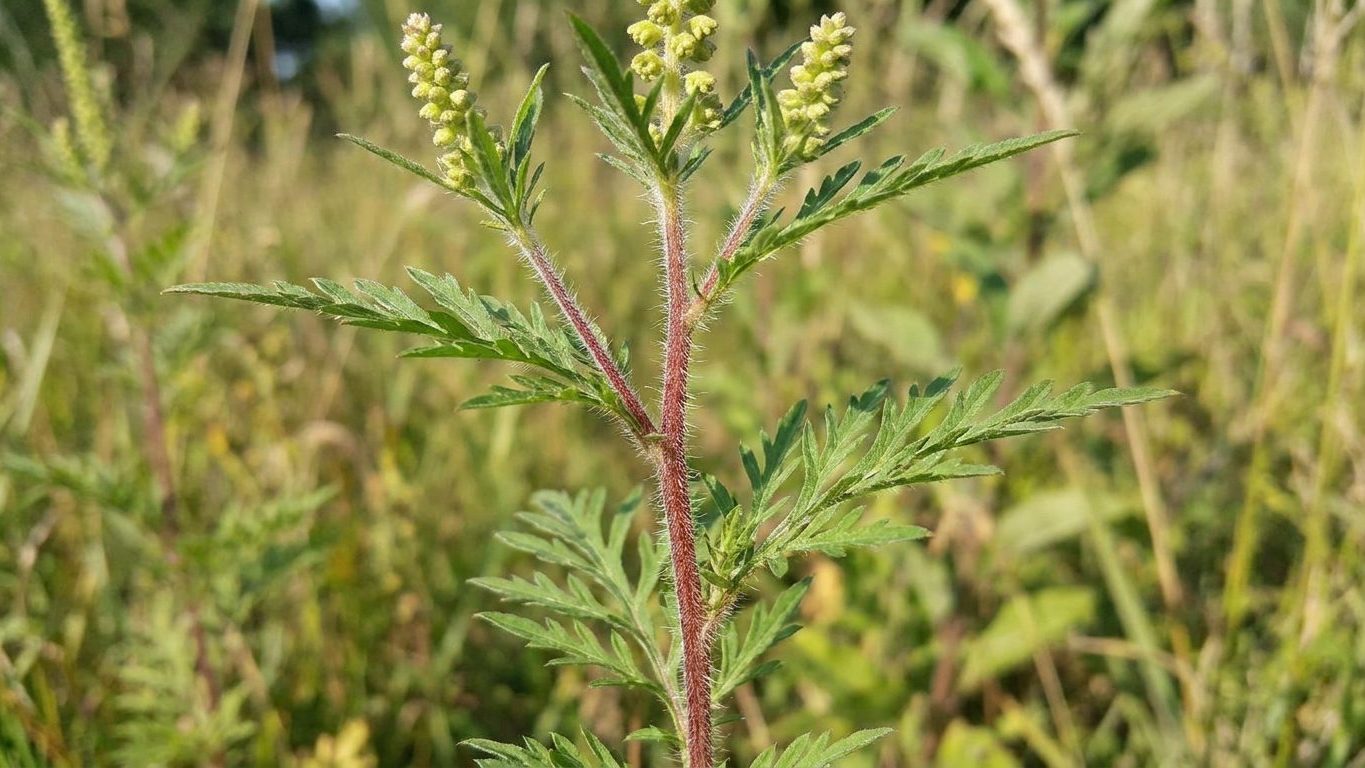
A single stem of ragweed can release up to a billion pollen grains in a few weeks, a figure confirmed by the Jura prefecture’s prevention sheets. The production of pollen and seeds by this plant is substantial: up to a billion pollen grains per plant and more than 10,000 seeds per plant. This volume helps explain why French law leaves no room for landowners: prevent its growth, uproot plants before flowering; the obligation applies to everyone, individuals as well as communities.
- A single ragweed plant releases up to a billion pollen grains in a matter of weeks
- Only 5 pollen grains per cubic meter of air are enough to trigger allergic symptoms
- French law obliges all landowners and occupants to uproot ragweed before it flowers
An Invader Arrived Through Seed Trade
Ragweed, Ambrosia artemisiifolia, is an invasive plant in the Asteraceae family, native to North America. It has spread across many regions of the world, notably Europe, through seed trade and human movement, dating back to the 19th century, often mixed into imported seed lots.
It is a pioneering plant that colonizes bare soil and disturbed habitats.
It grows mainly in vacant lots, along roadsides, on construction sites, and in agricultural fields. A simple pile of soil left by works, an abandoned plot, or a freshly tilled garden is enough for it to establish itself. Its life cycle begins with seed germination as soon as temperatures reach 10–15°C, typically between April and June. In the Auvergne-Rhône-Alpes region, the most affected in France, 75% of reported cases concern agricultural plots and roadside edges.
How to Correctly Identify Ragweed
On the ground, the reddish, hairy stem of ragweed already sets it apart from a common weed. Its leaves are deeply cut, almost fern-like, remaining green on both sides, top and bottom.
The plant is frequently confused with common mugwort, whose leaf undersides are whitish, unlike ragweed.
In late summer, the plant develops long spikes at the tops of its stems, bearing male flowers responsible for allergies. Flowering runs from late July to late September, with a pollen release peak around mid-August. A spike comprises 20–50 capitula, tiny pollen factories arranged along the stem.
A Pollen Among Europe’s Most Allergenic
Ragweed pollination is anemophilous: wind, and wind alone, transports pollen from the male flowers to neighboring female flowers. Each plant can thus release up to a billion grains in a season, a record among herbaceous plants in our regions. It is estimated that 5 pollen grains per cubic meter of air are sufficient to trigger symptoms. Carried by favorable winds, this pollen can travel up to 200 kilometers, or more, contaminating areas far from the source plant.
In the United States, ragweed is present on 90% of the territory, where it constitutes the leading cause of asthma in the country.
In Auvergne-Rhône-Alpes, the region most affected in France, more than 20% of the population would be exposed to ragweed pollen, according to the Regional Health Agency. Symptoms range from rhinitis to conjunctivitis, up to tracheitis and asthma crises among the most sensitive. In 50% of cases, the allergy can lead to the onset of asthma or worsen it.
The Law Requires Destruction, Plot by Plot
The articles D.1338-1 to R.1338-10 of the Public Health Code regulate ragweed control at the departmental level. When its presence is observed or likely, the prefect determines by order the modalities of measures to prevent appearance or to combat its proliferation. Every owner, tenant, operator, manager of built or unbuilt lands, rights holder or occupant in any capacity must implement the measures established by the prefectural order within the deadline it sets. In Allier, a department heavily concerned by the issue, the prefectural order of 15 October 2019 states that the obligation to combat ragweeds and to prevent seed dispersal applies on all surfaces without exception.
Each citizen can report ragweed presence via a national platform, consulted by the territorial referents designated in each department. The monitoring of pollen concentrations in the air relies on the National Aerobiological Surveillance Network, whose readings feed regional alerts.
The Allier order is clear: it must “destroy the ragweed plants already developed before pollination and prevent any seed dispersal.”
In the soil, ragweed seeds retain their germination power for up to 40 years according to Swiss studies, while other research mentions viability for more than 10 years. They have the ability to germinate at depths of up to 8 centimeters, which complicates any definitive eradication. A plot cleared of its adult plants can still see new shoots emerge years after the last uprooting, as long as the buried seed bank has not been exhausted.
Sources: auvergne-rhone-alpes.ars.sante.fr | jura.gouv.fr | poitou-charentes-nature.asso.fr
