
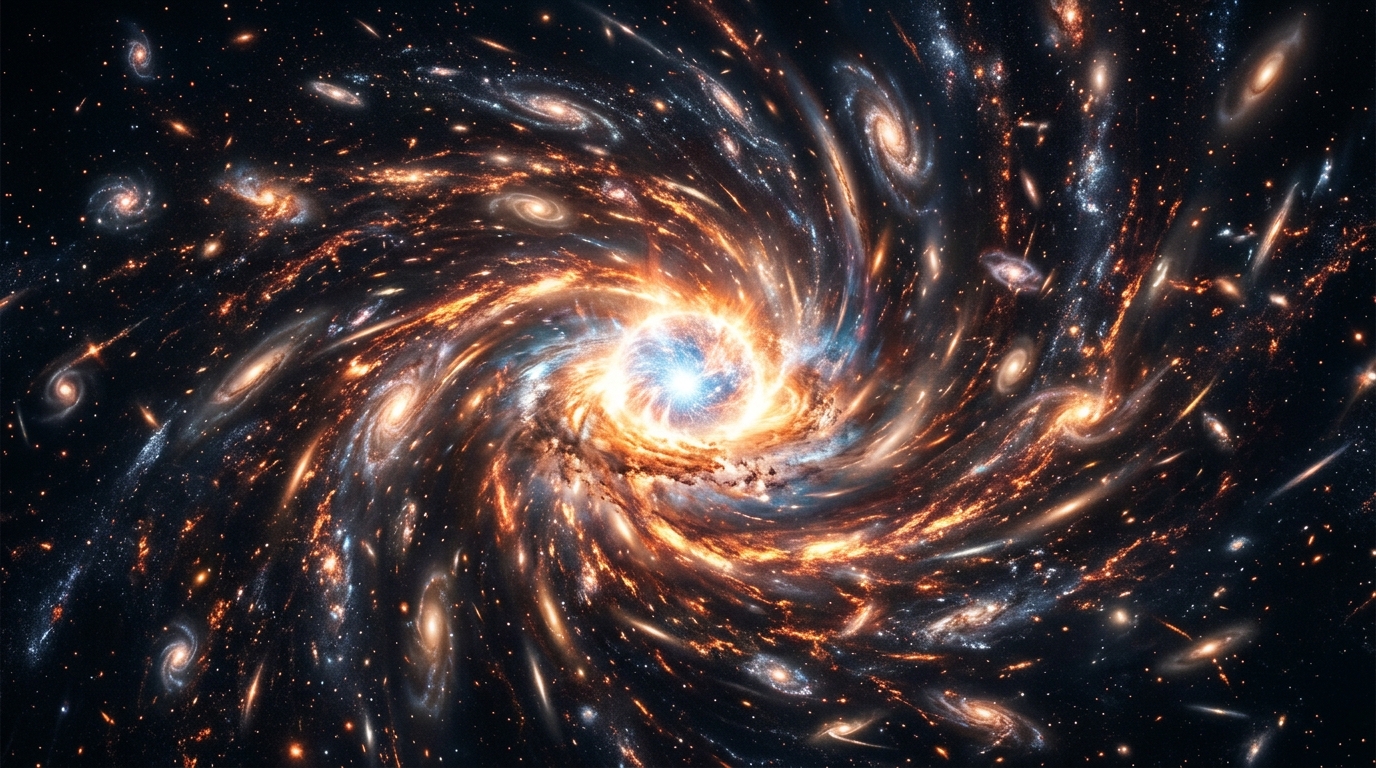
For decades, cosmic end-of-world scenarios have all revolved around a single focal point: the famous singularity, that moment when the entire universe would squeeze itself down to vanish into an infinitely dense point. It’s often imagined as the final act, the curtain call after which nothing exists. But if this classic ending concealed a much subtler killer, hidden within the light itself? Because before spacetime collapses in on itself, an obscure phenomenon could transform every corner of the cosmos into a furnace capable of vaporizing stars and planets long before the fateful hour.
- In a Big Crunch scenario, the cosmic microwave background would blueshift, heating up progressively to thousands of kelvin.
- This temperature would exceed the Sun’s surface (5,500 kelvin), vaporizing planets and stars long before the final collapse.
- This warming of relic radiation would occur well before the singularity, becoming the true destructive factor rather than the spacetime collapse itself.
- The wrong suspect: why the singularity is not the real threat
- When fossil light becomes a furnace: the blueshift mechanism
- Thousands of kelvin: the thermal countdown that scorches everything in its path
- A Big Crunch harsher than expected: what this scenario changes for the cosmic future
The wrong suspect: why the singularity is not the real threat
In the collective imagination, the final singularity holds a prime place. It symbolizes the ultimate apocalypse, one that would succeed a hypothetical Big Crunch, this scenario where the universe’s expansion would reverse into a generalized contraction. Logically, one assumes that everything would remain roughly stable until this terminal moment, as if matter and light were patiently waiting before the definitive collapse.
Yet this vision neglects an omnipresent actor, often forgotten: the cosmic background radiation, this relic diffuse backdrop that formed a few hundred thousand years after the Big Bang. Today, it bathes the universe in cold light, barely 2.7 kelvin above absolute zero. Subtle, almost invisible, it disturbs no one. But in a contraction scenario, this same radiation would radically change behavior, becoming the real executioner long before the singularity would have its say.
When fossil light becomes a furnace: the blueshift mechanism
To understand this turn of events, one must consider a phenomenon well known to astronomers: the décalage vers le bleu, or blueshift. When the universe expands, the wavelengths of light stretch and redden, much like the sound of a siren growing more distant. But if the universe contracted, the opposite effect would occur: each photon would see its wavelength shorten, gaining energy as space tightened around it.
Applied to the relic radiation, this mechanism would have vertigo-inducing consequences. This light, today so cold that it passes almost unnoticed, would heat up gradually as the contraction accelerated. What was once a gentle thermal whisper would progressively become a roaring energy, increasing in intensity far more quickly than the approach of the singularity itself would suggest.
Thousands of kelvin: the thermal countdown that scorches everything in its path
This is where the revelation hits home. In this cosmological contraction scenario, the relic radiation would not merely warm slightly: it would blue-shift until it reached temperatures of thousands of kelvin. To give a sense of scale, the Sun’s surface peaks at around 5,500 kelvin. In other words, the cosmic background radiation, that peaceful remnant of the Big Bang, would become a furnace comparable to a star.
Such ambient heat would leave no chance for organized structures. The planets would vaporize, their atmospheres ripped away and surfaces reduced to incandescent plasma. The stars themselves, though accustomed to extreme internal temperatures, would have their outer layers literally dissolved in this sea of pervasive radiation. The phenomenon would not be localized: it would affect the entire universe simultaneously, as if a gigantic oven were heating up uniformly, with no safe haven anywhere.
A Big Crunch harsher than expected: what this scenario changes for the cosmic future
This reinterpretation of the Big Crunch profoundly reshapes our view of the universe’s end. Far from a quiet collapse where matter would pile up calmly to the final point, this scenario sketches a generalized blaze, long before the famed singularity. Galaxies, planetary systems and potential life forms would be destroyed well before spacetime itself ceased to exist.
This finding shifts the true turning point of cosmology. It is no longer the extreme geometry of the singularity that would mark the end of all material organization, but rather the rising temperature of the relic radiation, acting as an early thermal alarm. A nuance that, while purely theoretical, invites reconsidering the order of events in contraction cosmology scenarios.
Ultimately, this conceptual shift serves as a reminder of how much light, even the most discreet and cold, can conceal unforeseen destructive potentials. The cosmic background radiation, long seen as a silent witness to the universe’s past, would reveal itself capable of becoming its own executioner if conditions were to invert. It calls for reconsidering, once and for all, the order in which the cosmos’ final chapter would be written.
