
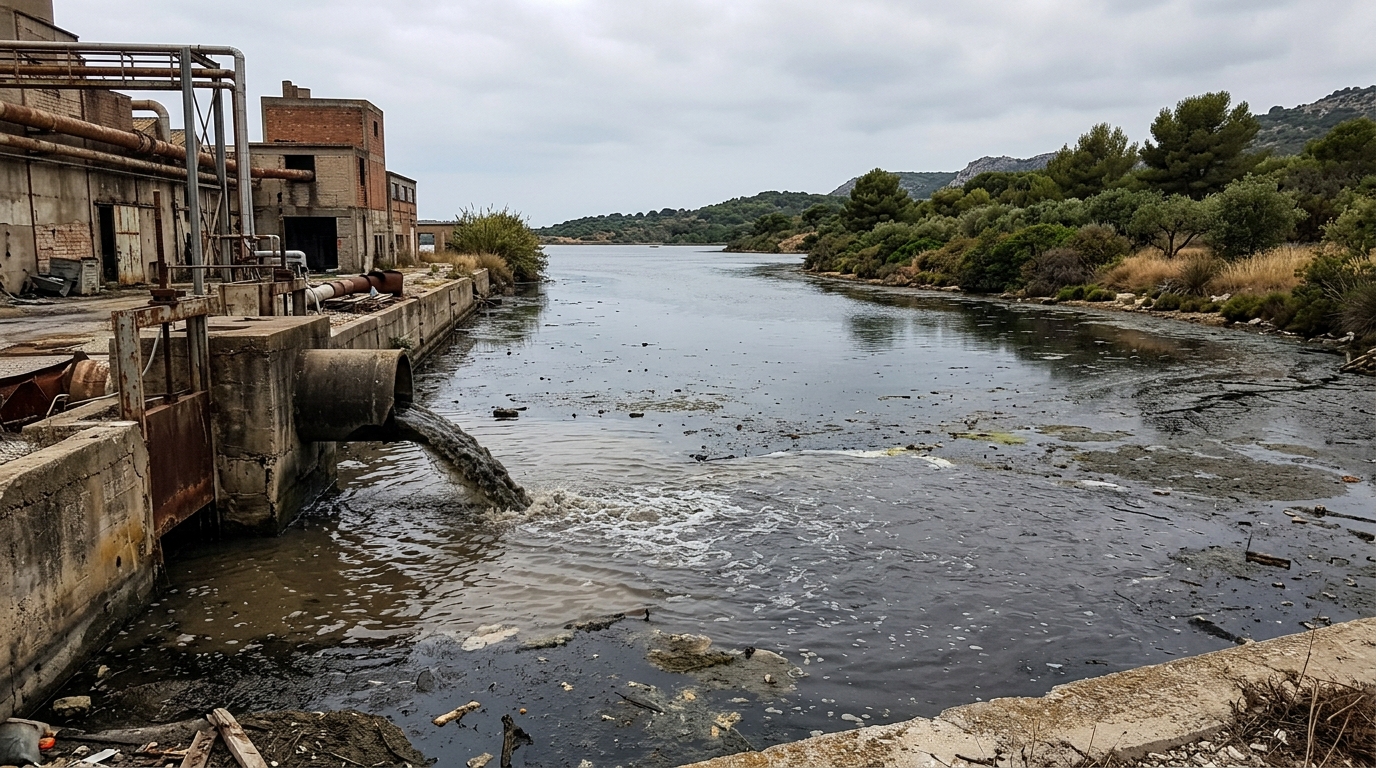
Imagine a vast sheet of water wedged between Marseille and Aix-en-Provence, naturally meant to carry the scent of iodine and the sea, yet for decades resembling a river more than a saline lagoon. This is precisely the situation of the Étang de Berre, France’s largest Mediterranean lagoon, which has been unwillingly transformed into the receptacle of a sprawling industrial project conceived nearly sixty years ago. A billion cubic meters of fresh water poured into a salty expanse each year: the outcome of an energy choice that seemed self-evident at the time. In 1966, EDF launched the Saint-Chamas industrial canal, an infrastructure designed to generate hydroelectric power by diverting the waters of the Durance. On paper, the idea looked virtuous—clean, renewable energy. In practice, it has slowly and steadily disrupted an entire ecosystem, caught between two natures, neither truly sea nor truly river, and now choking on its own imbalance.
- Since 1966, the EDF Saint-Chamas canal has discharged up to a billion cubic meters of freshwater from the Durance into the Étang de Berre each year, triggering stratification, eutrophication and anoxic episodes such as in 2018
- Following a European condemnation in 2004, discharges were capped at 1.2 billion m³ per year, a threshold still twice as high as the 600 million m³ deemed sustainable by scientists
- Following action by Gipreb, EDF signed in September 2023 a protocol prohibiting summer discharges, ratified by the Marseille court in 2024, while a diversion project toward the industrial zone is under study
- A canal designed for energy, not for the ecosystem
- When fresh water chases salt water, life disappears
- From foul-smelling mudflats to fish fleeing the lagoon
- Fifty years of discharges, and now what?
A canal designed for energy, not for the ecosystem
In the 1960s, national priorities were clear: to produce electricity in large quantities to support economic growth. The Durance, a mighty river descending from the Alps, stood as an ideal hydraulic resource. EDF then conceived an extensive diversion system, with the Saint-Chamas power plant as a key link. Water was captured upstream, channeled, and passed through turbines to generate electricity before being dumped directly into the Étang de Berre, which at the time was treated as little more than a natural outlet.
Almost no one questioned the ecological consequences of such a choice. As a result, the Durance now flows at only a twentieth of its natural discharge level near Cavaillon, because so much water has been diverted to feed this industrial circuit. This massive redirection allowed electricity production for decades, but it created a hydrological imbalance that the Étang de Berre continues to pay for today.
When fresh water chases salt water, life disappears
A salty lagoon and a river do not share the same density, chemical makeup, or main inhabitants. By releasing roughly 900 million cubic meters of fresh water into this Mediterranean lagoon each year, the Saint-Chamas plant disrupted a balance built over millennia. Freshwater, lighter, tends to layer above saltwater rather than mix with it, a phenomenon ecologists call stratification. The result is two separate layers coexisting, preventing oxygen from circulating between the surface and the depths.
This process, coupled with a large influx of nutrients that stimulates algal blooms, has a precise ecological name: eutrophication. When these algae die and decompose, they consume the oxygen available, creating zones where life cannot endure. That is exactly what happened in 2018, during a heat spell that triggered a true anoxia crisis. The lagoon was, quite literally, starved of oxygen in its depths, causing the death of a portion of its fauna and flora and leaving a lasting mark on the memories of nearby residents and lagoon managers alike.
From foul-smelling mudflats to fish fleeing the lagoon
The consequences of this imbalance extend beyond a single isolated episode. Year after year, the bottom of the Étang de Berre has accumulated sediments rich in decomposing organic matter, forming mudflats that emit foul odors during the hottest periods. Fish, unable to survive in water starved of oxygen, move away from certain areas, disrupting the local food chain—from invertebrates to the birds that typically feed there.
In response to this ongoing degradation, Gipreb—the body charged with managing the lagoon—ultimately pursued legal action against EDF. A legal reminder was already needed: in 2004, after a ruling against France by the European Court of Justice, fresh-water discharges were capped at 1.2 billion cubic meters per year, the equivalent of more than 300,000 Olympic-sized swimming pools, compared with more than two billion previously. A notable advance, certainly, but still far from sufficient. Scientists argue that to sustainably preserve this unique ecosystem, the plant should not discharge more than 600 million cubic meters of fresh water each year—half of the earlier ceiling.
Fifty years of discharges, and now?
Facing judicial pressure and ecological urgency, EDF ultimately agreed to an amicable settlement aimed at reorganizing its fresh-water discharge practices. The company pledged to adjust its electricity production according to the seasons, accommodating the lagoon’s particular fragility during the hottest months. This commitment materialized in September 2023 with a protocol between Gipreb and EDF that now prohibits fresh-water discharges during the summer, the period when stratification and anoxia pose the greatest danger to local wildlife and flora. The agreement was subsequently validated by the Marseille tribunal in September 2024, giving it official and binding force.
Yet the most radical solution remains under study. An old proposal, repeatedly raised over the years, would see the fresh-water discharges diverted toward the neighboring industrial zone rather than being dumped into the lagoon. Considered technically complex and costly, this project has been brought back into the spotlight by Christophe Béchu, the Minister for Ecological Transition, during a site visit. The mayor of Saint-Chamas, who also chairs Gipreb, now regularly updates on the project’s progress as a feasibility study assesses its viability. The stated objective is bold: to capture and reuse the fresh water that has thus far been wasted in a destructive outflow, rather than continuing to fuel ecological disturbances that have persisted for decades.
As autumn returns and temperatures ease, allowing the Étang to regain a measure of calm after a scorching summer, the Saint-Chamas dossier vividly illustrates the contradictions of an energy model built in a different era. Generating electricity without polluting water or emitting greenhouse gases seemed obvious in 1966. Yet protecting the climate on one hand while destroying a unique ecosystem on the other raises a broader question: how do we truly evaluate the environmental footprint of an energy infrastructure? Will the Étang de Berre endure long enough to see the long-awaited diversion project finally come to fruition?
