
A vine planted this spring will not yield a usable grape next year. It takes about three years before the first harvest, and several more years before achieving a consistent quality, capable of entering a serious blend. Yet, in France, tens of thousands of hectares of mature vines, sometimes planted for decades, are voluntarily uprooted each year.
The French vineyard produces more than it sells.
- Wine consumption in France has fallen by 70% over sixty years, dropping from 120 litres per person per year to 40 litres.
- A scheme offering permanent uprooting aid provides €4,000 per hectare to remove vines from the market and curb overproduction.
- Uprooting a vine irreversibly destroys a terroir: the compacted soil and pulverized roots do not quickly rebuild, preventing any future replanting for several years.
A market that no longer keeps pace with production
In sixty years, French wine consumption has fallen by 70%, from more than 120 litres per year per inhabitant to under 40 litres. Today, France consumes 24.4 million hectolitres of wine annually, about 36 litres per person. The loss of interest is particularly felt among younger generations, less inclined to wine at every meal.
Cellars overflow, prices drop.
To take land off the market, a national program of permanent uprooting was opened in late 2024, with a flat aid of €4,000 per hectare for uprooting of plots, within the limit of €120 million in credits allocated by the Ministry of Agriculture to the plan to reduce vineyard potential. At the close of the window, 5,418 requests for permanent uprooting aid on 27,461 hectares were recorded by FranceAgriMer. A new round followed, this time with a national target of 32,500 hectares for the available budget. Combined, these two waves bring the uprooted vines close to the symbolic milestone of 30,000 hectares uprooted over two campaigns.
What happens, concretely, in the plot
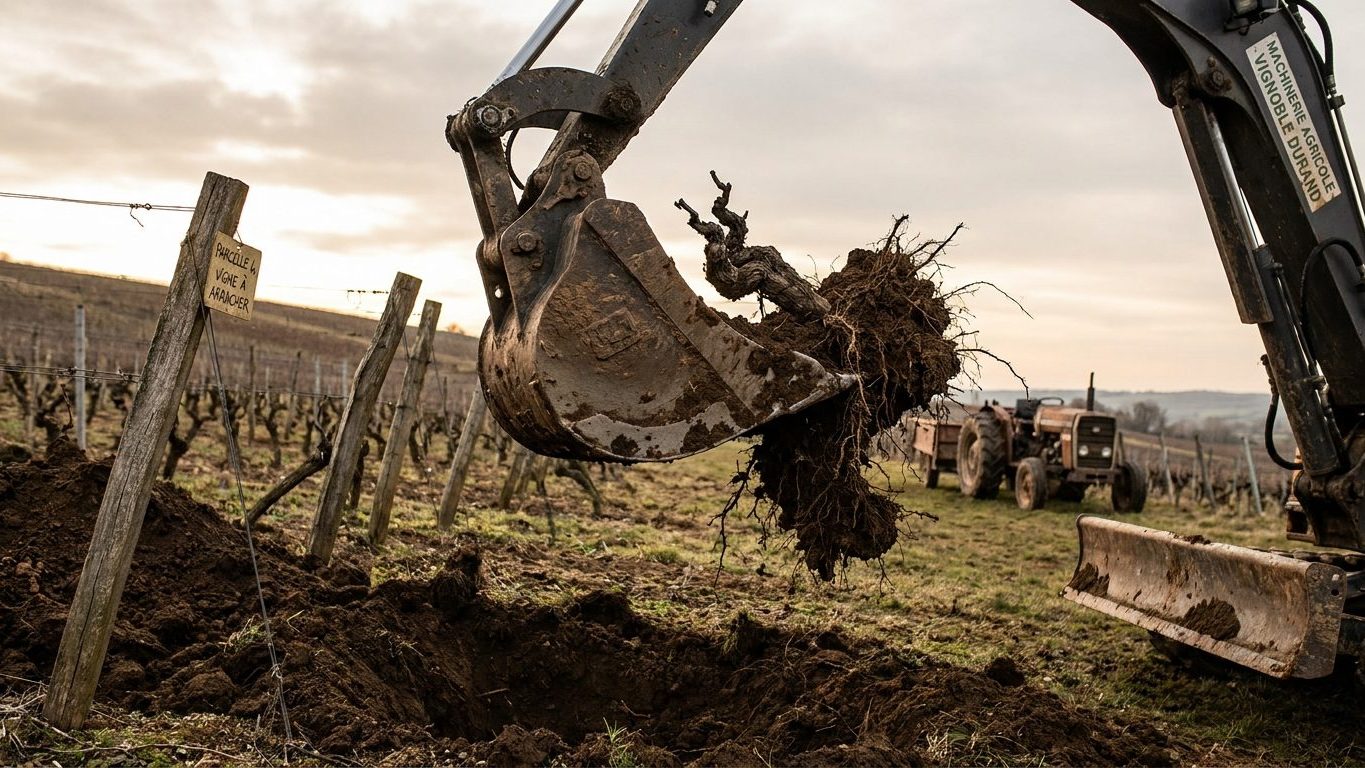
On the ground, the operation is nothing like a harvest. A mechanical shovel or a winch extracts each vine along with its root, the root system anchoring the plant for more than thirty years in some cases. The training wire is released, metal or wooden stakes are uprooted in turn and stacked along the row.
The vines are then gathered into windrows before being shredded or burned on site.
Once the timber is cleared, the plot passes to the subsoiler, a tool that fractures the soil deeply to break old roots and decompact the earth. It is only at this stage that the land technically becomes an agricultural field again. The entire operation, from the first vine removed to the last pass of the machine, is often completed in a single day of tractor work for a plot of average size.
What the hillside becomes once the vines are gone
The rest depends on each grower, but the paths tend to converge. The plot is left fallow, transformed into pasture for grazing, or switched to an annual crop that is easier to manage. This shift changes the look of a hillside: the dry-stone walls lose their function, the farming tracks cease to be maintained at the same pace, and the seasonal labor previously mobilized each autumn for harvest simply has no reason to be called.
A wine landscape also thrives on these back-and-forth movements between rows of vines and open plots.
A capital that cannot be restarted like a machine
A carefully tended vine yields for decades, often well beyond thirty or forty years. Uprooting, therefore, amounts to erasing, in a single day of work, half a century of pruning, soil work, and selection of planting material. The act is voluntary, encouraged by public aid, but it is far from innocuous for the long-term trajectory of a vineyard.
Soil compressed by machinery and roots destroyed by the subsoiler do not recover overnight. And joining the scheme comes with an administrative cost: participation means being unable to obtain replanting authorizations for the uprooted areas, as well as foregoing any new planting authorization for several vintages to come. A terroir does not restart like a machine you switch back on; it must be replanted, allowed to grow, and wait again for its first three years before the first harvest.
Sources: draaf.nouvelle-aquitaine.agriculture.gouv.fr | reussir.fr
