
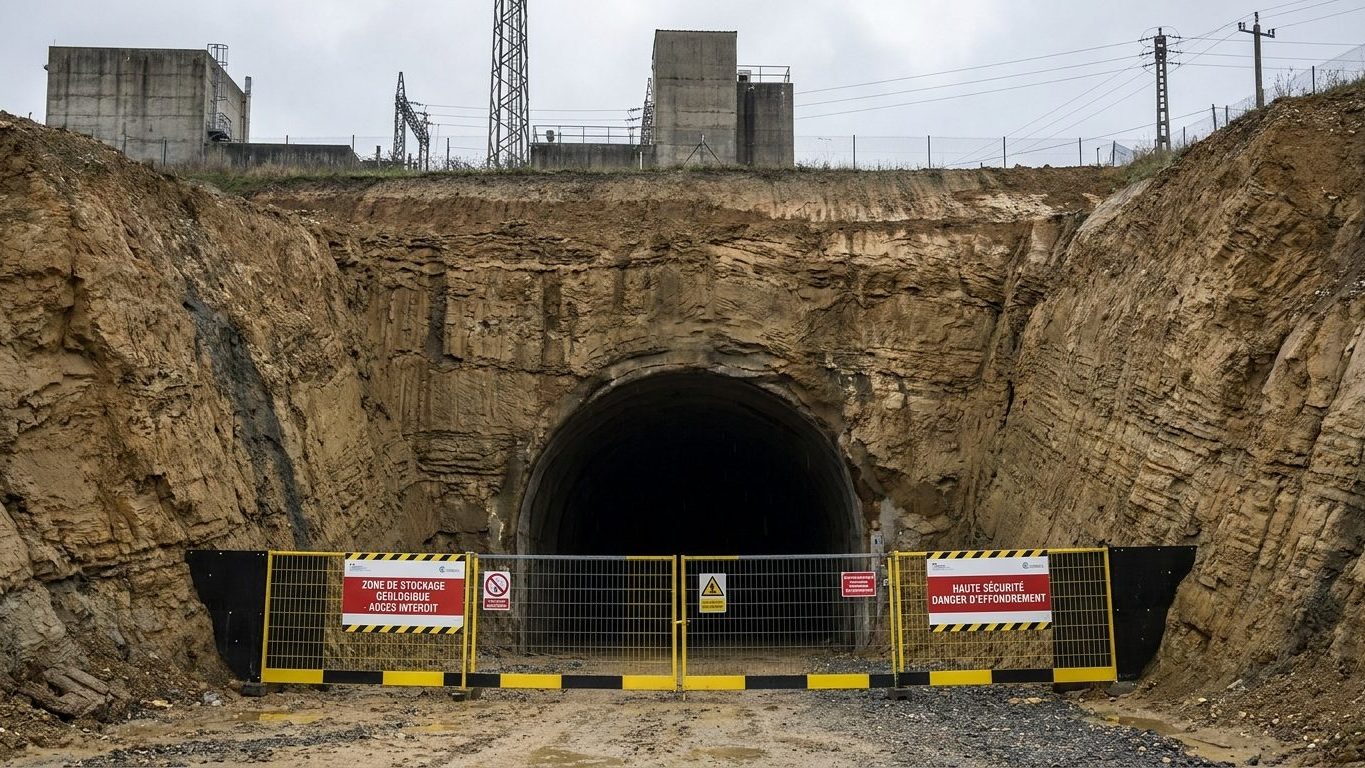
A facility that could operate longer than the duration of Rome’s existence to house wastes that will remain hazardous long after our writing, our languages, and probably our civilization have faded away. This is the bet behind the Cigéo project, a geological repository that the National Agency for the Management of Radioactive Waste (Andra) plans to excavate at the boundary between the Meuse and Haute-Marne. The most radioactive and long-lived wastes from French nuclear energy will be stored in galleries dug 500 meters underground, within a clay layer. It is a project without precedent, in both its timescale and its cost.
- The Bure clay self-heals: its mineral swelling seals fissures when rehydrated.
- The confinement aims for isolation spanning hundreds of thousands of years, vastly outlasting written human history.
- The reference cost of the Cigéo project is set at €33.4 billion under 2025 economic conditions.
Why this particular clay, and not another
This clay layer formed more than 160 million years ago, long before the first hominids appeared. This geological detail is not trivial: its age and formation are precisely what make it a credible candidate to imprison radioactive materials for unimaginable spans. The rock exhibits extremely low permeability, slowing the movement of substances toward the surface.
But clay has another quality less known to the general public. Research on cores sampled at Bure revealed a substantial self-sealing capacity during rehydration of the material. If a fissure forms during the digging of galleries, the moisture in the soil causes swelling of the clay minerals that gradually closes the gap. Researchers also observed that the swelling of these minerals significantly reduces water permeability once healing has occurred. A rock that repairs itself — that is the central argument that tipped the scales in favor of this site over others.
The containment mechanism finally rests on slowness. Unlike a permeable soil where water flows and carries contaminants, the clay-rich rock slows the movement of matter to such a degree that radionuclides would take hundreds of thousands of years to reach the surface. In the meantime, radioactivity would have diminished considerably.
Numbers that exceed human comprehension
The written history, from the earliest Mesopotamian cuneiform tablets to the present, covers roughly five thousand years. Cigéo aims for an isolation measured in hundreds of thousands of years. A single sentence suffices to illustrate the gap: we are talking here about tens of times the entire written memory of humanity.
The industrial timetable of the project is dizzying. The objective cost of Cigéo was set by ministerial decree for the study, construction, and operation phases over more than a century. More than a century of work and operation for a site that must subsequently remain safe without any active human monitoring. The project itself began in 1991, thirty-five years ago, and is still only in the administrative-dossier stage.
Money matters are far from simple. The cost was long set at €25 billion under 2011 economic conditions. But a reassessment issued by Andra in May 2025 pushed estimates higher, with a forecast range at the authorization stage between €29.8 and €37.5 billion depending on the assumptions used. The State ultimately fixed, by decree, the reference industrial cost at €33.4 billion under 2025 economic conditions, including €9.7 billion for the initial construction phase up to commissioning. Other bodies, such as the ASNR, have cited a figure that has since been further revisited to around €37 billion. Estimates vary, but all agree on a magnitude: tens of billions of euros, financed on the polluter-pays principle by the three major players in the French nuclear sector.
Reversibility and memory: the two blind spots of the debate
How can one guarantee that a site that has been sealed could be reopened if needed? Law has spoken on a precise point: Parliament included the principle of reversibility in the 28 June 2006 law on the sustainable management of radioactive waste, later detailed in the 2016 law. Cigéo must be reversible for at least 100 years. One hundred years is long by human standards and negligible when compared with the hundreds of thousands of years targeted for the final isolation. Some scientists on the site openly question the feasibility of reopening after a few centuries, once storage is permanently sealed.
The other challenge is this: how to warn generations who will not speak French or any current language about the danger beneath their feet? A text, a sign, an inscription — none of these will survive intact over tens of thousands of years. Faced with this linguistic vertigo, a program called “Memory for Generations to Come” brings together historians, anthropologists, and linguists with the aim of transmitting information about the site’s existence and danger across time scales far beyond our current civilizations. Practically, this means a system of durable markers combining universal pictograms with multilingual messages designed to remain intelligible over tens of thousands of years.
The project marked a symbolic milestone in 2022 with its declaration of public utility, before Andra submitted a request for creation authorization, which was then subjected to the technical scrutiny of safety authorities. The procedure, still ongoing, must pass through several regulatory steps before a final decision can be rendered. In the meantime, the debate between supporters of burial as an inevitable course and opponents who denounce an irreversible bet on the future will continue to animate the Meuse and Haute-Marne, far from resolved.
Sources: theses.fr | cigeo.gouv.fr | assemblee-nationale.fr
