
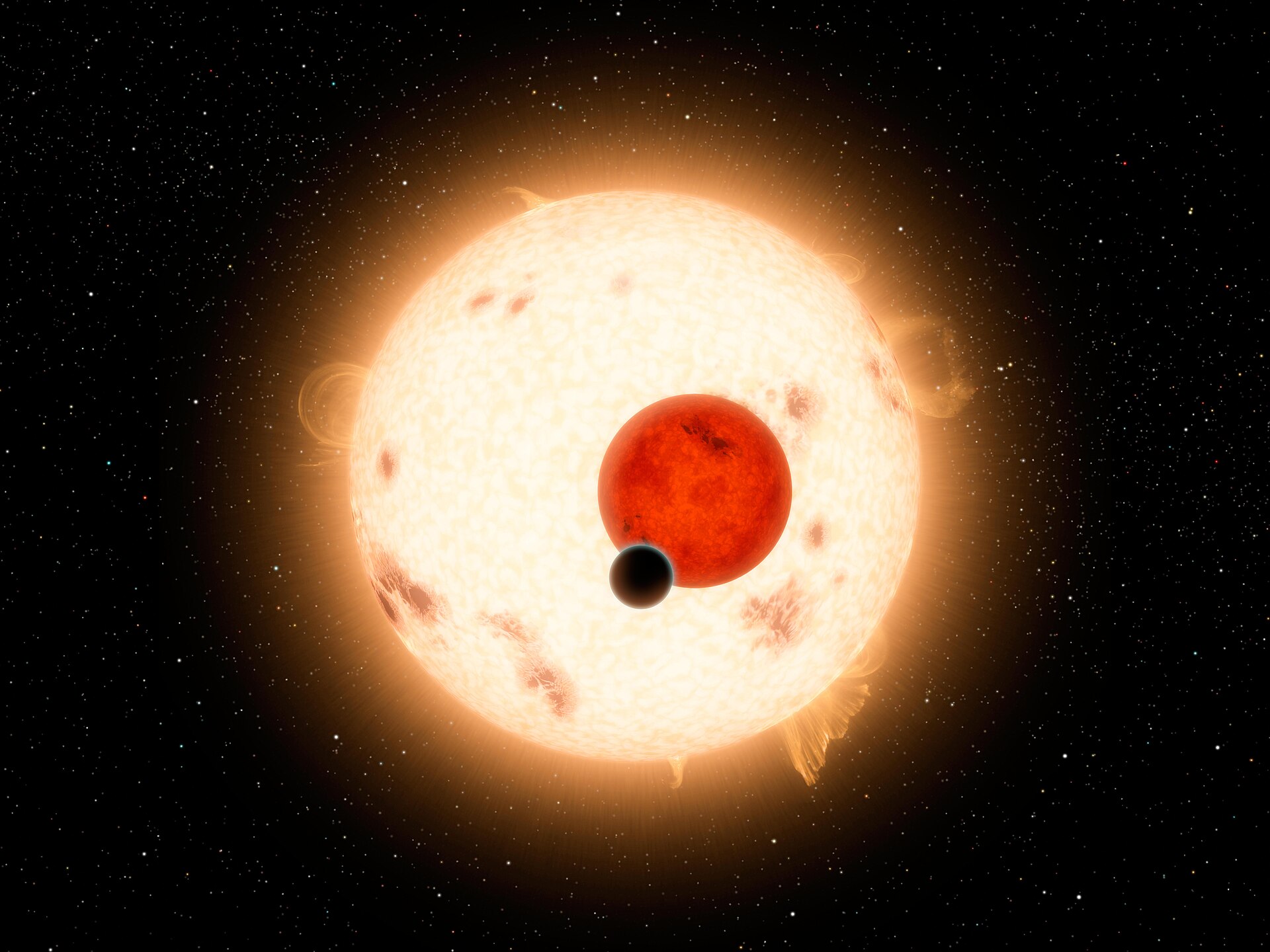
There is a mental exercise that many of us have tried at some point, often without realizing it: imagining what a sky with two suns would look like. We immediately think of that iconic scene where a young hero gazes out over the desolate horizon of a planet swept by two blazing stars. What was once pure fiction a few decades ago has nonetheless found a troubling echo in reality. Somewhere in our galaxy, about 200 light-years from Earth, a real world achieves this feat that physics itself judged improbable: to orbit, again and again, around two stars at once, without ever tearing itself apart under their gravitational grip.
- Kepler-16b, discovered in 2011 thanks to the Kepler telescope, is the first confirmed circumbinary planet, orbiting a orange dwarf and a red dwarf at 200 light-years from Earth.
- This cold gas giant, roughly the size of Saturn, completes a full orbit in 229 days, at a distance similar to that of Venus from the Sun.
- Its orbital stability, achieved by staying sufficiently far from the center of gravity of the two stars, upended theoretical models of planet formation in binary systems.
- A planet that should not exist
- Two suns, two shadows, one world
- 229 days to tame a gravitational chaos
- What Kepler-16b reveals about binary systems
A planet that should not exist
For a long time, astrophysicists regarded binary star systems as environments far too hostile to allow planet formation. The idea was simple on paper: when two stars tug on each other and orbit around one another, their respective gravitational fields are in constant competition. The expected result was that dust and debris would have to assemble to form a solid world, but they would have been dispersed, torn away, or simply ejected from the system before they could take shape.
It was precisely this theoretical certainty that Kepler-16b’s discovery, in 2011 thanks to data from the Kepler space telescope, came to challenge. This planet became the very first confirmed circumbinary planet, meaning a world that orbits not one but two stars simultaneously. A celestial achievement that immediately reminded a whole generation of astronomy enthusiasts of the famous Tatooine from cinema, except that here it is not a writer’s fictional backdrop but a real object, observed and measured.
Two suns, two shadows, one world
The system in which Kepler-16b resides is in itself a curiosity. It rests on an unusually paired stellar duo, consisting of an orange dwarf, whose mass is about 69% that of our Sun, and a much smaller red dwarf, with only 20% of solar mass. These two stars dance around one another in a constant gravitational ballet, and it is precisely this complex motion that, by casting two distinct shadows as it passes, allowed astronomers to detect the planet’s presence.
Contrary to the image of a desert world scorching under a blistering sun, Kepler-16b is not an arid landscape. It is, in fact, a cold gas giant, roughly the size of Saturn, composed mainly of gas, rock, and ice. An atmosphere that is frigid and tumultuous, far from the sunny vistas one might imagine, but no less fascinating for all that simply by existing.
229 days to tame a gravitational chaos
What makes Kepler-16b so special is not merely the fact that it hosts two suns, but how it manages to maintain a stable trajectory despite the perpetual tugging it endures. The planet takes 229 days to complete a full orbit around its two stars, a duration that places it at a distance similar to that between Venus and our own Sun.
This detail is far from trivial. It actually reveals the key to its survival. Scientists eventually understood that stable orbits within a binary system are entirely feasible, provided the planet lies far enough away from the shared center of gravity of the two stars. Too close, and it would have been dismantled or ejected in a short time. By staying at a proper distance, Kepler-16b found the perfect balance—a anchor point where the forces that could tear it apart end up stabilizing it for billions of years.
What Kepler-16b reveals about binary systems
Beyond its spectacular nature, this discovery has had far deeper consequences for our understanding of planetary formation. By proving that a world could be born and endure in an apparently unstable environment, Kepler-16b opened the door to a complete reevaluation of the theoretical models used up to now. Binary systems, long considered dead ends for planet formation, are now seen as privileged observation grounds, capable of hosting worlds with unique dynamics.
This planet has thus acted as a true keystone, prompting researchers to reconsider their certainties and to multiply observations of other stellar pairs. It reminds, with a certain cosmic elegance, that the universe does not always bend to the models we construct to understand it, and that it always preserves the capacity to surprise us, even when we believe we have laid the most solid theoretical foundations.
In reflecting on this gas giant, which continues, at hundreds of trillions of kilometers from us, its silent ballet between two suns, we gain a sense of how much our galaxy still harbors mechanisms once thought impossible. Kepler-16b may be only the first of a long series of similar worlds yet to be discovered, and this prospect adds another reason to lift our eyes to the sky, if only to wonder how many other truly real Tatooines still await us somewhere in the darkness.
Source : NASA
