
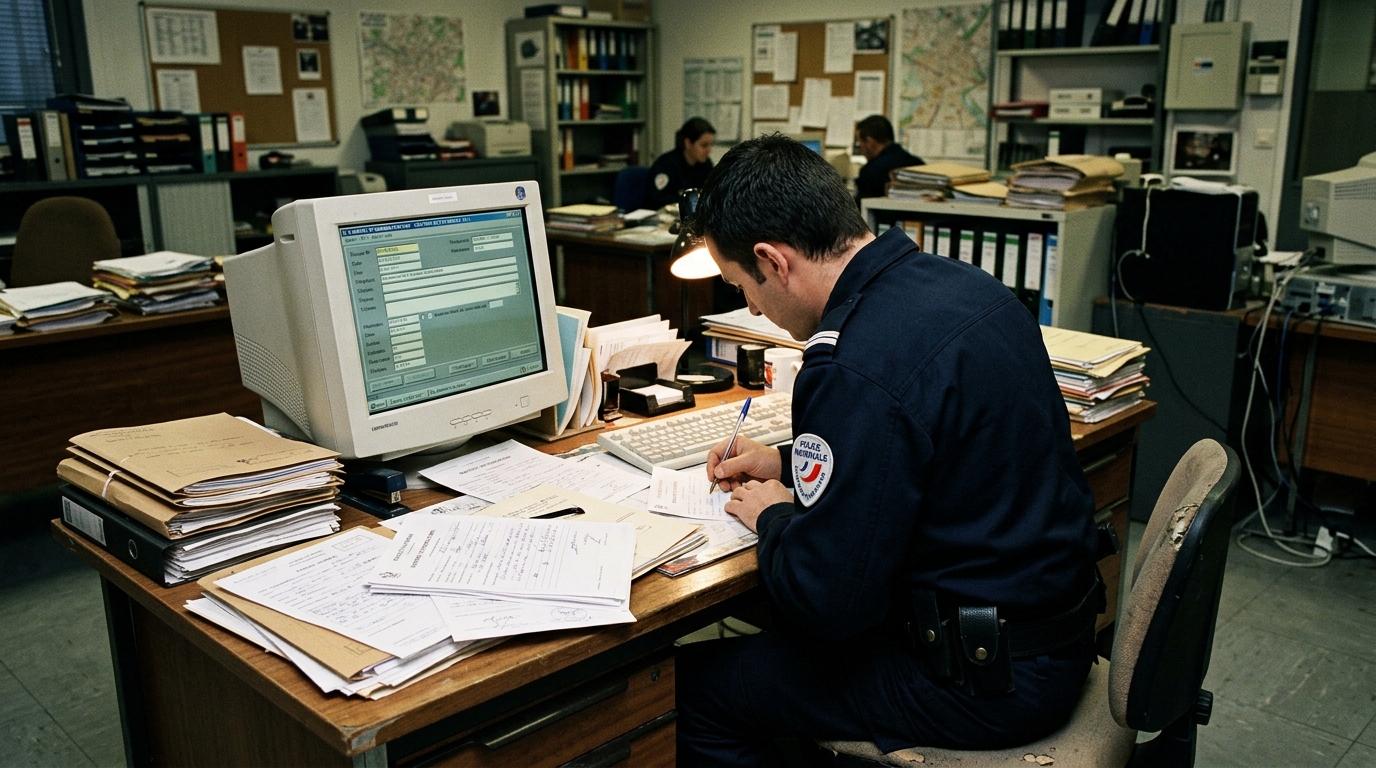
In 2015, the Ministry of the Interior launched Scribe — a software intended to revolutionize the drafting of criminal procedures for French police. Ten years later, the Court of Auditors puts the fiasco at 257.4 million euros. Six officials have just been sentenced to a total fine of 18,000 euros. And police officers still need 17 clicks to save a simple PDF file.
What you will learn
- What Scribe was supposed to do — and why it never really worked
- How 257.4 million euros could disappear in an IT project without tangible results
- Why the Court of Auditors fined six senior officials a total penalty that amounts to 0.007% of the damage
2015: a miracle software for investigators
The Scribe project stems from a simple and legitimate observation. The software used for drafting criminal procedures by the national police — the LRPPN — is deemed obsolete, slow, and ill-suited by investigators. Each criminal procedure requires a series of tedious manipulations. The Directorate General of the National Police and the Ministry of the Interior decide to replace it.
The initial ambition is broad: to equip simultaneously the national police and the gendarmerie with a common, modern tool capable of digitizing procedures and improving interoperability between services. The contract is awarded to Capgemini, which takes charge not only of software development but also of choosing its technical architecture. The rollout was to be completed by the end of 2019.
Chaotic governance documented in 500 pages
The Court of Auditors’ order — 500 pages — details with relentless precision the sequence of malfunctions that led to the shipwreck.
First documented problem: the gendarmerie quickly withdraws from the project — a decision that immediately reduces the ambition of mutualization and deprives the project of part of its initial justification. Without the gendarmerie, Scribe ceases to be a joint tool and becomes an exclusively police software, causing the unit cost to skyrocket.
Second problem: responsibilities are diluted. The Court highlights “diluted responsibilities,” a “flawed budgetary oversight,” and “nine contested strategic decisions” that each, at their level, contributed to the escalation of the fiasco. It characterizes the whole as a grave collective fault — perfectly illustrating why it is so hard to point to a single culprit.
Third problem: Capgemini’s technical choices. The provider, responsible for both development and the choice of architecture, ends up in a structurally conflicting situation. The Court notes “significant accounting irregularities” and the contestable awarding of public support to the provider itself.
The result: 17 clicks to save a PDF
After six years of development and tens of millions spent, Scribe is abandoned in 2021. But the term “abandoned” deserves nuance: the software was indeed partially deployed. The problem is that it remained “still inappropriate for the realities of police officers” according to the exact wording of the Court of Auditors.
The most revealing detail of the failure is also the most concrete: it takes no fewer than 17 clicks to save a file in PDF format within Scribe. A software meant to simplify investigators’ work has made certain tasks more complex than before.
In 2022, a comprehensive relaunch of the project is decided under the name XPN. In February 2025, Le Monde reveals that this successor is also about to be abandoned. A parliamentary inquiry committee is filed with the National Assembly in March 2025 — signed by dozens of deputies. The commissioning of XPN is now not planned before 2029.
257 million euros: what this figure hides
The Grand Total cost of the Scribe fiasco, estimated at 257.4 million euros by the Court of Auditors, merits an explanation. This figure does not simply represent the development costs paid to Capgemini. It encompasses a much broader scope: external support missions, maintenance costs of the old LRPPN system that should have been replaced, and especially the cost of time lost by thousands of investigators forced to use a defective tool for years.
The Court of Auditors distinguishes this total from the direct financial damage assessed in the legal proceedings: 30.21 million euros. It is on this basis — not on the 257 million — that the sanctions were calculated. The financial court itself acknowledges that it is “impossible to determine precisely” what portion of the damage can be attributed to each official.
Six officials, 18,000 euros in fines: the calculation that shocks
The order of the chamber for contentious matters of the Court of Auditors, issued on October 16, 2025 and disclosed by Le Monde on December 2, 2025, fines six individuals for their role in the Scribe fiasco:
- Two former Directors General of the National Police
- Two former Secretaries General of the Ministry of the Interior
- A police “technologies” adviser
- A former gendarmerie general, head of the Service for Technologies and Information Systems of Internal Security (STSI²)
The total amount of the fines pronounced: 18,000 euros. That is 0.007% of the 257 million invested in the project. It is less than a month’s salary for a divisional commander.
The Court justifies this amount by the impossibility of identifying a single official whose decisions would have constituted “the main cause of the fiasco” — the various breaches forming, in its view, “an indivisible whole.” A “grave collective fault,” then, but symbolic individual sanctions.
What this fiasco reveals
The Scribe affair sits within a string of black episodes in France’s state IT projects. It follows the abandonment of Louvois — the military payroll software that had cost 157 million euros and paid erroneous balances to 160,000 soldiers — and it precedes SIRHEN, the human resources management system for the Education Ministry abandoned in 2018 after 400 million spent for 2% of the staff covered.
In each of these cases, the same pattern emerges: insufficient governance, private contractors with too dominant a position, responsibilities too diluted to enable real accountability — and sanctions so weak that they fail to deter future decision-makers.
The real question posed by the 18,000-euro fine for 257 million euros of damage is not legal. It is political: how can we ensure that those responsible for such fiascos have a concrete incentive to prevent their recurrence?
