
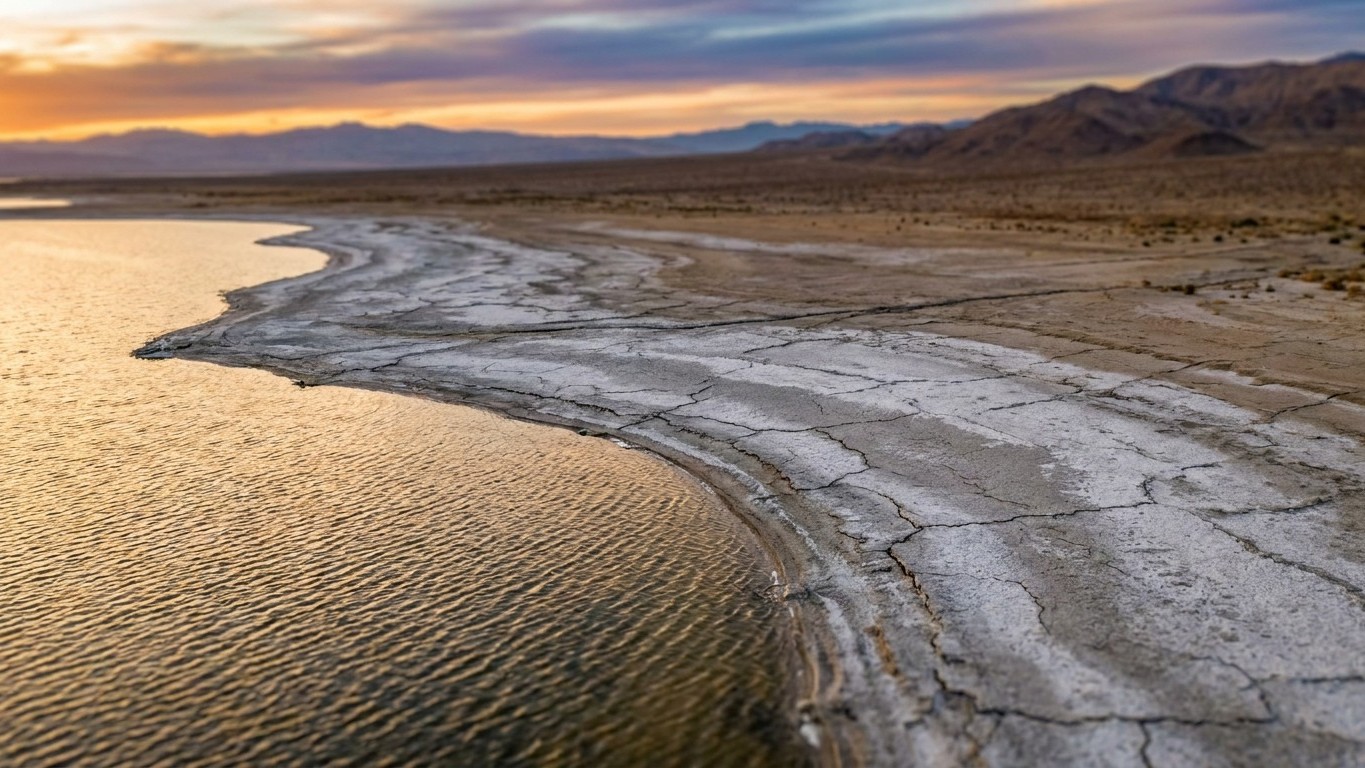
An engineering accident shaped California’s geography. In 1905, an uncontrolled breach in an irrigation canal diverted nearly the entire Colorado River into a desert depression below sea level. For about eighteen months, water poured into the fault before engineers managed to seal the leak. The result: the birth of California’s largest lake, the Salton Sea, born from a miscalculation rather than a natural phenomenon.
À retenir
- Did a 1905 engineering error really shape California’s geography?
- How can a lake created by accident be dying today?
- What is so valuable beneath the sediments that disappear?
The Engineering Mistake That Gave Birth to a Pocket Ocean
It all began with the Imperial Valley’s agricultural ambitions. In 1901, private companies excavated canals from the Colorado to irrigate this promising desert. Yet by 1904, silt clogged the Imperial Canal, preventing the valley from receiving water. To circumvent the issue, engineers opened a temporary water intake, meant to substitute the blocked flow. A bad idea.
The winter floods of 1905 toppled this improvised installation. The temporary diversion of the Colorado, built to replace the canal’s blocked supply, was shattered by the floods, and the river altered its course to flow into the Salton Sink. The breach widened at a staggering rate: the river carved channels that formed cascades, eroding the ground at roughly 1,200 meters per day and carving gorges 15 to 25 meters deep over more than 300 meters wide. In total, the flood created more than 60 kilometers of channels and eroded between 300 and 340 million cubic meters of soil and rock, carried down to the basin’s bottom.
The affair took on a political dimension. The Southern Pacific Railroad’s line found itself submerged, and the company’s president, E. H. Harriman, appealed to President Theodore Roosevelt, who then asked Congress to assist the railroad in stopping the floodwaters. Thousands of workers were mobilized to push the river back into its original bed. It would be until the railroad sealed the breach definitively that the disaster ended. By the time the breach was closed, eighteen months later, the Salton Sea stretched 58 kilometers in length and 42 kilometers in width, making it California’s largest lake.
A Lake Without a River, Doomed to Dry Up
Here lies the paradox that renders this history relevant well over a century later. A lake born from an overflow of water is dying today from a lack of water. Without direct inflow from the Colorado, the Salton Sea depends almost entirely on drainage from agricultural fields in the Imperial Valley and the Coachella Valley. Yet these inputs are shrinking year after year, driven by drought and water-saving measures imposed on regional farming.
The decline is measurable in hard numbers. Since 2003, with drastic reductions in inflows, the sea’s level has fallen by 13 feet and its surface area has shrunk by nearly 60 square miles, about 16%, reflecting a loss of roughly 3 million acre-feet of water. Evaporation has also concentrated the salt: since 2000, salinity has surged by more than 80%, reaching about 75 grams per liter—more than twice that of the oceans.
This exposed bottom is far from trivial. It carries the chemical memory of decades of intensive farming, pesticides, and residues. When the desert wind rises, it lifts this fine dust and scatters it over nearby communities, which are largely low-income and Hispanic. A study from the University of Southern California found that 24% of children in the area suffer from asthma, a rate well above the national average of 8.4% among boys and 5.5% among girls. Researchers at UC Irvine went further in 2025, following 700 children over several years: their work shows that children living near the Salton Sea exhibit stunted lung growth and higher asthma rates, with reductions in lung function greater than those seen in urban areas adjacent to heavily trafficked highways. California authorities attempt to limit damage by covering the most exposed areas with straw or vegetation, but the pace of measures struggles to keep up with the desiccation.
Under the Dust, White Gold
This damaged landscape, however, hides one of the most coveted resources of the energy transition. Beneath the bed of the Salton Sea and the surrounding geothermal zones lie hot brines rich in a rare mineral wealth. A study commissioned by the U.S. Department of Energy at the Lawrence Berkeley National Laboratory, published in late 2023, sent a jolt through the sector: an estimated deposit of 18 million metric tons of lithium, nicknamed “white gold,” valued at around $540 billion, would be trapped in the geothermal brine beneath the Salton Sea. By the estimates, this could supply more than 375 million batteries for electric vehicles, with potential lithium production surpassing 3,400 kilotonnes.
The region quickly adopted a new nickname, Lithium Valley, and drew in a handful of industrial players determined to capitalize. The preferred technique, direct lithium extraction, allows separating the metal from the brine already pumped to generate geothermal electricity, without opening new open-pit mines. Governor Gavin Newsom compared the area to Saudi Arabia of lithium, given the scale of the deposit and its potential to reshape American independence from China on this strategic mineral. A significant obstacle remains, almost ironically: this extraction itself requires substantial water, in a region that already lacks enough to keep its lake afloat.
The Salton Sea thus encapsulates a century of power struggles between humans and the California desert. Born from an excess of water, it today withers from scarcity, while concealing under its sediments enough material to fuel millions of electric cars for decades. The luckiest accidental lake in American history could, if extraction projects proceed, become one of the country’s most strategic industrial sites, provided that the health of its lakeside residents is not sacrificed in the process.
Sources: earthmagazine.org | planetizen.com
