
Only three countries on Earth know how to produce this gas: Qatar supplied a third of it, until a sudden attack deprived hospitals and balloon merchants of it all at once.
No factory, laboratory, or chemical multinational can manufacture this gas. It forms through natural radioactive decay within certain rocks, on geological timescales that far exceed anything achievable in industry, and then slowly seeps into a few pockets of natural gas scattered around the globe. Once released into the open air, it escapes for good into space: too light, it always ends up breaking free from Earth’s gravity.
- Helium can only be produced by natural radioactive decay, impossible to manufacture industrially
- Three countries control 90% of global supply, and an attack on Qatar blocked a third of the reserves
- Hospital MRIs compete with semiconductor plants and toy stores for the same gas
A gas that is never manufactured, recovered by chance
From a physical standpoint, this gas is a rare molecule on Earth, typically found in natural gas deposits where it appears at concentrations sometimes below 0.05%, making economic extraction challenging. In most cases, it is a co-product, recovered mainly from large liquefied natural gas sources within the gaseous leftovers of liquefaction trains. No one extracts this gas for itself: it is recovered incidental to another operation, or not recovered at all. Only about a dozen sources supply the world market, 90% of it from three major players: the United States, Qatar, and Algeria.
Once lost in the atmosphere, it never comes back.
Hospitals, toy stores, chip factories: the same bottle, different urgencies
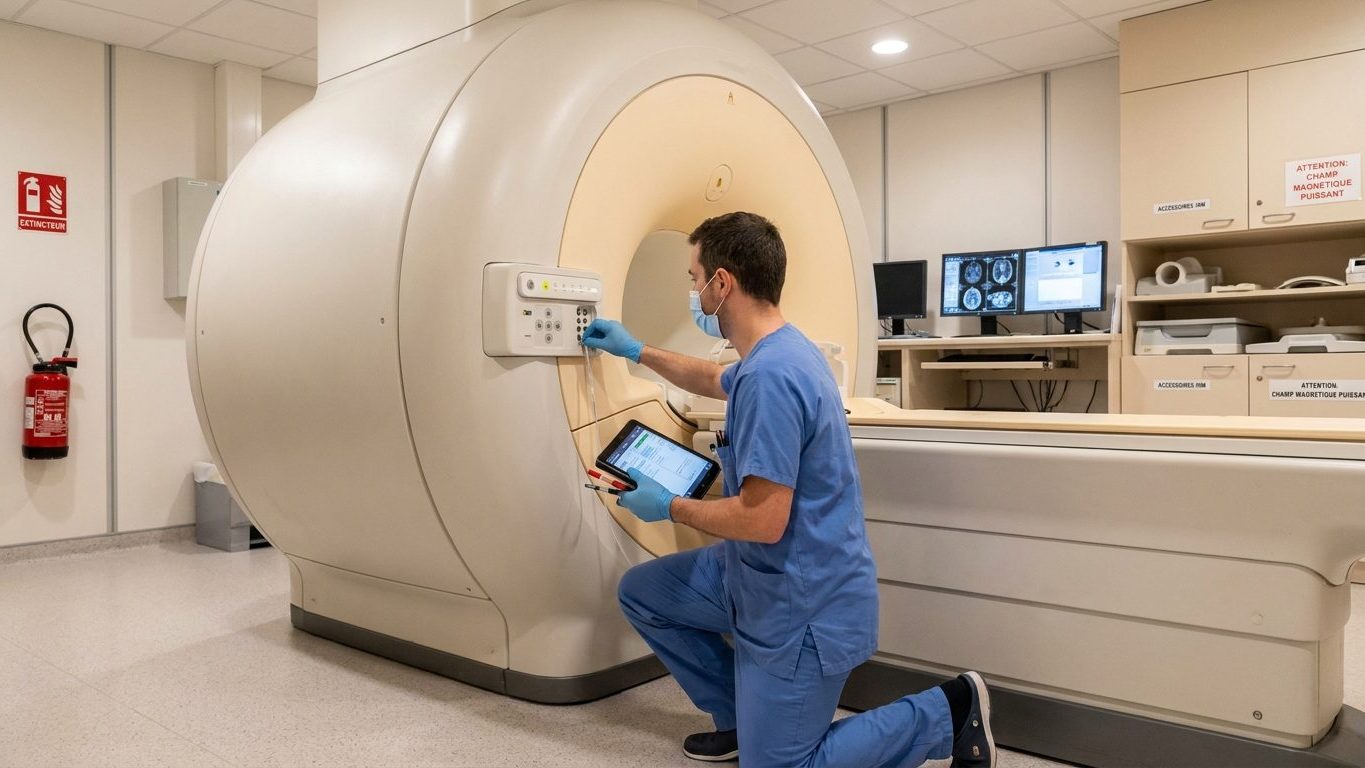
MRI scanners require this gas in liquid form to keep their superconducting magnets at ultra-cold temperatures, enabling efficient operation. Without it, the machine stops dead. A safety consultant for MRI systems sums up the situation plainly: “Without enough helium, the scanner cannot operate and becomes effectively a very expensive paperweight.”
Since early March 2026, a major Qatar-based gas complex has not delivered a single molecule of this gas: drone attacks damaged the site’s recovery infrastructure, blocking nearly a third of the global supply. An industry consultant warns that MRIs will fail, adding that shortages could delay repairs if service providers lack access to sufficiently purified gas. Semiconductor foundries, also extremely gas-hungry, find themselves in direct competition with operating theatres for the same cargoes. The medical sector has less room to maneuver to absorb a sudden supply shock, and for hospitals, the speed of adjustments could matter more than for chip manufacturers.
In the face of this gas, hospitals always take precedence over birthday parties.
This isn’t the first such warning. During the previous shortage, which began in early 2022, the American Party City chain went bankrupt in January, hit in part by rising prices for this gas—essential for inflating its parade balloons. A balloon-emporium toppled, against a backdrop of a resource many consumers associate with celebrations, never with an operating room.
Recycling, the only real antidote to the shortage
To tackle these difficulties, one of the sector’s major industrial groups is accelerating the deployment of recovery and recycling solutions among its industrial customers, devices that capture gas escaping by evaporation and reinject it into the production loop. Investments in circular-economy technologies are becoming a priority to reduce the market’s exposure to the fluctuations of primary extraction. Some French research laboratories had anticipated the shift long before the current crisis. At the Institute of Genetics and Molecular and Cellular Biology, the director of the Nuclear Magnetic Resonance team obtained European funding to install a recovery and compression station for the evaporated gas.
Recovery rates typically hover around 70 to 80% in the medical field, while certain industrial applications, notably in semiconductors, exceed 95%. The gap is explained by the nature of the installations themselves: an MRI magnet in continuous operation leaks gas more readily than a hermetically sealed etching chamber designed for the chip industry.
Some municipalities are even moving to prohibit balloon releases at public events, a symbolic step toward preserving a non-renewable resource. On the scale of a hospital, a single balloon release weighs almost nothing. But the sum of millions of such gestures, each year worldwide, has added up.
This gas will continue to be in short supply as long as its formation depends on geological processes that nothing or no one can accelerate. The real question is no longer where to find more, but how long it will be before the next hospital must decide: a functioning MRI, or a children’s party with balloons floating in the air.
Sources: mana-sys.fr | usinenouvelle.com
