
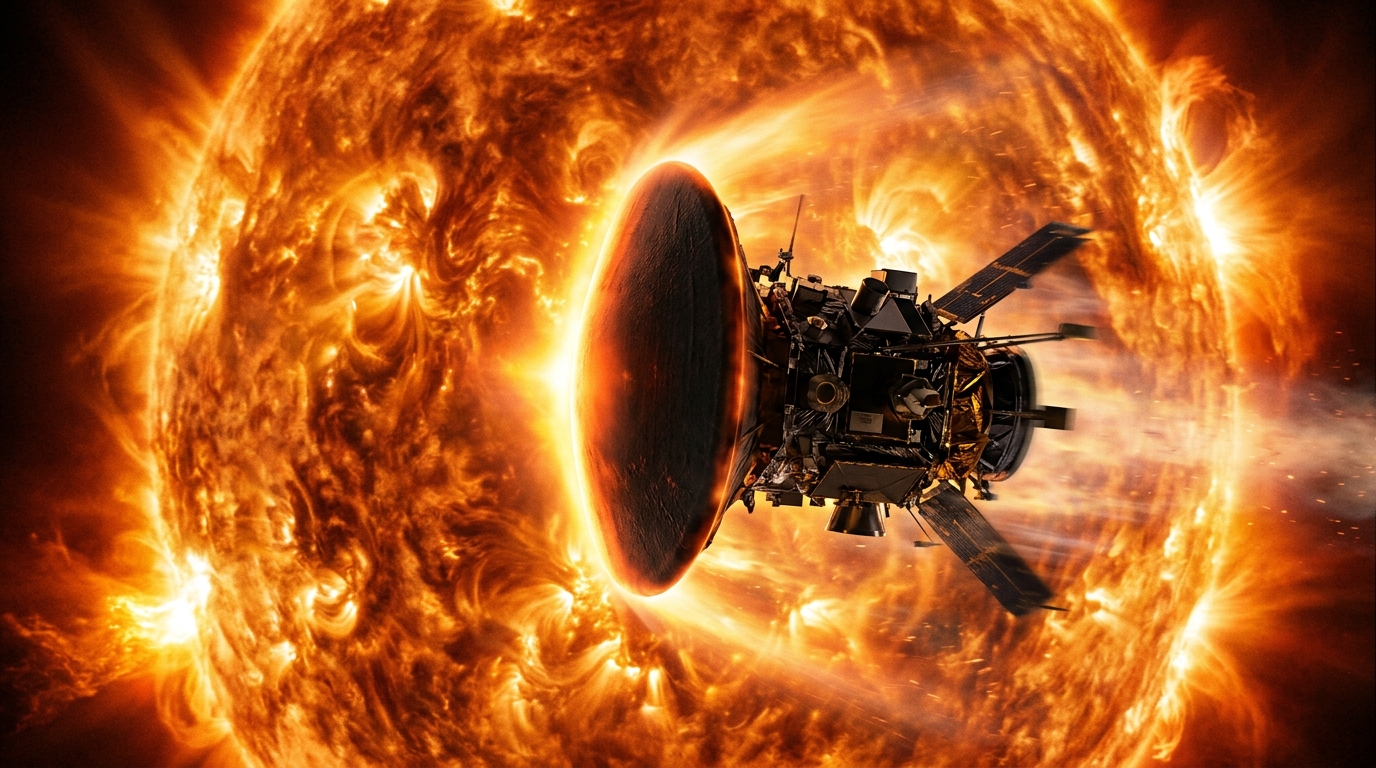
Imagine an object capable of crossing Paris in under a second, while withstanding enough heat to melt steel. It isn’t science fiction, but the reality of a NASA probe that, right now, skims our star at a speed almost unimaginable. This feat of engineering, bordering on a miracle, rests on a protection system of astonishing simplicity, nearly trivial in the face of the inferno it must endure.
- The Parker Solar Probe’s thermal shield weighs only 73 kilograms yet endures temperatures around 1400°C thanks to an eleven-centimeter-thick carbon composite.
- Parker Solar Probe reaches 692,000 km/h thanks to Venus’s gravity assists, without consuming extra fuel.
- At 6.9 million kilometers from the Sun, the scientific instruments stay at about 30°C despite the shield’s extreme heat, thanks to the vacuum of space and the device’s geometry.
- The probe that skims the Sun without melting: a feat that defies logic
- A carbon shield lighter than a suitcase yet resistant to 1400 degrees
- 692,000 km/h: how Parker Solar Probe became the fastest object ever built by humanity
- At 6.9 million kilometers from the Sun, the technology that keeps instruments at ambient temperature
- What this technical feat reveals about the future of solar exploration
The probe that skims the Sun without melting: an achievement that defies logic
Approaching the Sun has long been a fantasy, the Icarus dream that ended with burned wings. Yet the Parker Solar Probe succeeds where the myth fails: it ventures into the very heart of the solar atmosphere, in the mysterious region known as the corona, without ever disintegrating. This feat has for a long time seemed impossible given the seemingly insurmountable physical constraints.
What makes this mission fascinating is precisely the paradox it embodies. How can a craft built by humans survive temperatures that would instantly vaporize most known materials? The answer lies in a single word: ingenuity. Rather than trying to isolate the probe completely from the heat, engineers opted for a subtler strategy: to deflect and absorb the majority of this energy before it reaches sensitive components.
A carbon shield lighter than a suitcase yet resistant to 1400 degrees
Herein lies the heart of the mystery: what protects the Parker Solar Probe weighs almost nothing. The probe’s thermal shield, known as the TPS for Thermal Protection System, does not exceed 73 kilograms, a negligible weight compared to the scope of its mission. To put it in perspective, that is barely the weight of an adult, even as this shield must withstand temperatures approaching 1400 degrees Celsius.
This shield rests on a carbon composite structure, a material whose lightness is matched only by its exceptional thermal resistance. About eleven centimeters thick, it acts like a giant parasol that absorbs and reflects solar radiation before it reaches the spacecraft’s body. This technology, partly borrowed from research on thermal shields for space capsules, has been pushed to its limits to endure an environment that even scientists call extreme.
692 000 km/h: how Parker Solar Probe became the fastest object ever built by humanity
Beyond the heat, it’s the probe’s speed that impresses just as much. During its closest approaches to the Sun, Parker Solar Probe reaches the vertiginous speed of 692,000 kilometers per hour. At that pace, it could connect Paris to New York in just a few seconds, a figure that leaves one dizzy and makes it the fastest object ever designed by humankind.
This phenomenal speed is not the result of luck, but the outcome of a clever gravitational ballet. The probe uses Venus’s gravity, which it crosses several times throughout its mission, to gradually adjust its trajectory and move ever closer to the Sun. Each flyby acts like a celestial slingshot, accelerating the craft without drawing a single drop of extra fuel. It is this orbital mechanics, as elegant as it is effective, that allows the probe to shatter speed records while conserving its resources.
At 6.9 million kilometers from the Sun, the technology that keeps instruments at ambient temperature
The most astonishing detail remains perhaps this: while the probe’s forward shield endures furnace-like temperatures, the scientific instruments located right behind it operate at about 30°C. A staggering temperature difference achieved just a few meters apart, as Parker moves at around 6.9 million kilometers from the solar surface, a distance that may seem vast but is incredibly close to our star on the scale of the solar system.
This feat rests on a principle as simple as it is effective: the vacuum of space, which naturally limits heat conduction. Coupled with the shield’s precise geometry and onboard thermal regulation systems, this setup allows cameras, sensors, and other measurement instruments to operate under conditions nearly identical to those in a terrestrial laboratory, despite the hell raging mere centimeters away.
What this technical feat reveals about the future of solar exploration
Beyond the technological prowess itself, the Parker Solar Probe mission opens major prospects for understanding our star. By approaching directly the solar corona, the probe provides unprecedented data on solar winds and eruptions that can disrupt Earth communications and satellites. This valuable information helps scientists better anticipate space weather, a strategically important challenge as our reliance on satellite technologies grows.
This technical achievement also inspires future generations of space probes, which could rely on similar materials and principles to explore other extreme environments of the solar system. Whether approaching Mercury or planning missions to even more hostile bodies, the experience gained from Parker Solar Probe constitutes a true open-air laboratory, whose lessons extend far beyond the study of the Sun.
This space adventure reminds us how human ingenuity can turn the impossible into tangible reality, sometimes with solutions that are almost disarmingly simple. As the probe continues its cosmic ballet around our star, one cannot help but wonder which other celestial frontiers this technology might someday push back.
