
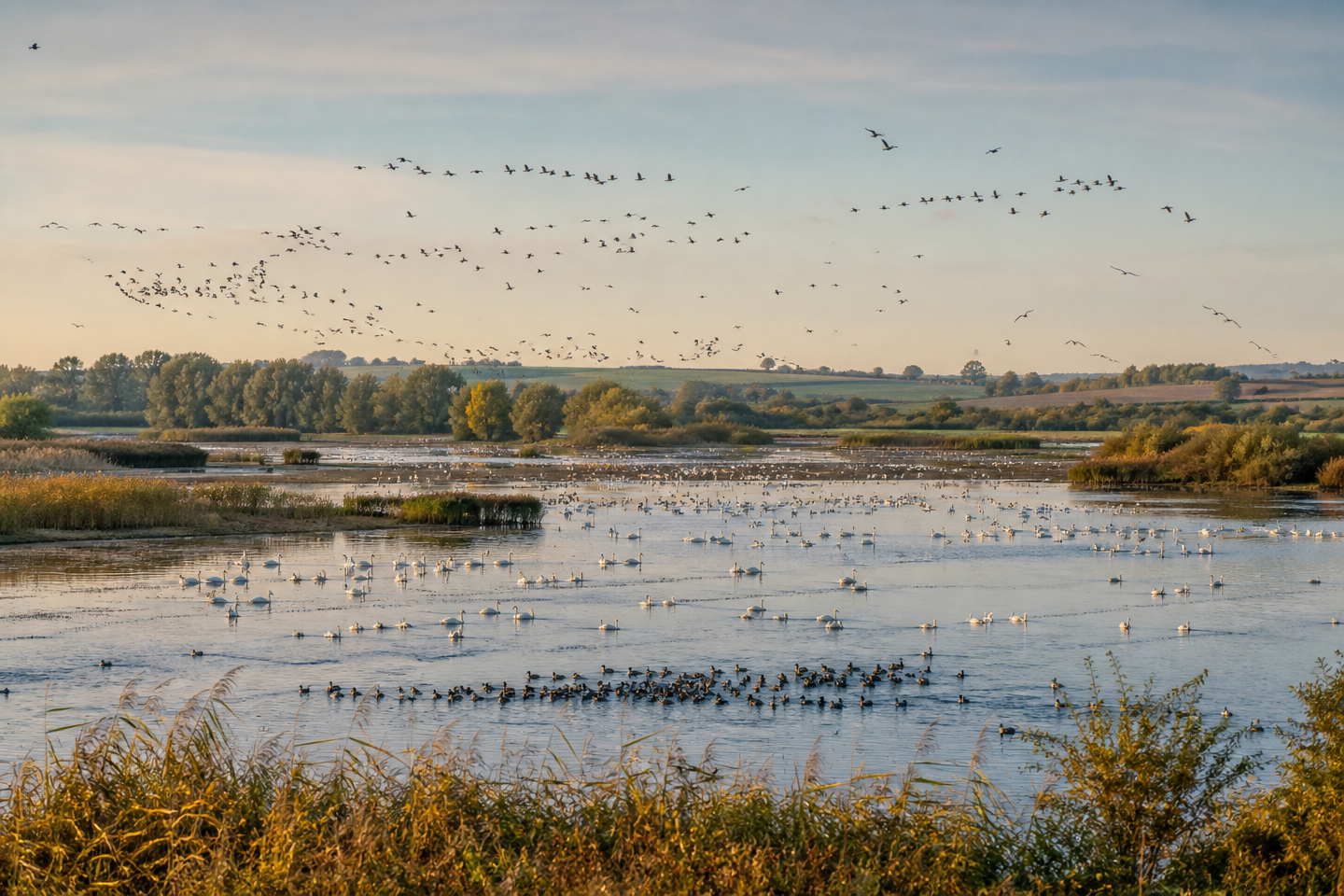
On a November morning at dawn, no fewer than 50,000 common cranes rise in unison above the calm waters of a Champagne lake, forming a living cloud visible for miles around. This sight, rare and striking, is not the product of a natural accident. It is the outcome of a project conceived more than half a century ago to address a very different urgency: protecting the capital from the fury of the Marne. By trying merely to tame a river, the French state, perhaps unwittingly, shaped one of the continent’s most important fossilized habitats for migratory birds.
- Created in 1974 after the 1910 flood, the Marne Reservoir was designed to protect Paris by smoothing out the river’s floods.
- Its filling-and-emptying cycle reveals autumn mudflats that attract more than 200,000 cranes during migratory stopovers.
- The LPO Champagne-Ardenne coordinates weekly volunteer counts and highlights the dangers posed by power lines and wind turbines to this migratory corridor.
- A colossal project born from a historical fear: the 1910 flood
- When concrete becomes a refuge: the accidental birth of an Eden for birds
- 200,000 cranes, an aerial ballet visible from space
- The Marne Reservoir, a discreet sentinel between engineering and biodiversity
- A flood-control dam turned global natural heritage
A colossal project born from a historical fear: the 1910 flood
To understand the origin of this extraordinary landscape, one must go back to the early 20th century, when the flood of the Seine and its tributaries had submerged Paris for several weeks. This collective trauma left a lasting mark on the public imagination and pushed authorities to rethink river management upstream of the capital. The idea was simple on paper but colossal in execution: to dig immense artificial reservoirs capable of holding back water during floods, then releasing it gradually to prevent any downstream overflow.
Thus, in 1974, an artificial lake spanning several thousand hectares arose in the very heart of Champagne. What began as a civil engineering project designed to blunt the floods would soon reveal a second vocation, unsuspected by its designers.
When concrete becomes a refuge: the accidental birth of an Eden for birds
The hydraulic operation of this lake follows a precise cycle: a filling phase from December to June, followed by a draining phase from July to November. This alternation, conceived solely for hydraulic safety reasons, reveals each autumn vast mudflats—these mud and shallow-water zones especially coveted by birds. Waders, ducks, geese, and especially cranes find a providential pantry and a nocturnal refuge there, safe from terrestrial predators.
This lake indeed lies right on one of the major migratory routes linking northern Europe to the wintering grounds in Spain and North Africa. Cranes leaving Scandinavia and Germany, notably from Hornborga, Kvismaren, Rügen or Diepholzer, pass through France each autumn before heading mainly to Spain. Unknowingly, the French administration had laid out a huge welcoming carpet right in the middle of their journey.
200,000 cranes, an aerial ballet visible from space
At this time of year, as autumn settles in and days shorten, the migratory ballet is in full swing. According to recent monitoring, about 100,000 cranes were already gathered on the site, out of some 450,000 expected over the season. In the previous season, no fewer than 320,000 cranes were observed migrating south during the post-nuptial migration through Champagne-Ardenne, a figure that boggles the mind when imagined as synchronized wingbeats.
Some exceptional weather episodes even amplify this phenomenon: a climatic block had held as many as 50,000 cranes at dawn on November 7, at the roost of the nearby Forêt d’Orient National Nature Reserve. Of the 300,000 cranes that traverse France each year, only a few thousand truly stop on the lakes of the Aube, and only a few hundred stay through winter before departing again in February.
The Marne Reservoir, a discreet sentinel between engineering and biodiversity
This lake so generous to the winged fauna bears a more technical name in administrative files: the Marne Reservoir. This artificial flood-control structure, designed above all to protect Paris, now each autumn hosts more than 200,000 cranes on migratory stopovers, a figure that places the site among the most frequented in Europe for this species. The dual life of this structure perfectly illustrates how human engineering can, almost inadvertently, generate ecosystems of astonishing richness.
That success is by no means accidental. The Ligue de Protection des Oiseaux (LPO) Champagne-Ardenne has, for many years, coordinated weekly counts, with around twenty volunteers spread around the lake each Sunday morning. A meticulous, quiet but essential effort that enables year after year to monitor population trends and anticipate periods of peak visitation.
A flood-control dam turned global natural heritage
While the primary role of these Champagne lakes remains to prevent downstream flooding, especially toward Paris, their environmental function is now recognized to such an extent that they are treated as a dedicated preservation site in their own right. But this ecological success remains fragile: the LPO regularly warns about the dangers posed by power lines and wind turbines to this migratory corridor, used each autumn by hundreds of thousands of cranes, often flying at night or with limited visibility.
The movement will swing in the other direction soon enough, as every year, with a return migration peak typically observed between March 5 and 15, when cranes begin the northward trek to their breeding sites in Scandinavia and Germany.
There is something deeply ironic, and ultimately rather reassuring, about this story: a structure conceived in fear of a past catastrophe has become, almost by accident, one of the most precious sanctuaries for European biodiversity. The question remains whether this balance between concrete, water, and wildlife can endure in the face of growing pressure from energy infrastructures that, too, are shaping the Champagne landscape.
