
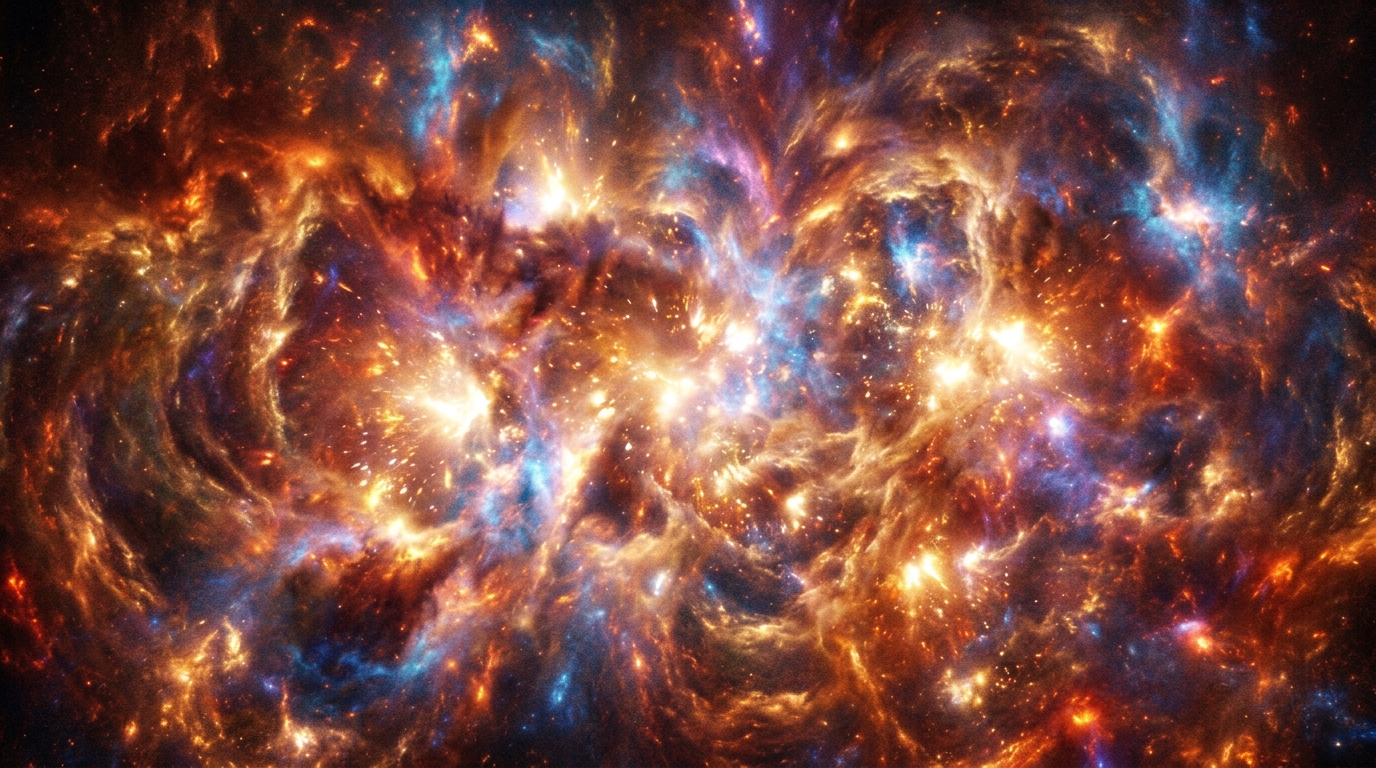
Look up at the starry sky on an autumn evening, and you will see light that is thousands, even millions, of years old. Yet there is an insurmountable boundary to this journey back in time, a wall beyond which no telescope, however powerful, can peer. This boundary is the famed primordial fog that wrapped our universe during its first 380,000 years of existence. An opaque curtain through which even light could not pass. Thanks to data recently published by the ACT telescope, perched high in the Chilean Andes, scientists have greatly refined our understanding of this distant yet foundational epoch.
- For 380,000 years, the universe was a dense soup in which photons trapped by free electrons could not travel freely, rendering the cosmos opaque.
- Recombination, which occurred when the temperature dropped below 3,000°C, allowed electrons to bind to protons to form the first stable hydrogen atoms, finally freeing the light.
- ACT telescope data, combined with Planck’s, offer a fivefold increase in resolution on this cosmic microwave background, confirming the expansion rate while leaving a discrepancy with measurements from nearby astronomical objects.
- When the universe was a hot, opaque soup
- The mystery of the 380,000 years that froze light
- The moment everything tipped: the recombination explained
- What this primordial fog still reveals today
When the Universe Was an Opaque, Burning Soup
Hard to imagine a cosmos where light itself had no place. Yet that was precisely the state of our universe just after the Big Bang. An extremely dense and hot soup comprising electrically charged particles, free electrons, and photons trapped in a ceaseless ballet of collisions. At that epoch, no stable matter could exist: atoms did not have time to form, instantly torn apart by the surrounding thermal agitation.
This opacity was not poetic license but a hard physical reality. Photons, the particles of light that normally race through the void unimpeded, were constantly scattered by free electrons, much like a pinball bouncing around without ever finding the exit. The result: light could not travel in a straight line, and the entire universe resembled a dense fog, impenetrable to direct observation.
The Mystery of the 380,000 Years That Frozen Light
Why precisely 380,000 years, and not more or less? That span corresponds to the time the ever-expanding universe needed to cool sufficiently. It’s a bit like a pot of boiling water left to cool: as the temperature drops, the conditions change dramatically. In our cosmos, this gradual cooling allowed electrons to slow down enough to be captured by atomic nuclei.
This period remains completely inaccessible to direct observation, regardless of how advanced our instruments are. Even the ACT telescope, a six-meter radio telescope perched on Cerro Toco at an altitude of 5,190 meters in the Atacama Desert, cannot see beyond this limit. Its exceptional location, which currently makes it the world’s highest permanent telescope, helps it minimize atmospheric disturbances. A strategic site chosen specifically to study the farthest reaches of our cosmic history.
The Moment Everything Tipped: the Recombination Explained
Physicists call this turning point the recombination. A somewhat misleading term, since it is really the first time electrons and protons combined; they had not bound before. Nevertheless, at roughly 380,000 years after the Big Bang, the temperature fell below about 3,000 degrees Celsius—a threshold low enough for electrons to bind permanently to atomic nuclei and form the first stable hydrogen atoms.
This sudden release had an immediate and spectacular effect: the light, previously trapped, began to travel freely through space. This radiation fossil is today known as the cosmic microwave background, a frozen imprint that bathes the entire universe, including our own galaxy. ACT focused its observations on this background between 2017 and 2022, later publishing its latest major data release in November in the Journal of Cosmology and Astroparticle Physics, after nearly twenty years of service since 2007.
What This Primordial Fog Still Reveals Today
Far from being a mere historical curiosity, this ancient fog continues to yield valuable information. By combining ACT data with those from the Planck satellite, researchers achieved a resolution five times higher than Planck alone, with an especially fine measurement of the polarization of this fossil radiation. A precision that effectively lets us zoom in on the tiny temperature fluctuations present in this 13.8-billion-year-old radiation.
These new measurements confirm the expansion rate of the universe already calculated by Planck, while allowing the ruling out of several alternative theoretical models proposed in recent years. One disagreement, however, persists and continues to trouble cosmologists worldwide: the expansion rate inferred from this cosmic microwave background does not exactly match what is obtained by observing nearby astronomical objects. An enigma that these new data have not resolved, leaving another mystery hanging over our heads. It must be noted that ACT is no stranger to landmark discoveries: the instrument has notably enabled the first detection of gravitational lensing in a map of the cosmic background radiation, as well as the discovery of the impressive galaxy cluster El Gordo.
Reconstructing these earliest moments of our universe is almost like archaeological work, except that the clues lie in the sky rather than underground. Each new datum gathered by instruments like ACT fills in a little more of the shadow surrounding our cosmic birth. It remains to be seen whether next-generation telescopes will ever fully crack the mystery of this tension between the various measures of the expansion rate, or whether this enduring puzzle still holds many surprises for us.
