
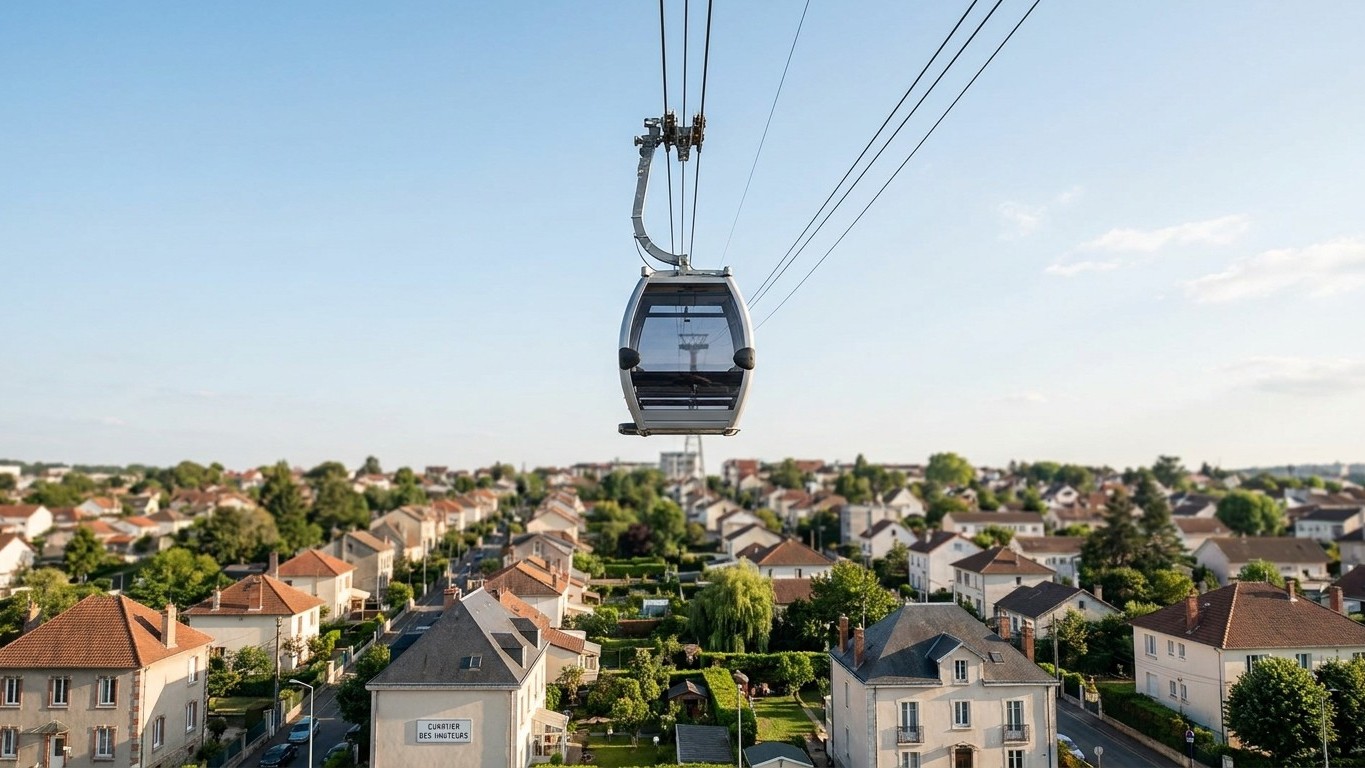
In the archives of Orléans Métropole, a project for an urban cable car has lain since 2020, its abandonment costing five million euros, purely swallowed by studies that never culminated in a single pylon planted. The tale repeats itself, with variants, in several other French cities that once dreamed of cabins suspended above their roofs before tucking the plans away in a drawer. The common bond across almost all these dossiers? A legal question largely underestimated at the outset: can a cabin pass over a neighbor’s garden without their consent.
Key takeaways
- Orléans spent 5 million euros on a cable car project that was ultimately abandoned without laying a single pylon
- A legal lock dating from 1941 blocked overflights of private properties for decades
- Political patience and management of neighbor disputes matter more than cost or technology
A mode of transport that looks appealing on paper
The economic argument recurs in every study. For the link between Créteil and Villeneuve-Saint-Georges in Val-de-Marne, the project was estimated at 72 million euros for 4.5 km, i.e., about 16 million euros per kilometer. By comparison, rail tramways cost 22 to 30 million per kilometer, and metro lines 90 to 120 million per kilometer, according to Certu figures from 2012. It helps explain why so many elected officials were tempted by cable rather than rail, especially when crossing a railway, a river, or a hill without expropriating half a neighborhood.
In practice, the ground story has remained modest. Brest opened the way first: the Brest cable car, the first urban cable car in France dedicated to everyday travel, went into service in November 2016. The facility, 460 meters long, straddles the Penfeld for a 3-minute ride and can carry up to 1,850 passengers per day. Toulouse followed with Téléo, put into service in May 2022: since May 14, 2022, the Toulouse urban cable car connects the Oncopole to Paul-Sabatier University via the Rangueil CHU, for a cost of 82.41 million euros, of which 11.8 million came from subsidies. It is today the longest urban cable car in the country.
The legal lock that blocked years of files
For a long time, a 1941 law acted as an almost insurmountable brake. It did establish a right-of-overflight servitude, but it was designed for ski stations and prevented the overflight of private properties unless expropriations occurred, and it proved inapplicable outside mountain areas. Consequently, passing a cabin over a suburban pavilion in an urban zone was impossible without negotiating property-by-property, an administrative nightmare that chased away more than one project promoter.
The government finally bridged this legal void at the end of 2015. The law of July 8, 1941 establishing an overflight servitude for cable transport was repealed as it related to urban cable transport, replaced by a more precise framework. Henceforth, the lowest point of overflight could not lie closer than 10 meters from the surveyed properties, and owners held a right to compensation. On paper, the blockage was lifted. In reality, litigation did not truly end: in Toulouse, the administrative court received four collective petitions from an insurance company, an association, and a condominium association seeking the annulment of administrative decisions allowing the south urban cable, contesting notably the servitude of public utility for overflight of private properties by the cable. The court dismissed these challenges, but the episode vividly illustrates the fragility of the legal setup, even after the law was clarified.
Files that lie dormant, others that end up buried
Orléans remains the clearest example of a project that died after years of hope. The cable would connect the new Interives district to Aubrais station by flying over railway tracks in under three minutes. Approved in late 2016 and entrusted to Vinci Construction, the project was abandoned in September 2020 by the metropolis’s new president. The deputy president in charge of finances revealed that the community had spent five million euros on this project, for the studies and for contracts awarded to the company Poma. Two lawsuits had been filed against the development even before the political abandonment.
Lyons experienced a similar scenario with the project linking the city to Francheville, to the west of the urban area. The Lyon cable car, intended to connect the city to Francheville, was ultimately cancelled, amid local opposition visible even in public comments, where residents denounced flying over the surrounding belt of green space with flora and fauna to protect. The ecological motive here overlapped with the more traditional concerns of residents about overflight of their parcels, a combination that ultimately weighed more heavily than cost or speed arguments.
Not all dossiers end up buried with the tombstone of major projects. The Val-de-Marne project, pursued for more than a decade, proves otherwise. The urban cable project has been driven for over 10 years by the Department of Val-de-Marne, declared of public utility in October 2019, and financed by a 125-million-euro agreement notified in July 2021. After successive postponements relative to the initial calendar aimed at 2023-2024, the line, renamed Cable 1, finally opened on December 13, 2025, between Créteil and Villeneuve-Saint-Georges, with about 12,500 daily travelers a few weeks after its launch.
This contrast says much about the real mechanics of urban cable cars in France. It is neither the cost nor the technology that sinks most projects, but the political patience required to endure ten or fifteen years of appeals, changes of government, and the legitimate anxiety of a neighbor who sees a cabin pass ten meters from their terrace. Other cities, notably in Île-de-France where a dozen projects remain under study around the Saclay plateau, now watch closely which of these two scenarios they will face: early shelving or slow maturation.
Sources : toulouse.tribunal-administratif.fr | maire-info.com | driea.ile-de-france.developpement-durable.gouv.fr
