
Picture the scene: in the middle of the Cold War, a CIA analyst scrutinizes spy satellite photos over the Caspian Sea. In the image, a massive silhouette, whose outlines were completely unknown to Western military catalogs, seems to float on the surface of the water. Neither the shapes of Soviet bombers nor those of conventional warships match what he sees. The craft measures almost the length of a football field, weighs several hundred tons, and yet it gives the impression of flying just above the waves. This mystery, etched in the annals of American intelligence under the nickname Caspian Sea Monster, hides a story of engineering as fascinating as it is little known.
- The KM, nicknamed “Caspian Sea Monster” by the CIA, exploited ground effect to fly between 3 and 14 meters above the water using ten jet engines.
- The craft crashed in 1980 following a pilot error and still lies at the bottom of the Caspian Sea, too heavy to salvage.
- The ekranoplan program was abandoned because of their inability to sail in rough seas, poor maneuverability, and high costs, then finally ended with the collapse of the USSR in 1991.
- The Soviet Union was hiding a 544-ton monster in the Caspian Sea
- A giant that refused the laws of conventional aviation
- Speed and weight were not the real danger
- What actually halted the Soviet program
- The forgotten legacy of a project that could have changed maritime transport
The Soviet Union Was Hiding a 544-Ton Monster in the Caspian Sea
It all began in 1966, after several years of discreet tests conducted from 1961 on smaller prototypes. At the Volga shipyards, Soviet engineers completed the construction of an extraordinary machine, named KM, for Korabl-Maket, literally “ship-model” in Russian. Once finished, the craft was transported to the Kaspiysk naval base on the shores of the Caspian Sea, where it would carry out the bulk of its operational career. With a length of 92 meters, a wingspan of 37.6 meters, and a maximum mass reaching 544 tonnes, the KM would remain for decades the heaviest aircraft ever built, a record it would surrender only much later to the Antonov An-225.
It is precisely this colossal mass, coupled with a silhouette that resisted classification, that would intrigue American intelligence from the moment it entered service. Not quite a plane, not exactly a ship, the machine defied any conventional framework, which led the CIA to award it the famous nickname Caspian Sea Monster. A name commensurate with the mystery it embodied at the time.
A Giant That Refused the Rules of Conventional Aviation
The KM’s secret does not lie in revolutionary engine technology, but in a particular physical principle known as ground effect. In concrete terms, when an aircraft flies very close to a flat surface, such as water, a cushion of compressed air forms beneath its wings, generating a substantial extra lift. It was this phenomenon, exploited with masterful precision by Soviet engineer Rostislav Alexeiev, a specialist in lifting surfaces capable of supporting enormous loads at the water’s edge, that allowed the KM to “fly” without ever truly taking off in the conventional sense.
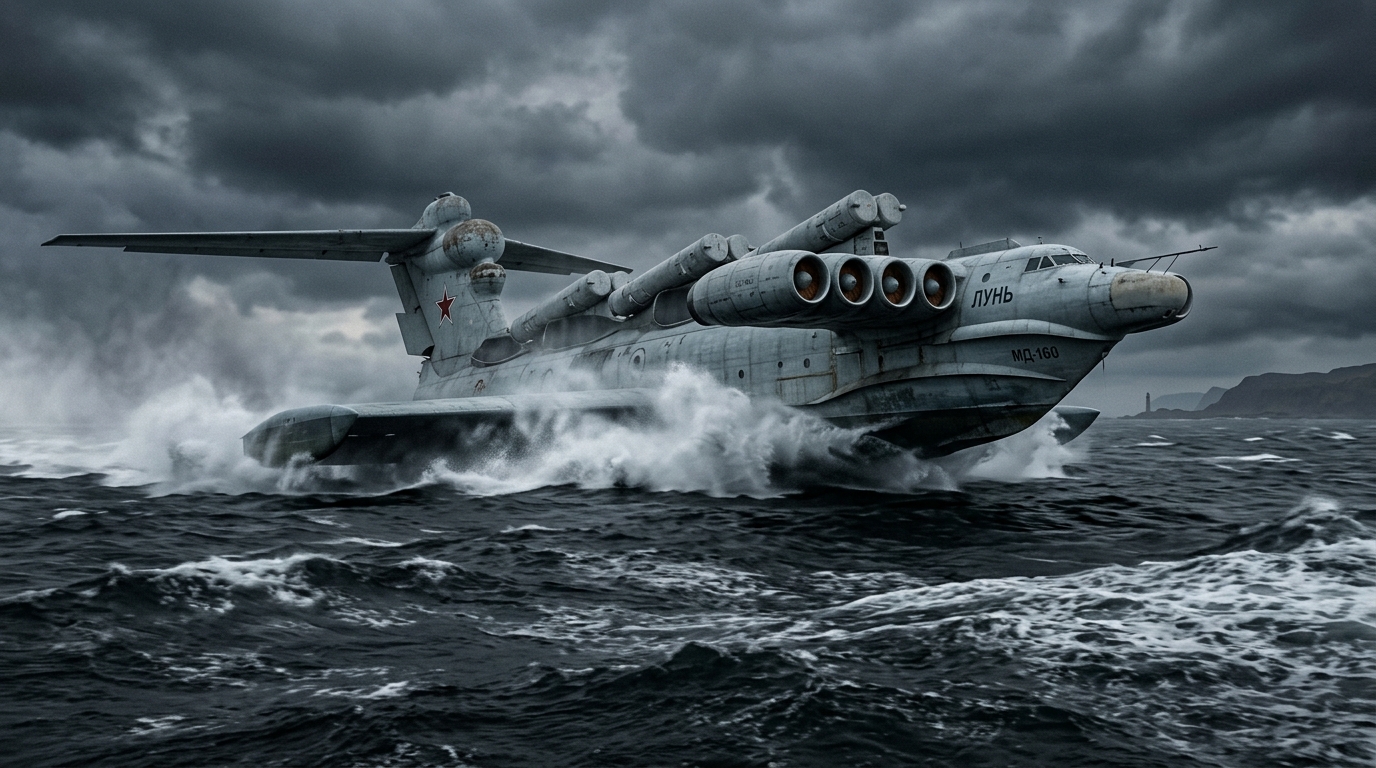
In practice, the craft operated between three and fourteen meters above the waves, never higher, due to insufficient power to escape the ground-effect zone. To achieve this, ten engines were required: eight of them, positioned at the front of the fuselage, blew air under the wings to create the famous air bubble at takeoff, while the two others, mounted on the tail, provided propulsion in cruise. A complex propulsion architecture, designed solely to maintain that delicate balance between flight and navigation.
Speed and Weight Were Not the Real Danger
One might reasonably assume that a craft capable of reaching 500 km/h while bearing several hundred tonnes posed a constant danger in itself. Yet, it was not cruising speed nor payload that posed the real problems during the fifteen years of intensive testing conducted by the Soviet scientists. The KM served as a true flying laboratory, allowing researchers to refine knowledge of ground effect without witnessing any major incidents related to its power or weight.
The flaw lay elsewhere, in a far more insidious mix of factors. In 1980, a pilot error during a test flight sufficed to trigger a fatal crash: the craft plunged and sank in the Caspian Sea. Too heavy to tow or salvage, it still lies at the bottom today. This tragedy illustrates how maneuverability—far more than sheer power—represented the device’s Achilles’ heel.
What Truly Stopped the Soviet Program
If the 1980 accident marked the definitive end for the KM itself, it did not suffice to bury the concept of the ekranoplan, which continued with the Lun-class, also known as the MD-160, put into service in 1987. Shorter, at 73.8 meters in length, this craft was conceived as a true assault weapon, equipped with six P-270 Moskit anti-ship missiles arranged in pairs on its back, designed to threaten NATO aircraft carriers. It cruised between one and five meters above the waves, combining speed with radar stealth, remaining almost invisible to surface detections.
But what really doomed the ekranoplan program was neither technology nor a single accident. Three structural failings accumulated over the years: capricious weather, since these machines could not take off or navigate in rough seas once waves exceeded 2.5 meters; a catastrophic maneuverability profile, with a turning radius so large that any turning required substantial space; and finally an exorbitant cost in fuel and maintenance, difficult to sustain in the long term. The collapse of the USSR in 1991 delivered the final death blow, abruptly halting the construction of a second Lun, the Spasatel, a version intended for rescue missions at sea.
The Forgotten Legacy of a Project That Could Have Changed Maritime Transport
Today the KM remains a unique specimen, never reproduced in identical form. No other ekranoplan of this precise scale has been built since its disappearance in the waters of the Caspian. As for the Lun-class, it is now on display, stranded on a beach near Derbent in Dagestan, and remains visible in satellite images, as a final frozen testament to this technological venture. A stark contrast to the mystery that once surrounded these machines in the eyes of Western intelligence services.
What makes this story particularly striking is the potential these machines would have offered for freight transport, blending aviation speed with a ship’s cargo capacity. A dream of an engineer left unfinished, blocked by more earthly constraints than by technical prowess.
Source: Wikipedia
