
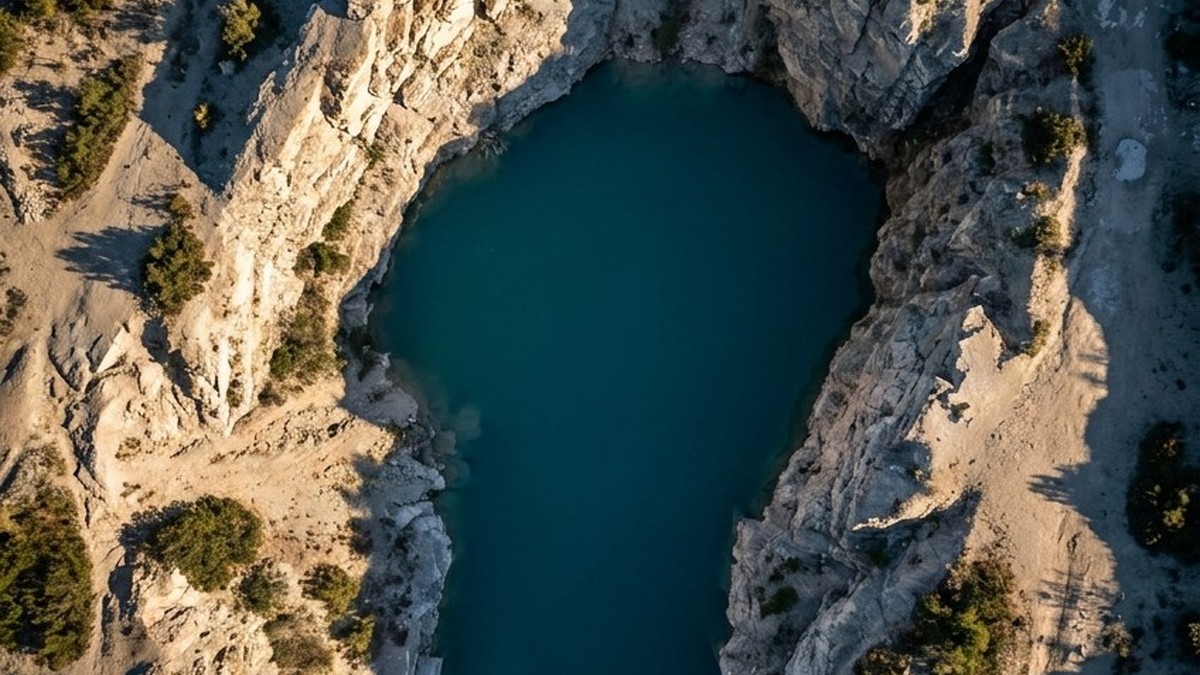
In the old pits of Trélazé, at the gates of Angers, more than six centuries of workers’ history lie sleeping since the last quarry closed in 2014, submerged beneath a striking blue-green hue. It is not the water’s color nor the slate’s character that keeps people away from the edge: it is what lies beneath the surface, invisible and silent, that makes these basins deadly for anyone who ventures close.
Key takeaways
- Why does such a gorgeous color hide such a deadly trap?
- Have six centuries of mining truly left behind what we see today?
- How did a site closed to the public become a social media darling?
Six centuries of shale under Anjou’s waters
The story begins well before the industrial era. The rise of slate mining dates to the 15th century, as evidenced by the opening in 1406, at Tirepoche, of the first open quarry. For generations, extraction remained artisanal: until the 18th century, slate was removed by hand using “hottées,” and pumping water was done with hand-operated towers. The turning point comes in the 19th century, with steam-powered machines and increasingly deep underground galleries.
The site’s scale then became considerable. The Trélazé slate works were, for a time, the largest in France. A reputation that endures through the centuries to a final moment: they were also the last to operate in France, their exploitation ending only in 2014. Six hundred years of continuous extraction, or almost, before the pumps stopped and the groundwater reclaimed the abandoned pits.
The resulting landscape is no accident of aesthetics. This succession of uneven mounds alternating with water-filled basins, the famous “bas fonds,” still imprints on the place that lunar color and volcanic curves, traces of a land churned by humans and iron. Today repurposed, the park offers 200 hectares of dry, shale landscapes, where vegetation has reclaimed its rights.
The blue-green color was never the problem
The color, precisely, intrigues every passerby along these former ponds. It results from the mineral nature of the slate and the particles it releases into suspension in the water: light is diffused in a way different from a ordinary lake, producing this almost unreal tint that has earned the site its fame. A purely optical phenomenon, not dangerous in itself. The slate museum, installed on site, tells this rock chemistry as well as the social history of the miners who extracted it.
But the visual fascination masks a classic trap of flooded old quarries, where beauty is often mistaken for harmlessness. The real danger is not visible at the surface. One must look elsewhere.
Vertical walls, icy water: the real danger is invisible
The municipality itself leaves no room for doubt. Even though the temptation is strong to dip into the picturesque waters of the Slate Pits, swimming is formally prohibited; the depth of the bottoms and the temperature of the water constitute a deadly danger. A message also hammered out by Angers Loire Métropole, the site’s operator: swimming is strictly forbidden in the old pools.
The danger mechanism is well documented by safety experts in quarry operations. First, the fall: quarries are not built to welcome swimmers, and access to water points is often abrupt, creating a significant risk of a fatal fall. Then the water itself, whose coldness can catch out bodies warmed by walking or sun. The temperature, sometimes very low, can lead to a deadly hydrocution, a phenomenon caused by the temperature difference between the surface and much colder underground inflows, which can occur even while one is swimming calmly. A thermal shock that offers no warning, and can immobilize an experienced swimmer in seconds.
This observation is not unique to Anjou. In the North, the pond known as the “blue water” at Trélon illustrates the same scenario on a larger, tragically dramatic scale: access to that site remains forbidden and public swimming has never been allowed, especially since the bottom is deep and the ground is particularly dangerous. There, the last fatal drowning occurred on July 26, 2006, when a 28-year-old woman fell from the cliff. A reminder that the picturesque veneer of these old quarries never erases the brutal relief that lies beneath the water: vertical walls plunge downward, with no beach or gentle slope to regain footing.
A classified site, reserved for supervised divers
The site’s classification says much about its recovered ecological value. The Slate Pits Park is a Sensitive Natural Area, recognized for the richness of its landscapes and biodiversity, a designation aimed at preserving and highlighting remarkable and fragile natural sites. Orpin d’Angers, linnets, grasshoppers with improbable colors: the fauna has recolonized what humans had dug out for six centuries.
As for the water itself, it is not entirely off-limits to those who know how to proceed. Diving clubs organize supervised outings there, sometimes even deliberately sinking a vehicle carcass to train students to operate in depth and in murky water. A paradoxical way to turn an old industrial danger into a technical training ground, under professional supervision, far from casual summer improvisation.
One more indicator of the growing online appeal of these basins: online interest in these blue-green waters rose by nearly 195% in recent summers, driven by photos circulating on social networks that do not always mention the accompanying prohibition. A craze that often precedes, by far, reading the signs posted at the water’s edge.
Sources: canalfm.fr | amopa49.fr
