
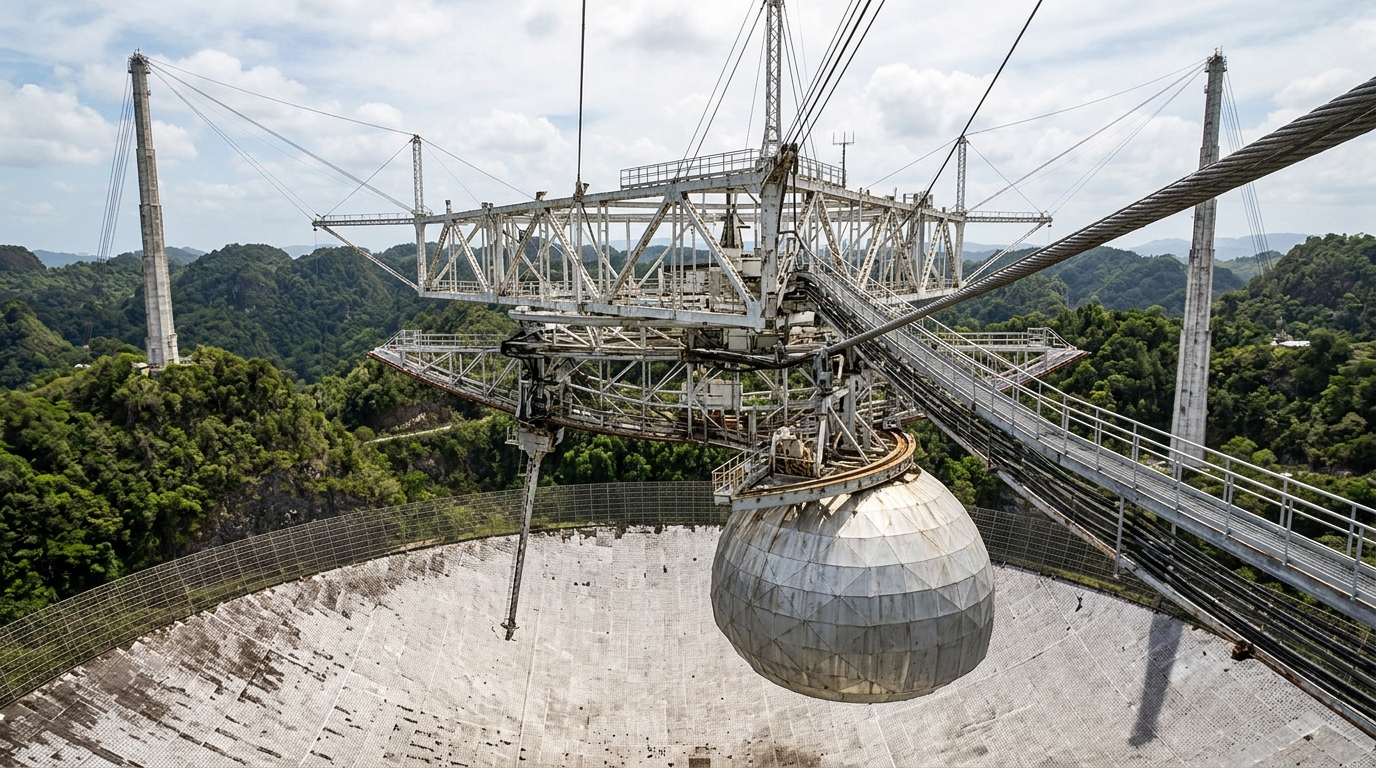
A metallic crash, a cloud of dust, and nearly six decades of scientific history collapsing in a handful of seconds. What happened that day was not the product of a weather whim nor of blatant maintenance negligence. The gigantic structure that loomed above the famous 305-meter mirror gave way to a far more insidious phenomenon, one that slowly gnaws at steel without ever leaving obvious external signs. A look back at the fall of one of the world’s most emblematic astronomical instruments, and the lessons it continues to teach engineers.
- The Arecibo radio telescope, built in 1963, collapsed on December 1, 2020 when its final load-bearing cables snapped in less than thirty seconds.
- The real cause wasn’t wind or classic rust, but creep-fatigue under corrosion, an invisible phenomenon creating internal microcracks inside steel cables.
- No lives were lost thanks to the preventive evacuation of surrounding areas, but the incident is prompting engineers to rethink how aging infrastructure is monitored.
- A giant that seemed indestructible since 1963
- The invisible enemy lurking in the steel cables
- The 30 seconds that changed everything on December 1, 2020
- What the fall of Arecibo reveals about our aging infrastructure
A Giant That Seemed Indestructible Since 1963
Nestled in a natural depression within Puerto Rico’s tropical forest, the Arecibo radio telescope long bore the title of the world’s largest single-antenna instrument. Its construction, completed in 1963, was already a feat of engineering: a vast 305-meter-diameter metallic reflector, crafted to capture radio waves from the far reaches of the universe, topped by a platform suspended in the air by a network of cables stretched between three support towers.
For decades, this installation withstood tropical storms, the occasional earthquakes, and the region’s constant humidity without surrendering. It enabled the detection of pulsars, the mapping of potentially dangerous asteroids, and even participation in the search for extraterrestrial signals. Its apparent robustness had made it a near-immortal symbol of scientific perseverance, to the extent that few imagined it could someday collapse onto itself.
The Invisible Enemy Lurking in the Steel Cables
It was neither the violent winds of a hurricane nor the classic rust typically associated with the degradation of metal structures that signaled the telescope’s demise. The real culprit hid inside the very load-bearing cables, in a process known as creep fatigue under corrosion. Unlike a sudden, visible rupture, this phenomenon works in silence, generating internal microcracks that gradually spread without altering the outside appearance of the metal.
The cables, under constant tension for years, eventually gave way under their combined weight and this invisible degradation. The tropical climate, with its high humidity year-round, likely accelerated this mechanism without being its primary cause. In other words, the structure appeared sound on the surface, while internally it was weakening, somewhat like a fruit whose skin stays smooth while the flesh rots quietly out of sight.
The 30 Seconds That Changed Everything on December 1, 2020
Early warning signs appeared a few months earlier, when a secondary cable failed, damaging part of the reflector. Then a second main cable snapped, plunging the engineering teams into a race against time to assess the overall stability. Despite analyses and attempts at reinforcement, the situation proved irreversible.
On December 1, 2020, without further warning, the remaining load-bearing cables failed almost simultaneously. The 900-ton platform, previously suspended above the mirror, collapsed directly onto the reflector in under thirty seconds. The impact destroyed a large portion of the facility, turning a major scientific symbol into a jumble of debris and tangled cables. No human lives were lost in the incident, as the surrounding areas had been evacuated as a precaution at the first signs of danger.
What the Fall of Arecibo Reveals About Our Aging Infrastructure
This collapse, far more than a simple isolated accident, illustrates an issue that extends well beyond astronomy. Numerous infrastructures around the world—whether bridges, dams, or massive antennas—rely on materials whose theoretical strength does not guarantee eternal durability under prolonged stresses and specific environmental conditions.
The example of Arecibo reminds us that a visual inspection, even a rigorous one, is not always enough to detect internal degradations that develop over the years. This has pushed many engineers to rethink how we monitor aging structures, integrating technologies capable of detecting microcracks or signs of fatigue before they become critical. The loss of this emblematic telescope did not merely mark the end of a valuable scientific instrument; it opened up a broader reflection on how we maintain our giants of steel and concrete.
As we reflect on this dramatic collapse, we realize how the apparent resilience of a structure can mask a deep vulnerability. Arecibo observed the mysteries of the cosmos for nearly sixty years before succumbing to a more earthly malady. The question now is how many other infrastructures, deemed indestructible today, actually hide the same silent fragilities.
