
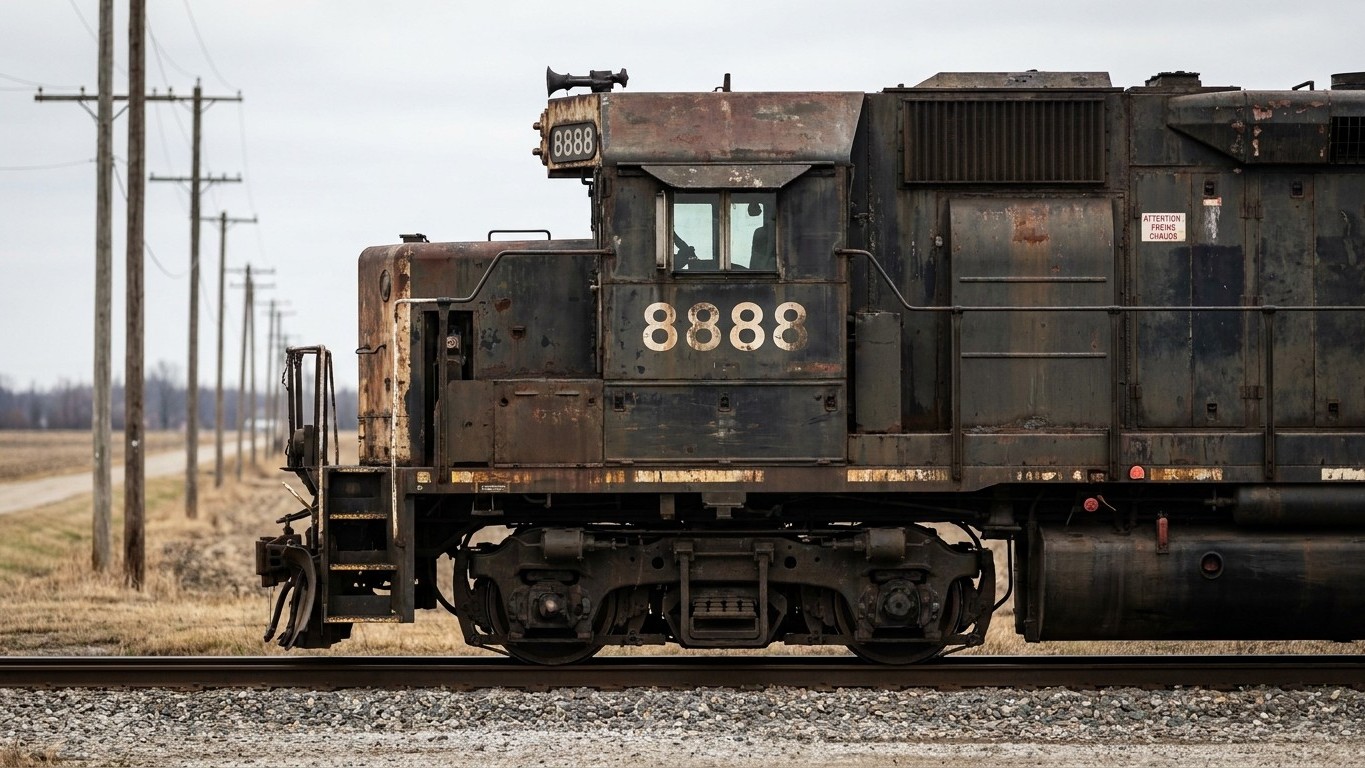
On May 15, 2001, a yard locomotive escaped from an Ohio classification yard while pulling 47 freight cars, two of them tank cars loaded with toxic chemicals, and traveled for about a hundred kilometers with no one at the controls. The episode, memorialized in American rail lore as “Crazy Eights,” mobilized police, railroad workers, and TV helicopters for nearly two hours, until an experienced crew managed to latch onto the runaway train from the rear to slow it down, meter by meter.
Key takeaways
- An incorrectly operated throttle frees a two-thousand-ton locomotive with no one at the controls across Ohio
- Safety devices fail to engage and braking attempts end up spectacularly failing
- A rival crew manages to hook onto the train from the rear to slow it gradually until it stops
A misaligned switch, and an operator error
The tale begins in the afternoon of May 15, 2001 at Stanley Yard, CSX Transportation’s classification yard near Walbridge, just south of Toledo. An engineer uses locomotive 8888 to move a consist of 47 freight cars from track K12 to track D10, in preparation for a later departure; 25 cars are empty but 22 are loaded, including two tank cars carrying thousands of litres of molten phenol, a toxic compound used in paints, glues, and dyes. This chemical can cause severe chemical burns on contact with skin or eyes and is extremely hazardous if ingested.
As the train advances, the engineer spots a switch that is not properly aligned. He concludes that, even though the train is moving slowly, it would not be able to stop before reaching the switch, and decides to step down from the locomotive to realign the switch on foot before climbing back aboard. The move seems routine, almost mundane for a rail professional. It was not.
After identifying the switch to be corrected, he leaves the cab but accidentally applies the throttle instead of the brake. The train lurches forward; the engineer tries to climb back aboard but falls. On the track slick with light rain, the man loses his grip. The locomotive, however, continues to accelerate, alone, with nearly two thousand tons of steel and chemicals in tow.
A locomotive left to its own devices across Ohio
With no one at the controls, the 8888 locomotive speeds through the state for almost two hours, peaking at up to 82 km/h. The safety systems designed to stop the engine in the absence of a operator — including the so-called “dead man” device — did not trigger. The consist moves through residential areas, along roadsides, and across grade crossings where local police already block traffic.
Initial attempts to bring it to a halt fail. The train hits a metal derail device meant to topple it off the rails into the embankment. Police posted along the line attempt a surprising tactic too: aiming at the red fuel-cutoff valve on the locomotive’s side to cut the diesel supply from a distance. Three shots strike the larger red cap on the tank, rather than the switch itself, which would not alter the outcome since the valve must be held down for several seconds to shut off the engine. The train, undeterred, continues southward.
The pursuit and the rear-attachment
It is eventually another crew that brings the chase to a close with a simple yet risky maneuver. A freight train travelling in the opposite direction is diverted to a siding, where its crew uncouples their own locomotive to let the unmanned train pass, then sets off in pursuit. The two railroad workers manage to attach their locomotive to the rear of the last car, then engage the dynamic brake on their own engine to slow the entire train progressively.
The speed drops gradually, car by car, until a threshold makes the feat possible. Once the train has slowed to 18 km/h, a CSX yardmaster runs along the convoy, leaps onto the lead locomotive, and cuts the engine. The train finally comes to a stop at the Route 31 crossing in Ohio, southeast of Kenton. The brake shoes of the 8888, used relentlessly throughout the journey, have literally melted from the heat.
The material and human toll, counter to the catastrophe one might expect, proves surprisingly modest. There was no derailment, no collision, and no serious injuries, even as the episode unveiled real flaws in rail procedures and later inspired the 2010 film Unstoppable, starring Denzel Washington and Chris Pine.
What the investigation revealed
Investigations by federal authorities focus less on individual fault than on the ergonomics of the locomotive cab itself. The incident prompted rail companies to revisit switching procedures in yards, braking tests, and the ergonomics of the control consoles, though it did not lead to a broad tightening of federal regulations. The confusion between the throttle and the dynamic brake lever — two controls placed close to each other on this locomotive model — emerges as the central technical flaw behind the human error.
As for the locomotive itself, it never left active service. The 8888 survived without lasting damage, aside from worn brake shoes, and was renovated and upgraded to SD40-3 standards in 2015 as part of CSX’s fleet modernization. It now operates under a new number, 4389, with a replaced cab. Twenty-five years after its runaway across Ohio’s countryside, this anonymous locomotive continues to haul freight somewhere on the American network, with most engineers who encounter it unaware that they are seeing the former “Crazy Eights.”
Sources: american-rails.com | locomotive.fandom.com | wvncrails.org
