
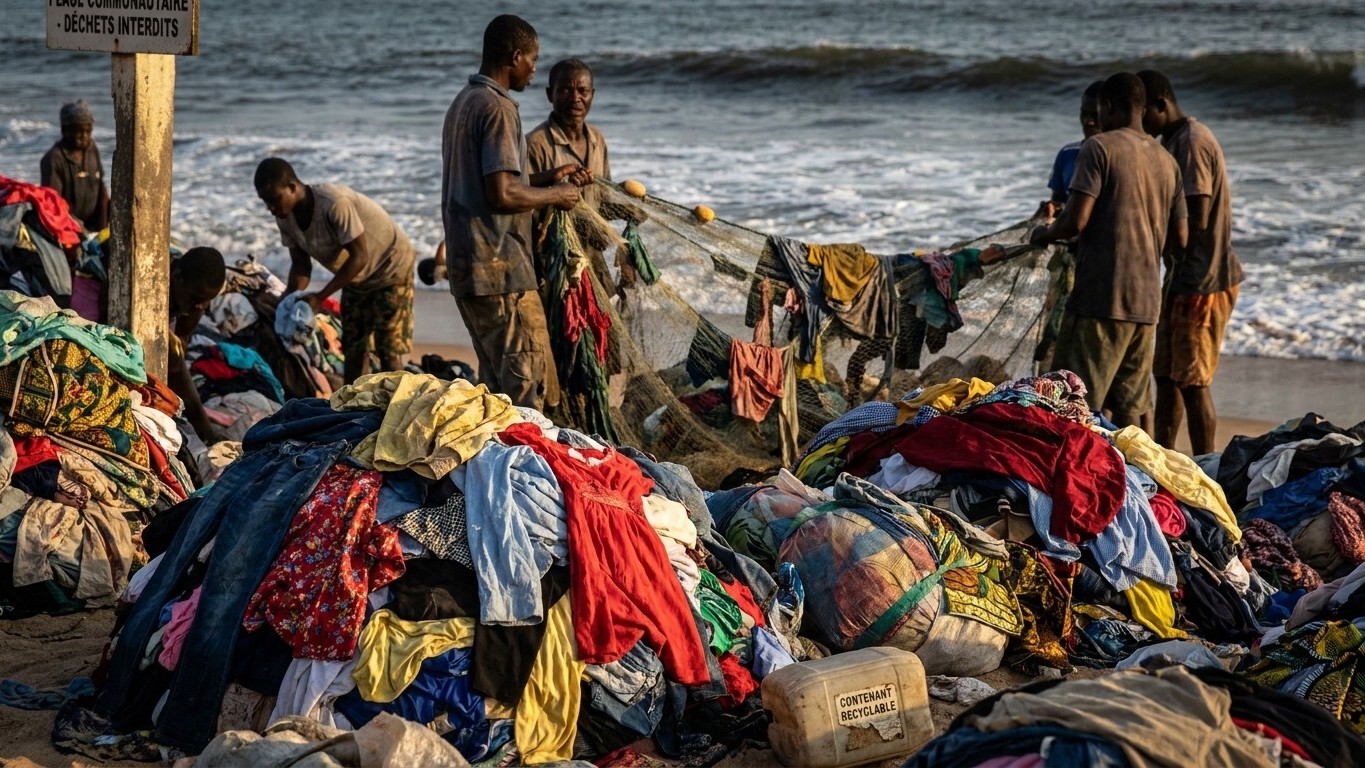
Every Thursday, container ships unload bales of used clothing at the port of Accra, arriving from Europe, North America, and China. The cargo heads to Kantamanto, a market sprawling over more than twenty acres in the heart of the Ghanaian capital’s business district. Kantamanto Market is vast, occupying over 20 acres in central Accra, its stalls dominated by second-hand clothes and footwear from the West and from China. The traders move through a staggering volume of about 15 million garments each week, according to the Or Foundation. An almost incomprehensible amount: it’s as if every resident of Accra were to receive, week after week, six new garments from abroad.
The original intention was not something sinister. In Europe or the United States, people sort through their wardrobes, drop a bag off at a charity, and tell themselves they are giving a second life to an old sweater. Much of this clothing starts as donations in places like Europe and North America. The charities collect the clothes, which are either given to those in need or sold to fund their cause. But these organizations sell only about 10% of what they receive. The remainder goes to export routes, toward the giant markets of West Africa. Kantamanto alone absorbs a large portion of this global flow.
À retenir
- Why do the clothes you donate to a charity end up 5,000 kilometers away from you?
- How can a market absorb 15 million pieces per week without bursting?
- Does the beach really become invisible under imported textiles?
A sorting that sorts nothing
The problem doesn’t arise at the moment of sale. It begins as soon as the bales are opened. About 15 million garments arrive each week in the country, most of them in Kantamanto, and roughly 40% will end up as waste. Of ten garments shipped in the name of recycling, four are unsellable as soon as they come out of the bag. There aren’t enough buyers fast enough, not enough quality, no market for a ripped pair of jeans or a faded T-shirt.
Facing this mountain of rejects, the Accra municipality tries to keep pace. The local council, the Accra Metropolitan Assembly, spends roughly $500,000 annually to collect and dispose of unsellable items from Kantamanto market. But it can process only about 70% of the market’s waste. The remainder is either burned nearby, causing air pollution, or dumped into fragile ecosystems. A substantial budget, absorbed each year, never catching up with the surplus. And when the country’s only sanitary landfill exploded in 2019 under the weight of used clothing, the Kpone Landfill closed after that fire, leaving one of the world’s fastest-growing metropolises without a properly managed dump. Since then, the overflow has nowhere to go, except toward the rivers, gutters, and, ultimately, the sea.
The beach turned into a fabric carpet
On the Korle-Gonno beach, a few kilometers from Kantamanto, fishermen haul in an unusual catch each day. It takes Nii Armah and his crew of 30 fishermen hours to haul their heavy nets to the shore of this busy Accra beach. In the end, their haul reveals a colossal barracuda and an unwelcome catch of discarded clothing bales. The fisherman sums up the situation in one sentence: “Our nets are losing out because of the clothes from the markets,” he says, adding that “the fish are slipping away… our livelihood” with them.
The sand literally disappears beneath the textiles. Field reports describe stretches of coastline where the sand is no longer visible on parts of Accra’s beaches, with piles of textiles and plastics rising more than 1.5 meters high. Walking barefoot on the sand, a banal beach activity, becomes an acrobatic maneuver between drenched sleeves and sodden collars. Two kilometers away, the Old Faduma community literally lives on these waste: once a dynamic and prosperous community, it has become one of the most notorious destinations for illegal dumping of Kantamanto’s textile waste, home to about 80,000 people, many of whom live in houses built on layers of refuse.
The act that yields its opposite
Here is the dizzying paradox. Giving a garment in the West is framed as an ecological act, a way to avoid waste and extend the life of an object rather than discarding it. But scaled to 15 million pieces a week, this virtuous individual deed becomes, collectively, a machine that buries an entire coastline. The aim was to prevent waste; the result, measured in tons along Accra’s beaches, is a buildup of refuse so dense that it physically hinders walking.
The head of waste management in Accra, Solomon Noi, offered a figure that sums up the imbalance more clearly than any long discourse: behind Accra’s waste crisis lies a stark arithmetic since 30 million people live in Ghana, yet 30 million garments arrive every fortnight. A garment imported for every inhabitant of the country, every two weeks. The amount of textile that escapes treatment each week is counted in tens of tons burned in the open air or swept by rainwater into the ocean, a cycle that neither the city’s $500,000 annual budget nor the goodwill of Kantamanto’s sorters can stem.
Sources: fashiondive.com | cnn.com
