
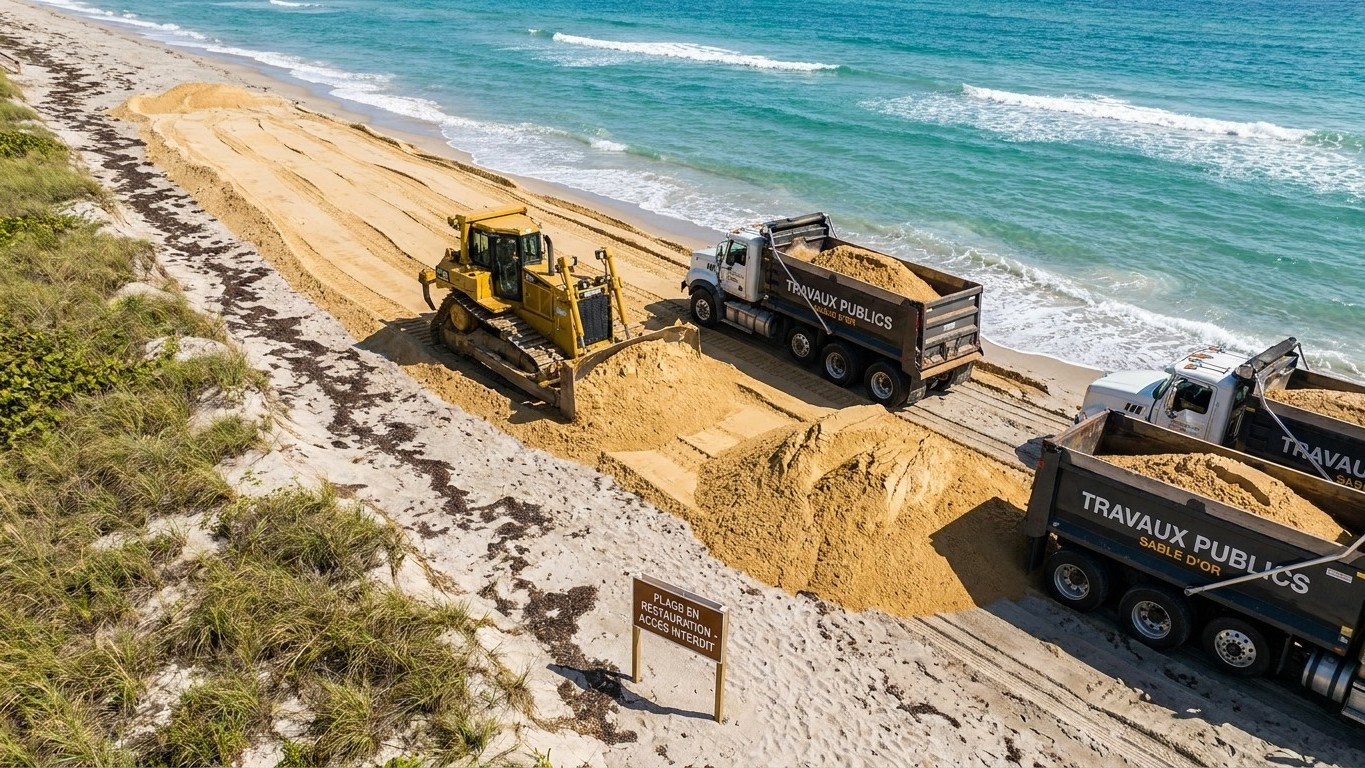
Fifty-one times. That is the number of sand replenishment operations the Miami Beach shoreline has undergone since the 1930s, a figure that spins the head when you realize each campaign mobilizes tens of thousands of trucks. Just in 2022, the US Army Corps of Engineers spent $40 million to move 835,000 cubic meters of sand and restore barely more than three kilometers of coastline. By replenishing Miami Beach 51 times since the 1930s, Florida has literally bought back from the sea 835,000 cubic meters of sand for $40 million, an operation that looks less like a one-off construction site and more like an endless subscription.
Key takeaways
- Why does Miami Beach need sand replenishment every two to three years?
- Where does the sand Florida dumps onto its coastal beaches originate?
- What is the real price of this decade-long battle against the sea at the state level?
A Century-Long Standoff with the Atlantic
It all began in the 1970s, when erosion became so visible that tourism professionals rang the alarm. In 1975, the US Army Corps of Engineers launched a broad replenishment project that strengthened the coastline of Miami Beach but also those of Sunny Isles, Bal Harbour, Surfside and Key Biscayne, by dredging sand near the offshore bars and depositing about 30 million cubic meters along the Dade coast, creating a beach about 90 meters wide. Miami Beach was the main beneficiary of the operation, with nearly 14 million cubic meters dumped along its six kilometers of shoreline, at a total cost of $80 million. Since then, the engineering corps have returned regularly, project after project, as if topping up a car that leaks.
Recent figures quantify the phenomenon. In February 2022, a project stretching over more than 16 kilometers of beach required 830,000 cubic meters of sand for a project costing $40.5 million, one of the largest of the decade according to local authorities. A little earlier, in 2020, a more modest operation had already mobilized $16 million to deposit 233,000 cubic meters of sand on eroded areas of Miami Beach, a project initially designed to repair Irma’s damage. The mechanism is always the same: we replenish, the sea takes back, we start again.
Sand Imported from Inland Areas
The sand is no longer offshore. Since nearby reserves have been exhausted, Miami Beach must source sand trucked in from central Florida, a region where several quarries operate an ancient coastal deposit called the Cypresshead Formation, which extends west of Lake Okeechobee toward Jacksonville. Concretely, this means whole convoys crossing the state before rolling along Collins Avenue and dumping about a dozen cubic meters of sand at a time onto the eroding beach.
This dependency has a price, and it is rising. The budget for the 2022 operation comes to just under $50 per cubic meter of sand, a rate once unimaginable for this type of restoration. Karyn Erickson, president of an engineering firm based in Sarasota that has worked on these projects for years, sums up the situation bluntly: “For sand, you now spend $30 to $50 per cubic meter.” On the statewide scale, the bill is colossal: Florida has spent at least $1.9 billion over 87 years of beach replenishment, according to the national database on the subject, and today the state allocates between $30 and $50 million per year to the maintenance of its beaches, a sum equally borne by local municipalities.
Buying Time, Not the Physics
The paradox is that this money does not solve the underlying issue. Robert Young, who heads a coastal engineering research program at Western Carolina University, points to a core contradiction: beach replenishment buys time, but does not change the physics of the coastline. Each new operation starts on a shore more fragile than the previous one; the sand returns to the beach but the ocean continues to rise, advance, and take back part of the material. In other words, the 52nd operation is already planned, without a precise date, but with an almost mathematical certainty.
The economic logic is also questioned. A large portion of these projects is funded by federal taxes paid by taxpayers living sometimes far from the coast, while the benefits concentrate in high-value real estate areas like Miami Beach or Palm Beach, where hotels, condominiums and tourist complexes benefit from protection largely financed by public funds. And Palm Beach is not left out: this neighboring city, which has already received more artificial sand than any other American city, is also at its 51st replenishment, proof that the phenomenon is not limited to a single stretch of coastline.
A Model to Compare, a Choice to Make
Taken in isolation, these figures might almost seem trivial in the face of the tourist profits. The taxes generated each year by beach-going tourists in the United States amount to $36 billion, more than four times the total spent on replenishment over a century, from 1923 to 2022. Hard to call the operation pure waste under such conditions. But the comparison with the Netherlands puts the timing back on track: the Dutch program deposits about 12 million cubic meters of sand per year, without trying to maintain a precise beach in front of a specific address, but by preserving the entire coastline as an integrated system. In Miami, repairs are done bite by bite, beach by beach, storm after storm. In the Netherlands, the coastline is thought of at the national scale and over multiple decades. Two philosophies, the same sand slipping through fingers.
Sources: miamidade.gov | harris.house.gov | en.clickpetroleoegas.com.br
