
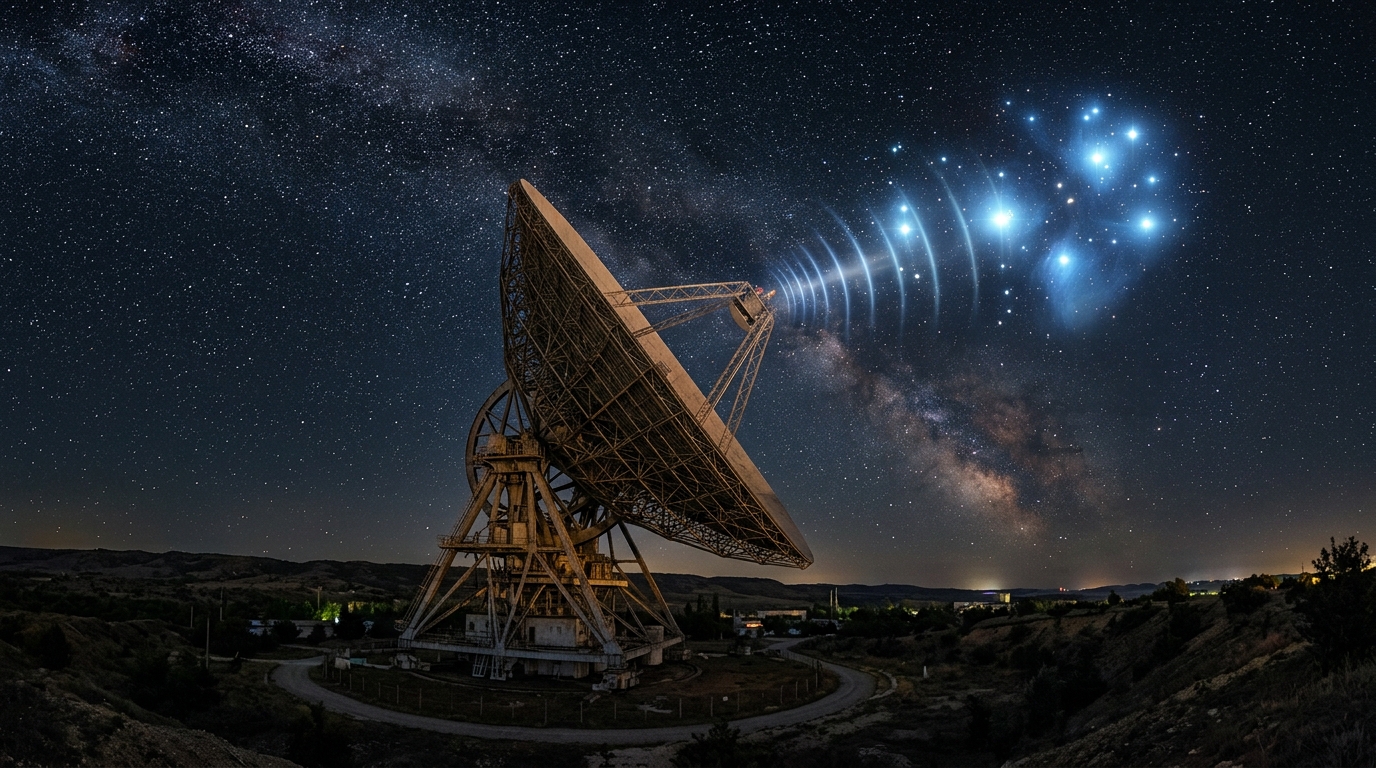
Imagine a letter mailed more than a quarter of a century ago, continuing its journey without ever faltering, and whose recipient may read it only in several decades, or perhaps never. This is precisely what has been unfolding in the interstellar void since 1999, where radio waves race at the speed of light toward nine carefully chosen stars. Neither the distance, nor the passage of time, nor even the lack of certainty regarding the existence of a potential reader has interrupted this cosmic missive. While the search for extraterrestrial life is often associated with passive listening to the sky, this story tells the opposite: that of a team that decided, one day, to take the initiative and send the first message.
- In 1999, the Soviet-era Evpatoria RT-70 radio telescope, located in Crimea, transmitted Cosmic Call messages toward nine stars deemed potentially habitable.
- The message relies on a universal language based on mathematics and physics, including binary representations, diagrams of our solar system, and information about human biology.
- Depending on the distance to each targeted star, the signals should reach them between 2036 and 2070, with no guarantee that any reply will ever be received.
- The Evpatoria RT-70, a Soviet antenna repurposed as a galactic messenger
- Cosmic Call, the content of a message designed for complete strangers
- Nine Stars, nine rendezvous spread out to 2070
- Waiting for a reply that may never arrive, the bold wager of Cosmic Call
The Evpatoria RT-70, a Soviet Antenna Recast as a Galactic Messenger
Located in Crimea, the RT-70 of Evpatoria is a monumental radio telescope 70 meters in diameter, originally built for Soviet military and scientific needs. After the collapse of the USSR, this colossal antenna could have faded into obscurity, like many Cold War infrastructures. But in 1999, it found an unexpected second life: that of a transmitter for one of the boldest interstellar communication projects ever attempted.
It is in this particular context, blending Cold War technology with forward-looking ambitions, that the Cosmic Call program came to life. The idea: to harness the power of this antenna to send radio signals toward star systems deemed hospitable to life, in the hope, however faint, that an extraterrestrial civilization might one day catch and decode them.
Cosmic Call, the content of a message designed for complete strangers
Crafting a message meant for beings about whom we know nothing—their language, their culture, even their biology—presents a vertiginous challenge. The designers of Cosmic Call thus bet on a universal language: mathematics and physics. The message includes binary representations, diagrams illustrating our solar system, as well as information about human biology and the structure of our planet.
The goal was not simply to say hello, but to convey a coherent image of who we are and where we come from, relying on scientific concepts presumed to be understandable by any civilization advanced enough to detect a radio signal. An intellectually fascinating wager, where every symbol had to make sense without a single word being spoken.
Nine Stars, Nine Rendezvous Spread Out to 2070
What makes this story especially captivating is the near-surgical precision of the ensuing cosmic timetable. The signals were directed toward nine stars at varying distances from Earth, some nearer, others much farther away. Result: the theoretical arrival dates span from 2036 to 2070, depending on how far each beam had to travel.
Practically speaking, this means that the first targeted stars will receive the message while children born today will have just entered their thirties, while the last will be reached only after nearly a century since the initial transmission. A timescale that far exceeds our usual human horizon and humbles us by reminding how the universe runs on clocks very different from ours.
Waiting for a Reply That Might Never Arrive: the Bold Gamble of Cosmic Call
The most troubling aspect of this venture is perhaps the complete absence of any guarantee. There is no proof that these stars host inhabited planets, nor that any potential inhabitants would possess the technical means to capture a radio signal from a distant solar system. And even if the message were received, it would have to be interpreted correctly, and a reply would have to be sent, which would lengthen the delay by several more decades.
Despite this dizzying uncertainty, the Cosmic Call project retains a strong symbolic value. It embodies the human will to reach out toward the unknown, without expecting an immediate return, somewhat like the Voyager probes that continue their silent journey to the far reaches of the solar system. As we enter this season of renewed space exploration, it is worth remembering that some messages, themselves, carry on patiently for far longer than most people imagine.
This story deftly blends Soviet technological heritage, universal scientific ambition, and patience on a cosmic scale. The Evpatoria RT-70 continues to embody this peculiar paradox: an aging infrastructure that becomes the starting point of a message that will traverse generations before reaching its destination. So, will these signals ever find an attentive ear somewhere in the galaxy, or will they remain forever the silent echoes of a simple human attempt? Time, at its own distinct pace, will tell.
