
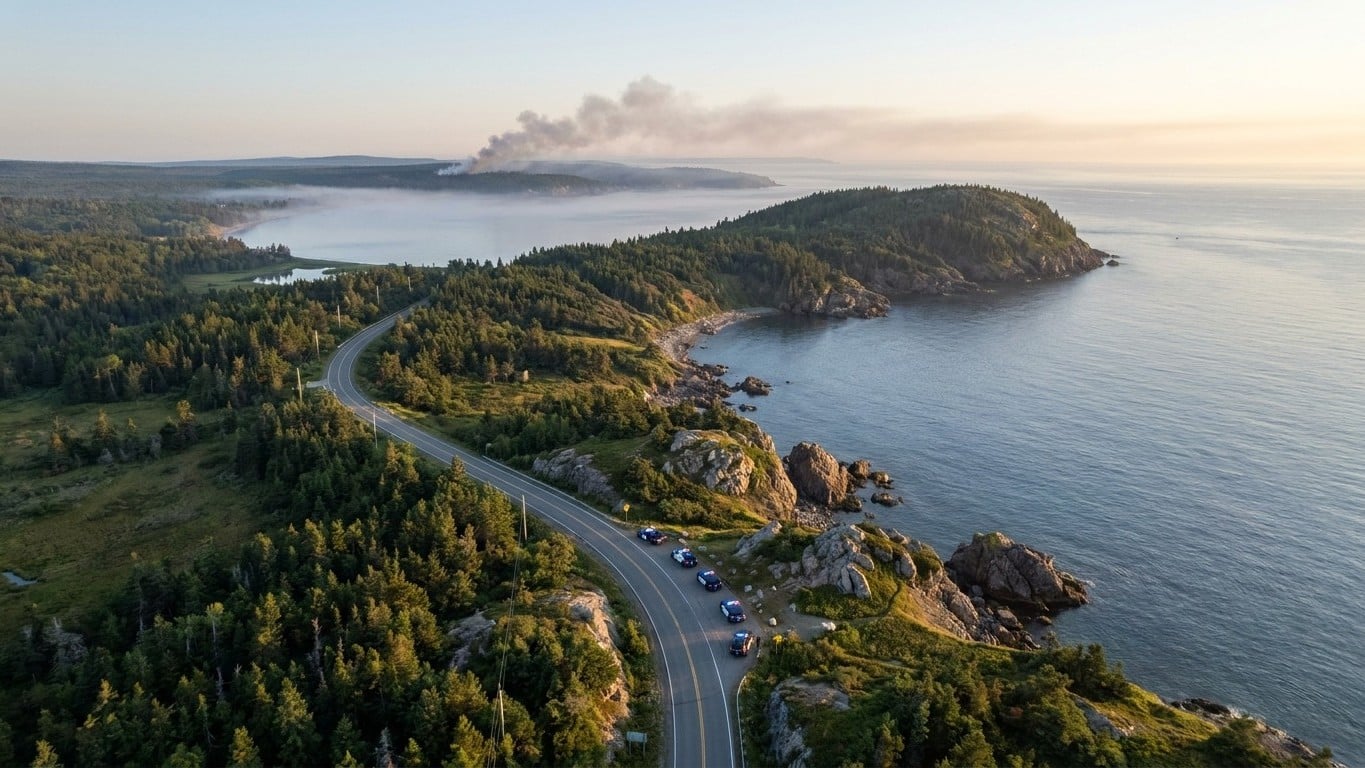
Three o’clock in the morning, Friday, July 24, 2026. Phones buzz all along the Cap-Ferret peninsula with that unmistakable alert tone that Bassin d’Arcachon residents will not forget anytime soon. A FR-Alert message, terse and unequivocal, orders immediate evacuation, by road or by sea, after the prefecture activated this system to command evacuations of all the villages on the peninsula. Five days later, the toll comes in: 220,000 people displaced, a figure France had not seen since the end of World War II.
This fire already ranks among the largest on record in France since World War II, with damages surpassing anything the region has endured in recent years. By 4 a.m. on Sunday, July 26, the burned area was estimated at 42,000 hectares, according to the Gironde prefecture. An area that nearly equals Paris intra-muros multiplied by four. The material toll grows as firefighters reach the damaged zones: at least 240 homes destroyed according to the prefecture, the commune of Le Porge being the hardest hit. In this single commune, around 170 houses were affected, a figure confirmed by a local official to AFP. And the fire did not stop at the gates of the metropolis: the massive blaze lay only 15 kilometers from Bordeaux, with authorities not contemplating evacuating the city itself.
Key takeaways
- Could a massive evacuation really have been organized without panic in less than a week?
- How did a region sidestep its own logistical bottlenecks?
- Which technological tool proved decisive in avoiding highway chaos?
A three-speed logistics: road, rail, sea
Moving the equivalent of Rennes’s population in five days does not happen by accident. The system was built in successive waves, as the flames advanced. It all started on Wednesday in Saumos, north of the Basin, before spreading methodically. With the overnight evacuation of additional municipalities located southeast of the Basin or near the metropolis, such as Marcheprime, Le Barp, Biganos, Mios and Cestas, i.e., 55,000 more people, the total reached 220,000 evacuees in Gironde, a figure described by several media outlets as one of the largest evacuations ever organized in France following fires.
The road network paid a heavy price. The A63 motorway between Bordeaux and Spain was closed for 60 kilometers, a major traffic artery between northern Europe and the Iberian Peninsula, effectively cutting off freight and holiday traffic in the height of summer. Rail was not spared either: rail traffic was interrupted south of Bordeaux, toward Arcachon and as far as Morcenx heading toward Dax and Mont-de-Marsan, according to SNCF. Facing this terrestrial paralysis, the state mobilized a massive manpower surge: 1,500 soldiers were mobilized from Saturday evening, an assembly rarely seen for a civil-security operation on the mainland.
The Cap-Ferret, the hotspot announced
There was one detail everyone knew, but no one had tested at scale. D106 is the only road that leads to the Cap-Ferret tip, and in case of danger it might not be enough if evacuation of all residents were required. This problem is not new: it had already been highlighted during the 2022 fires, prompting authorities to develop the following year a maritime evacuation plan with the help of boatmen. This plan, never activated until Friday, July 24, finally came off the shelf.
This jewel of the Arcachon basin, especially beloved by tourists, hosts dozens of villages and ten times more individual houses, all accessible by this single road to the mainland. It was impossible, under these conditions, to evacuate everyone by land alone without creating a monstrous traffic jam at the exact moment when every minute counted. The solution: an improvised maritime bridge. Between Cap-Ferret and Arcachon, over 400 people arrived by boat at the Arcachon jetty, after the prefecture ordered an evacuation of residents by both road and sea. Shuttles were dispatched from several jetties around the peninsula, turning a marina into a maritime crisis hub in a matter of hours. The plan originally intended to evacuate between 10,000 and 14,000 people in less than 24 hours if necessary by this route.
FR-Alert, the tool that averted panic
Without this system of alert by cellular networks, the story could have spiraled into chaos. FR-Alert is not triggered automatically by the fire itself; it is a crisis-management tool activated by humans, which sends concrete directives: evacuate, shelter in place, avoid a route, follow a specific itinerary. Its strength lies in its granularity. The alert can be disseminated by successive zones rather than a single wave across an entire territory, which limits traffic jams and saturation of road axes, exactly what allowed the Cap-Ferret peninsula to evacuate in a calm and orderly fashion. A technical detail that changes everything: the system sends a notification and a specific audible signal, even if the phone is in silent mode.
To gauge the scale of the Gironde operation, one must go far back into national history. The only comparable precedents in France are the Strasbourg evacuation in 1939, about 120,000 people displaced ahead of the conflict, and the exodus of 1940, eight to ten million on the roads, but in total chaos, with no state organization. On the international stage in peacetime, the references remain Chernobyl in 1986 with 350,000 people evacuated in the Soviet Union, Fukushima in 2011 with 154,000 displaced, or Hurricane Katrina in 2005 and its 1.2 million evacuees in Louisiana. In recent France, the AZF explosion in Toulouse in 2001 mobilized around 25,000 people, and the 2022 Gironde fires had already forced the displacement of about 36,000 residents, a figure that 2026 has multiplied by six in five days alone. A question that firefighters and prefects are already quietly asking themselves: what would have happened if the wind had shifted ten degrees toward Bordeaux?
Sources: aquitaineonline.com | france3-regions.franceinfo.fr
