
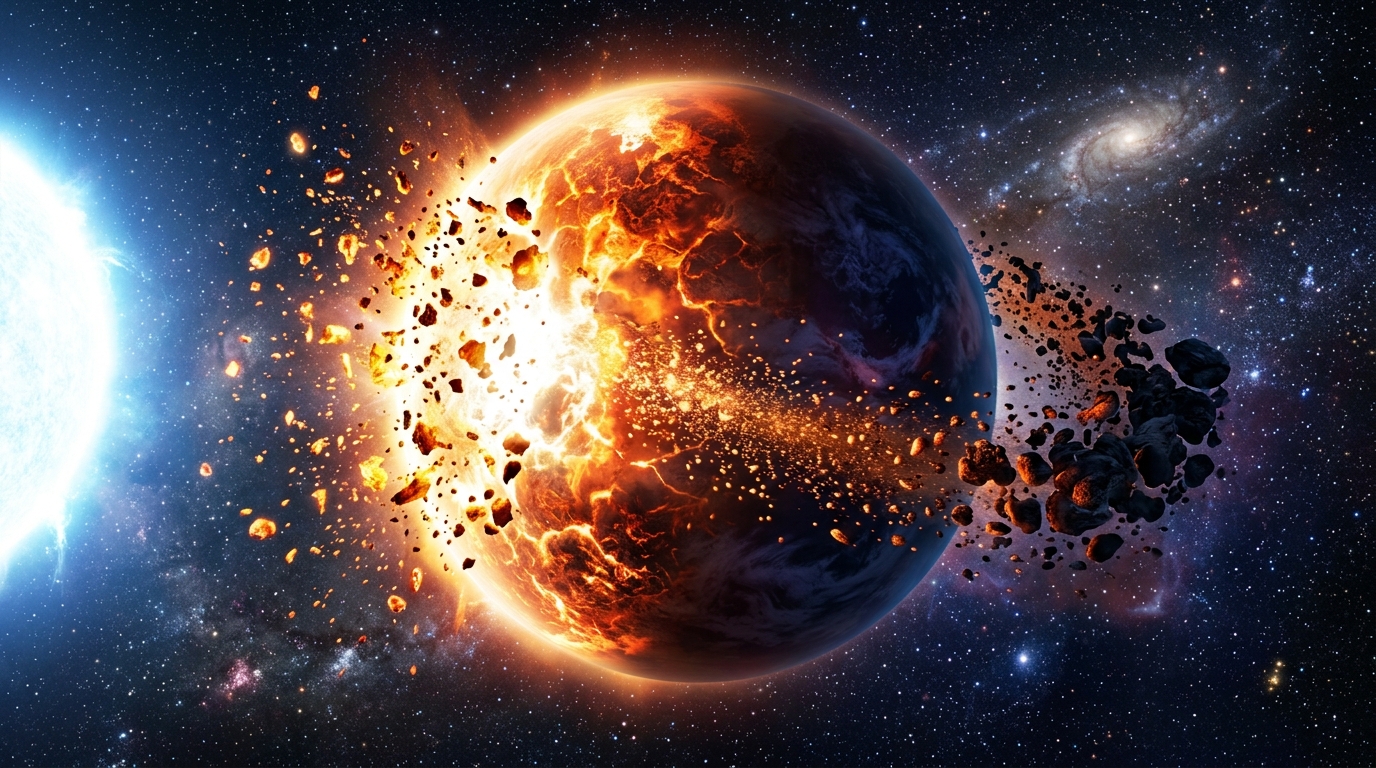
Imagine a pane of glass melting under the noonday sun, only to re-solidify again each night, over and over, in an endless loop. That is roughly what happens, on an atomic scale, on an exoplanet spotted at 670 light-years from us. There, it isn’t glass that breaks and reforms, but hydrogen molecules, subjected to heat so extreme that it surpasses the temperatures of some stars. A phenomenon that, when you take the time to understand it, offers a rather dizzying glimpse of what the universe is capable of producing in terms of extremes.
- KELT-9b, an exoplanet located 670 light-years away, reaches about 4 300 °C on its dayside, triggering the thermal dissociation of molecular hydrogen during the day and its recombination at night
- Tidally locked around a blue-white, hotter and more massive star than the Sun, KELT-9b completes a full orbit in just 36 hours
- Astronomers detected this cycle of molecular destruction and reassembly through spectroscopy, by analyzing the light filtered by the planet’s atmosphere as it passed in front of its star
- A planet so hot it defies the laws of chemistry
- An extraordinary host star that explains everything
- How astronomers cracked this atmospheric mystery
- What KELT-9b teaches us about extreme worlds
A planet so hot it defies the laws of chemistry
On this exoplanet named KELT-9b, the dayside climbs to around 4 300 °C, a temperature worthy of a red dwarf rather than a planet. In these conditions, molecular hydrogen, that well-known H2 found throughout the universe and typically renowned for its remarkable stability, simply cannot hold together. It literally dissociates, its atoms tearing apart under heat so intense that it is hard to imagine on human scales.
This process, which specialists call thermal dissociation, transforms the planet’s atmosphere into a chemical state rarely observed elsewhere. It’s a bit like watching, in real time, the destruction of a fundamental building block of matter, simply because the ambient temperature becomes intolerable. But the story does not end there: on the night side, the atmosphere cools enough for these same atoms to recombine, giving birth to molecular hydrogen once again. Then, a few hours later, on the day side, the cycle restarts, relentlessly.
An extraordinary host star that explains everything
To understand why KELT-9b reaches such wild temperatures, one must look at its star. It is blue-white, significantly more massive and hotter than our Sun. This extreme closeness between the planet and its star is the key to the puzzle: the closer a planet sits to such an energetic stellar source, the more radiation it absorbs in colossal quantities.
Another dizzying detail: KELT-9b completes a full orbit around its star in just 36 hours. An astonishing orbital speed that keeps it gravitationally locked, somewhat like our Moon in relation to the Earth. Concretely, this means that one face of the planet remains forever turned toward its star, while the other lies in perpetual darkness. This thermal imbalance between the two hemispheres is not merely an aesthetic detail: it is precisely what fuels the famous cycle of destruction and reconstruction of hydrogen observed by astronomers.
How astronomers cracked this atmospheric mystery
Detecting such a phenomenon at hundreds of light-years distance is a real technical tour de force. To achieve it, researchers relied on s spectroscopy, a technique that involves analyzing the light filtered by the planet’s atmosphere as it passes in front of its star. By breaking down this light, in a manner similar to using a prism, it becomes possible to identify the chemical signatures of the molecules present, without ever needing to get physically close to the exoplanet.
This method revealed spectral variations indicating the presence or absence of hydrogen molecules depending on the observed regions. Data gathered with several instruments thus confirmed this cyclic dissociation, a result that would have seemed utterly inaccessible just a few decades ago. It is a fine example of how technological advances today allow us to probe worlds we will probably never visit.
What KELT-9b teaches us about extreme worlds
KELT-9b belongs to a category of planets still poorly understood—the ultra-hot Jupiters, these giant gas planets hugging their star so closely that they endure temperatures rivaling those of stars themselves. Far from being merely a curiosity, this exoplanet pushes the boundaries of what was thought possible for a celestial body, forcing scientists to rethink parts of their theoretical models.
Studying this kind of object helps to better grasp the diversity, sometimes bewildering, of planetary systems that populate our galaxy. Every new observation further refines our understanding of the formation and evolution of exoplanets, including those that bear no resemblance to our own corner of the solar system. Between its record temperature, its ultrafast orbit, and its atmospheric chemistry worthy of an open-air laboratory, KELT-9b stands as a genuine teaching case for anyone interested in the frontiers of our galaxy.
Difficult, as this dossier closes, not to feel a slight vertigo at the scale of what space may conceal. KELT-9b reminds us that just a few hundred light-years away from our screens and our daily lives, entire worlds burn and rebuild themselves daily, without witnesses, without rest. So, how many other ultra-hot giants, just as extreme, await discovery by the next generation of observation instruments?
