
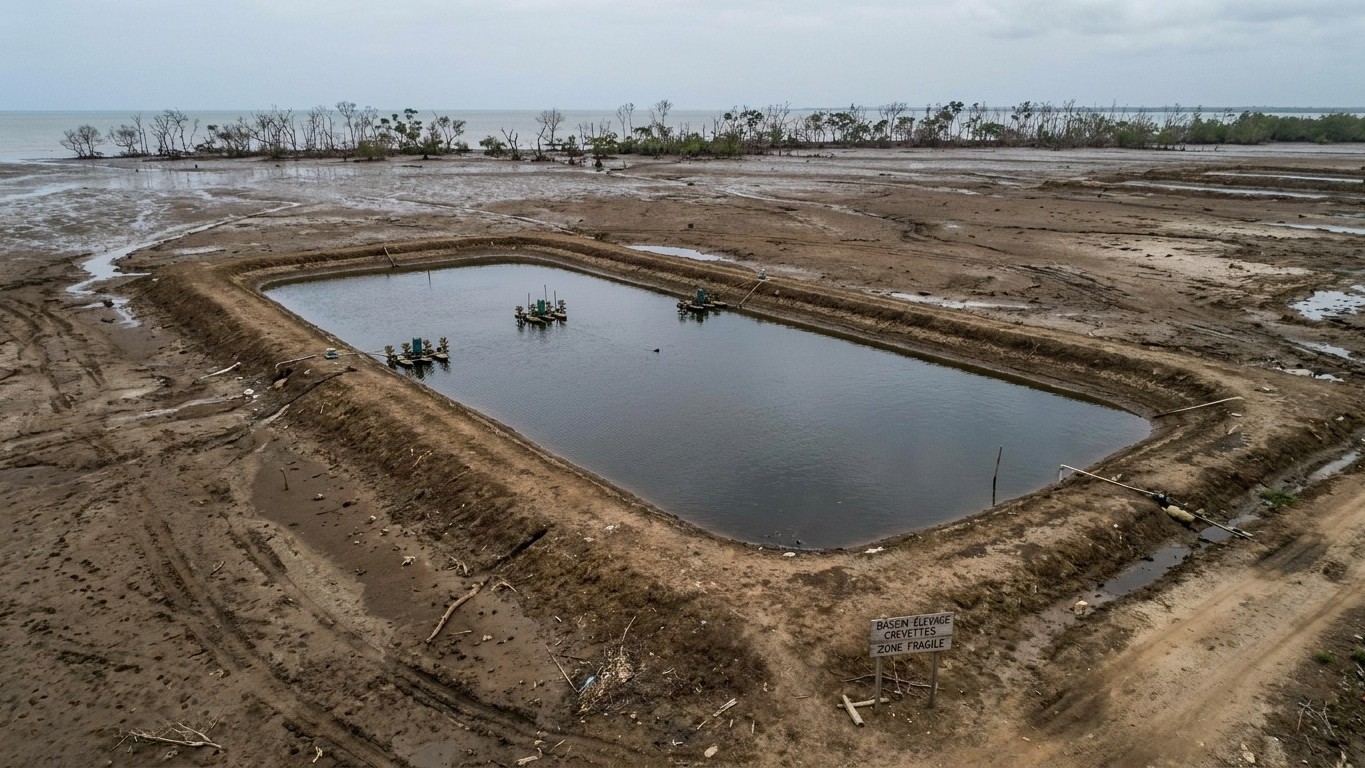
In Indonesia, a fishing village now watches over a mosaic of shrinking ponds, gnawed at year after year by a sea that nothing can stop. The assessment is simple and brutal: by leveling their mangroves to dig shrimp ponds, several tropical countries have removed the only barrier capable of protecting these same waters from storms. The irony is total, but it carries a price, measurable in lost hectares and houses swallowed by the waves.
Key takeaways
- Why thousands of hectares of mangroves disappeared in a few decades in Indonesia, Thailand, and Java
- How a stilted house was struck by a two-meter wave that no one had ever seen
- The paradox: restoring mangroves would boost shrimp production by 19%
A green shield sacrificed for immediate yield
Mangroves are not merely tropical scenery. These forests of mangrove trees, with their tangled roots plunging into the mud, serve as natural shock absorbers: they break the swell, slow the waves, and trap sediments that build the coastline. Mangroves dampen waves and storm surges thanks to their intertwined roots, reducing erosion and flood heights by up to 75% while trapping sediments to construct land against rising seas. A strip of about a hundred meters is enough to absorb a large portion of a storm’s destructive energy.
It is precisely this protective belt that aquaculture cleared on a large scale. Coastal development accounts for 40% of mangrove loss, while aquaculture takes 35%, with shrimp and fish farms wiping out mangroves to create ponds, even though one hectare of mangroves yields ten times more marine wealth than an intensive farm. In Indonesia, the shift began after the ban on bottom trawling in 1980: the move toward shrimp farming was propelled by government support, global market demand, and the prohibition of destructive trawl nets, shrimp becoming a lucrative alternative that pushed many coastal farmers to convert large mangrove areas into ponds. The calculation seemed flawless on paper: export earnings, jobs created within a few months. Few, or almost none, anticipated the bill that would follow.
The sea takes back what was torn from it
In the Mahakam River delta in Borneo, the scene shifted in a few decades. In the 1980s, shrimp ponds began replacing mangroves, and by 2020 about half of the delta’s forests had vanished due to weak regulatory oversight, increasing the area’s vulnerability to climate change. The consequence did not take long to manifest. A regional shrimp operator recalls a night in April when water surged onto the stilts of his house: “the wave was so strong it rose two meters above my house,” a phenomenon he had never experienced during a lifetime spent there.
The tangible numbers of this erosion are dizzying. The shrimp pond of this same operator shrank from ten hectares in the 1990s to four hectares today, and a cemetery once on that land is now submerged, erosion having swallowed both productive land and a portion of the community’s history. On Java Island, the scenario repeats almost identically: a Mangunharjo village resident recalls that within a few years, “coastal erosion destroyed the beaches and the livelihoods” of her hometown.
Thailand illustrates the same reversal on a broader scale. The clearing linked to shrimp aquaculture has halved the country’s mangrove cover since the 1960s, exposing the coasts to harsher erosion. The economic toll spared no one: mangrove losses have doubled flood risks and halved fishing, directly affecting families who depended on this resource even before the arrival of the farming ponds.
Replanting what we destroyed, still an uncertain bet
Facing this reality, several governments launched reforestation programs. The results have not always lived up to the ambitions proclaimed. In Indonesia, a major reforestation project announced as early as 2000 did not achieve the expected results, and according to experts consulted by researchers, faulty methods and limited practical support explain the program’s failure, which worsened the communities’ vulnerability to natural hazards such as erosion and inundation.
Other paths are beginning to bear fruit, notably by directly tying shrimp farmers to restoration efforts. In Ecuador as in Indonesia, Conservation International works with shrimp producers to increase production on part of their land while restoring mangroves on the rest. A more mature model still rests on a strict division of surfaces: 50 to 80% of the area is allocated to mangrove restoration and the remaining 20 to 50% is kept for shrimp farming, this separation allowing the two components to function independently while supporting natural regeneration and maintaining yields.
The most compelling argument to win over operators may be the most down-to-earth: mangroves protect their own investment. Restoring dense mangroves in all areas within a 100-meter radius of the ponds would raise total shrimp production by about 19%. This figure changes the game: it is no longer simply a matter of abstract conservation, but direct profitability for the person who digs the pond. Mangroves have never ceased to be the aquaculture’s best ally; it took destructive storms and submerged cemeteries for some to remember.
Sources : pacte-climat.eu | link.springer.com
