
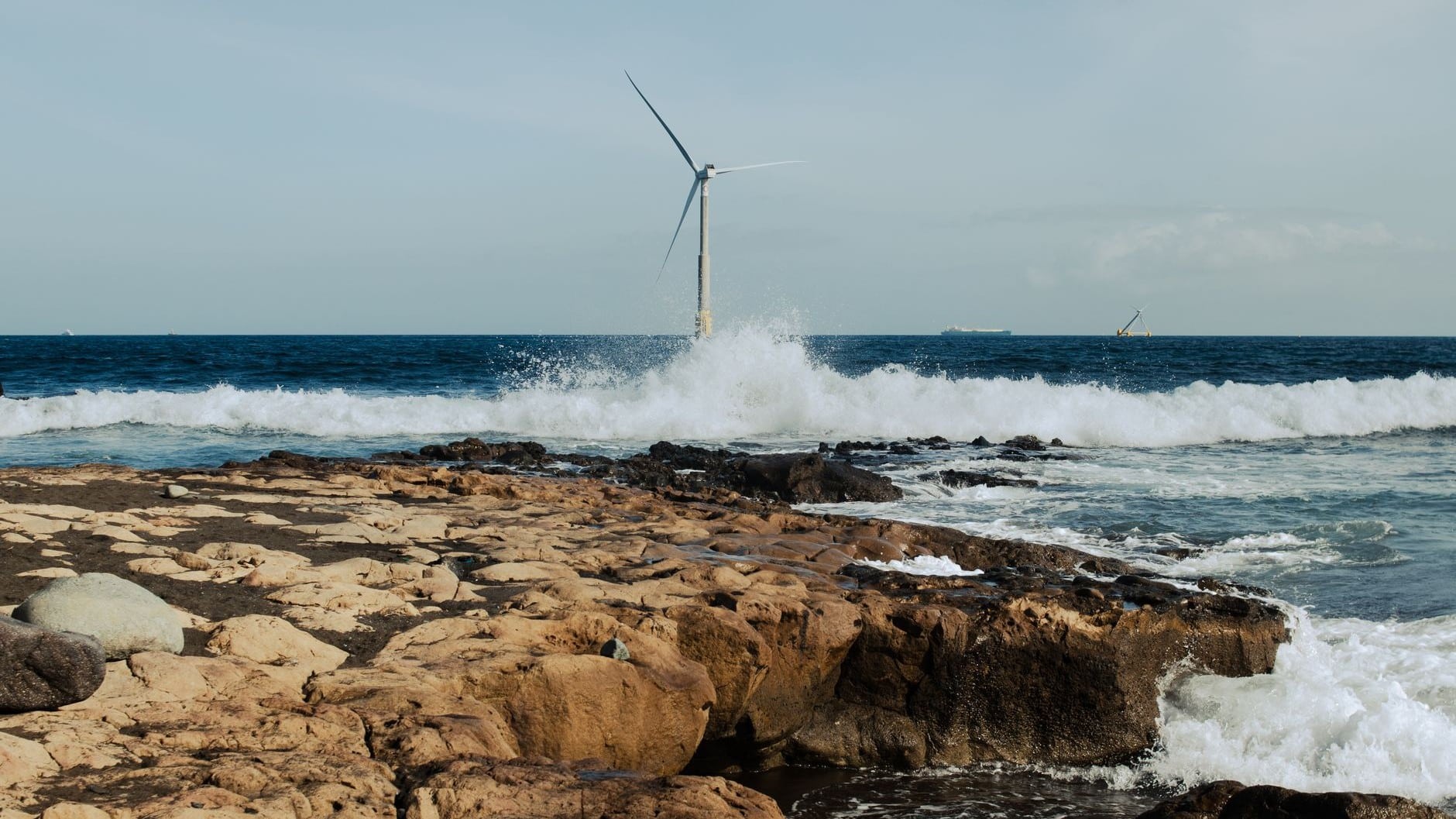
Two turbines weighing several hundred tons each, laid in 35 to 40 meters of water off the island of Bréhat, connected to the shore by a fifteen-kilometer submarine cable: that is what lay motionless in one of Europe’s most powerful tidal streams, while the company meant to take care of it had simply ceased to exist. The Paimpol-Bréhat site, in the Côtes-d’Armor, was meant to embody the future of French tidal energy. It became, in a few years, the symbol of an industrial fiasco paid for with tens of millions of euros of public money.
Key takeaways
- Two giant undersea machines that were meant to revolutionize French energy have vanished from the radar
- The project consumed 70 million euros of public money for zero commercial production
- While France gave up, a neighboring country became the undisputed world leader of this technology
A technological gamble launched with fanfare
It all began in 2008, when EDF began the first studies on this site chosen for its exceptional currents. The Paimpol-Bréhat complex was an hydro-turbine farm created in 2008, managed by EDF, and became the first farm, in France and in the world, of tidal turbines connected to the national electricity distribution grid. The technology chosen came from an Irish company, OpenHydro, which had been acquired in the meantime by the French naval group DCNS, which later became Naval Group and then Naval Energies.
After years of delays and prototypes tested in Brest’s harbor, the real kickoff occurred in 2016. In February 2016, EDF placed at 40 meters beneath the sea, off the Bréhat archipelago, a first turbine weighing 300 tonnes with a 16-meter diameter, mounted on a 900-ton base to withstand the currents, before a second turbine of the same size joined it in May 2016 at a depth of 35 meters. A 900-ton concrete base to support a 300-ton turbine: the engineering on display showed the scale of the project’s ambition. EDF made available to the turbine drivers its expertise in marine renewable energies and its interconnection infrastructures, including a 15-kilometer submarine cable equipped with optical fiber to monitor the operation remotely. The launch went ahead under the eyes of the ecology minister at the time, Ségolène Royal, and the leaders of DCNS. They promised to power thousands of Breton households with the sheer force of the tides.
The rust brought down the ambitions in a matter of months
The dream faltered almost immediately. Corrosion issues appeared on a key component of the turbines, and the two machines had to be pulled out of the water barely more than a year after their immersion. They were taken out in April 2017 due to corrosion problems. A bitter irony for devices expected to withstand decades of sea assault. In November 2017, EDF and Naval Energies threw in the towel: the lessons learned from the construction, immersion, and testing of the OpenHydro tidal turbines at the Paimpol-Bréhat experimental site led to closing this important development phase. Since 2011, the date of the first turbine being submerged, the site would never generate electricity commercially.
The next chapter was even more brutal. In July 2018, Naval Energies unilaterally decided to halt all its investments in tidal energy. After pressuring Bpifrance to take 36% of Naval Energies’ capital and inaugurating a tidal turbine assembly plant in Cherbourg, Naval Group unilaterally decided that marine current energy did not have an industrial future, and placed OpenHydro, in which it had invested more than 200 million euros, into liquidation. The fall was dizzying: the company went into liquidation with debts of around 280 million euros. The Cherbourg plant, opened in June 2018, shut its doors barely a month and a half later. The concrete result for Paimpol-Bréhat was: no manufacturer backing the machines anymore, no maintenance budget, an experimental site without an operator for a technology its own maker had just abandoned.
A hefty bill, and a widening gap with the British
How much did all of this cost taxpayers? The mayor of Paimpol at the time, discovering the halt of the project without consultation, pulls out his calculator. He notes that EDF was to install five hydro turbines on the test site for an estimated 28 million euros, and points out that the testing of the two submerged turbines ultimately cost 70 million euros, heavily subsidized notably by the Brittany Regional Council. Seventy million euros, funded in part by regional and European public money, for two machines that never sustainably powered even a single Breton home.
While France was on its knees, the United Kingdom persisted. On the MeyGen site in Scotland, the operator continued adding turbines year after year. By September 2024, MeyGen had produced 66 GWh of energy, more than all other tidal energy sites in the world combined, making it the world’s number one tidal energy site. Between 2018 and 2023 alone, MeyGen had generated more than 51 GWh of electricity between March 2018 and March 2023. Same current, same physical principle, two opposite industrial trajectories: on one side a country that maintained its financial support for the sector despite technical setbacks, on the other a France that unplugged at the first serious setback.
The topic is not entirely buried on the French side. As part of the 2026-2035 multiannual programming, the state plans to launch a first 250 MW tidal energy auction around Raz-Blanchard, with the aim of awarding contracts by 2030. This could relaunch, nearly ten years after the Bréhat fiasco, a sector that France technically had the means to dominate.
The Paimpol-Bréhat site, for its part, did not remain abandoned forever: the underwater infrastructures were reused to test other technologies. A new testing campaign began in April 2019 with the immersion at 35 meters depth of the HQ-OCEAN tidal turbine designed by the French start-up HydroQuest, which fed its first kWh into the grid in June 2019. This next-generation prototype, tested for two years, achieved a 90% availability rate by the end of the experiment, proof that Bréhat’s current had not finished serving, even after the industrial shipwreck that swallowed the first turbines and the public money that went with it.
Sources : usinenouvelle.com | edf.fr
