
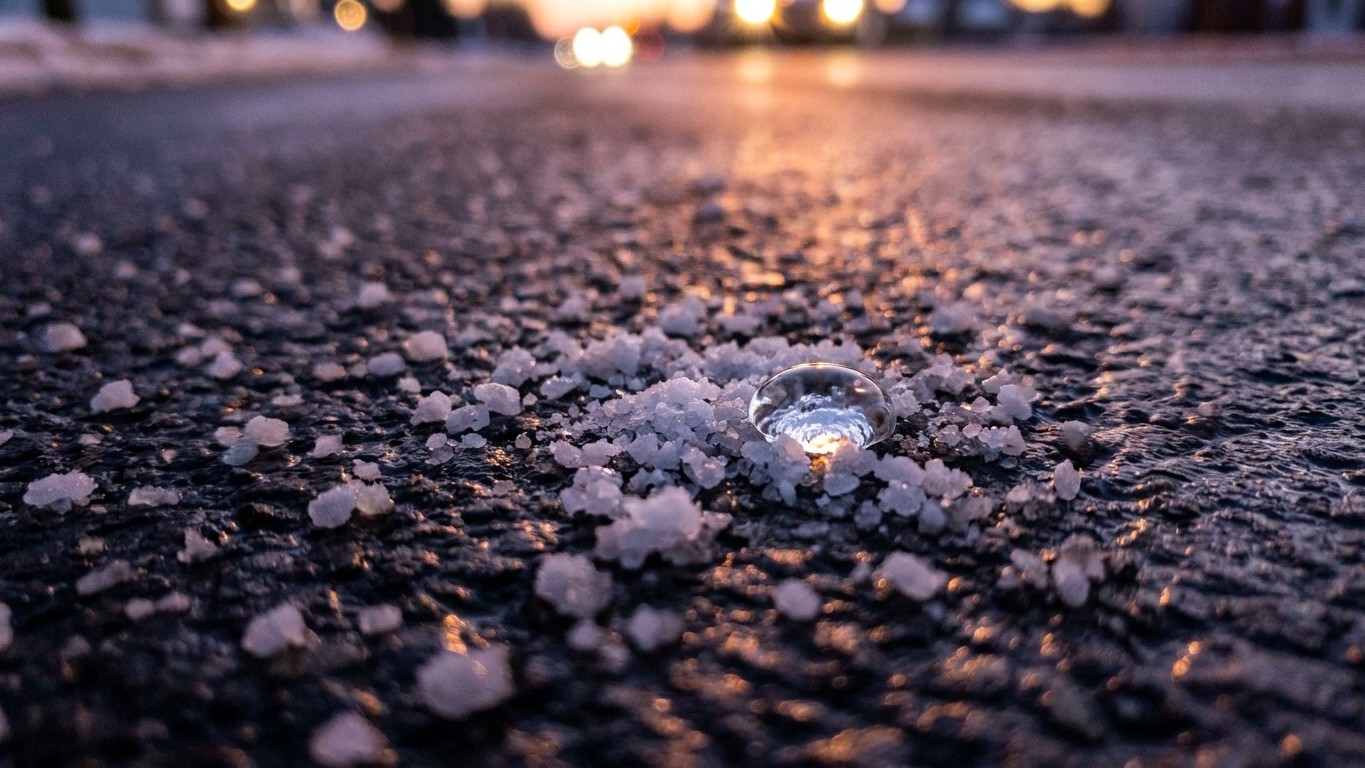
Each winter, tons of sodium chloride cover the road surfaces to prevent ice from forming and to allow motorists to travel safely. But once the snow melts, the salt does not evaporate: it runs off into ditches, seeps into groundwater, and eventually reaches rivers and lakes. What rises in these waterways is not a deposit of residual snow nor spread sand: these are chlorides, those dissolved ions that permanently alter the chemistry of fresh water.
Key takeaways
- Road salt does not evaporate with snow: it runs off into waterways and seeps into groundwater for months, or even years
- In Chicago, road salt inputs rose 33% over 30 years, but chloride loads in rivers rose 60%—why this gap?
- Urban lakes show chloride concentrations up to 43% above the official toxic threshold, creating oxygen-deprived dead zones in deep water
A safety measure that becomes an environmental problem
The scale of the phenomenon far exceeds a local anecdote. In North America, roughly 23 million metric tons of sodium chloride–based de-icer are spread on roads each year, and a large portion of this salt drains toward nearby water bodies, where it is recognized as a major source of chloride pollution in groundwater, rivers, and lakes. A study published in the Proceedings of the National Academy of Sciences, covering nearly four hundred water bodies, established a clear statistical link: roads and other impervious surfaces within 500 meters of a lake shore were strong predictors of high chloride concentrations. As a result, in the North American Great Lakes region, 94 of the 134 lakes with at least 1% impervious surface in their 500-meter buffer showed upward chloride trends.
The case of Chicago nicely illustrates the mechanism over time. An analysis of thirty years of data shows that road salt inputs in the region rose by 33% between 1990 and 2020, while chloride loads in the rivers increased by 60% over the same period. The gap between the two figures is not trivial: it reveals a cumulative effect, a kind of chemical memory of the landscape. Part of the salt does not head directly toward the waterways during melt; it first infiltrates the soil. Part percolates into groundwater, affecting public supply wells and increasing the amount of chlorides released to rivers as baseflow, even outside the salting season. The salt spread in a given winter continues to feed the rivers for months, sometimes years later.
Effects that spill well beyond winter
It is precisely this persistence that worries scientists the most. In France, recent work has shown that the reality is far more complex than previously thought: part of the salt directly affects roadside vegetation, causing burns observed on trees and shrubs along salted routes. Some field monitoring outside snow periods has also yielded surprises. A team working in the Outaouais River basin reported: we expected chloride concentrations to be elevated in winter, but we were genuinely surprised by the high contamination rates observed at other times of the year.
On the biological front, the question divides experts less than it reaches consensus: a scientific synthesis concludes that chlorides tend to reduce biodiversity of aquatic animals and plants while favoring the growth of phytoplankton, notably cyanobacteria, and that they diminish the water’s self-purification capacity by hindering nutrient accumulation in macrophytes and the decomposition of organic matter. In some urban lakes heavily exposed to road runoff, measurements exceed regulatory thresholds: a study conducted on a lake near a highway in Grand Rapids, Michigan, found chloride concentrations in the deepest part of the lake consistently surpassing the EPA chronic toxicity threshold of 230 mg/L, sometimes reaching 331 mg/L. These elevated levels disrupt natural water mixing and create deeper oxygen-deprived zones, a phenomenon documented by researchers at that site.
Infrastructure is not spared either. The dissolving power of chlorides seriously complicates drinking water treatment: according to the City of Quebec, chlorides greatly complicate drinking water treatment, as their solvent properties make them extremely difficult to extract. Some private wells near salted roads or road-salt depots may also see their water laden with sodium and chloride, with seasonal fluctuations betraying the source of the problem.
Alternatives exist, but salt keeps a step ahead
In light of this finding, road managers are not standing idle. Several techniques can limit the quantities spread without sacrificing road safety. Premoistening salt in the form of brine, for example, improves its efficiency while reducing the volumes needed: to be more effective more quickly, the salt can be predissolved in water, which yields brine. Other solutions involve adjusting the dosage based on the actual road temperature, or favoring abrasives when the frost is not too severe. Some jurisdictions have also strengthened their vigilance: the Quebec Ministry of Transport says it minimizes road-salt spreading near watercourses and aquifers as much as possible.
But none of these alternatives has yet toppled sodium chloride. Its dominance rests on an undeniable argument, laid out bluntly by an organization devoted to water protection: salt, due to its low cost and easy logistics, is the weapon against road icing. In the face of an icy roadway on a January morning, speed of action often takes precedence over every other consideration, and that is where the problem lies: the most practical product for immediate driver safety is also the one that leaves the deepest trace in aquatic environments.
A technical detail now allows distinguishing the source of salt found in water. Researchers sometimes use a discreet chemical tracer to differentiate road salt from the salt that would naturally occur in certain subsurface waters: iodide notably helps differentiate most road salts from those arising from naturally formed saline waters in the rock substratum. This kind of tracing tool becomes valuable as communities seek to document precisely the extent of the phenomenon before considering, season after season, revising their spreading practices.
Sources: ville.quebec.qc.ca | news.wisc.edu | ncbi.nlm.nih.gov
