
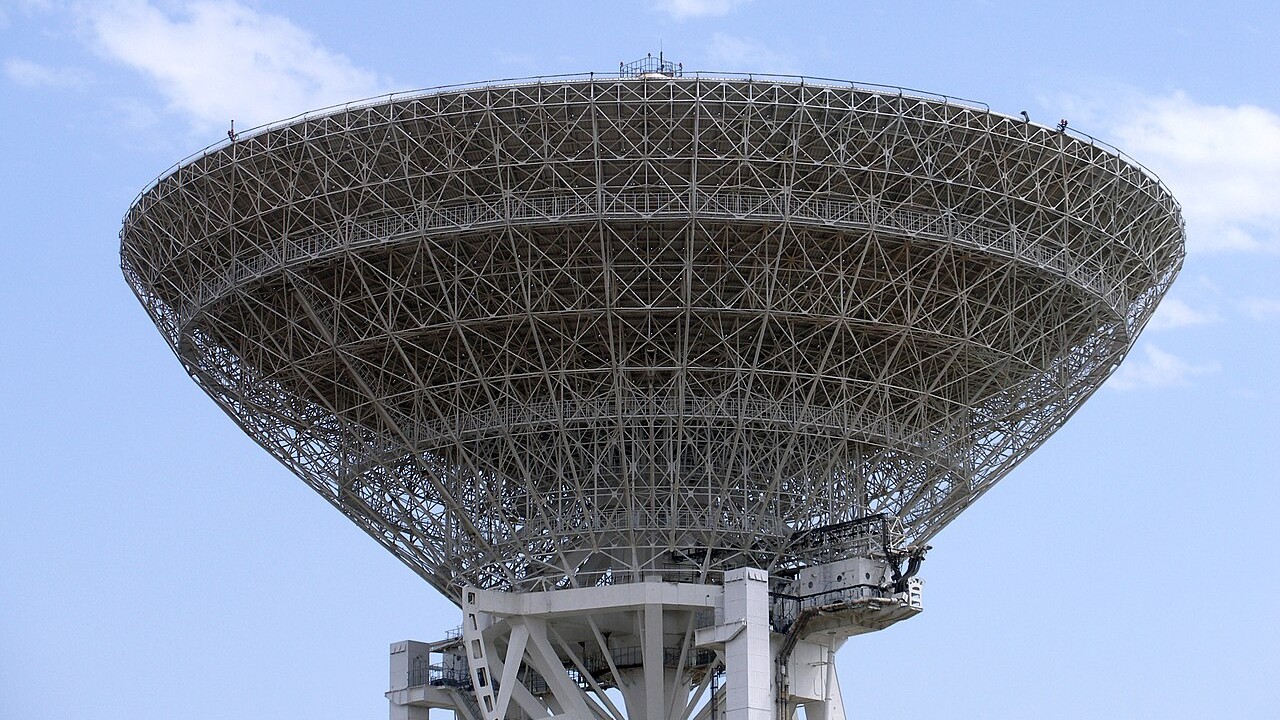
At an altitude of 2,324 meters, on a lonely plateau in the Turkestan range of Uzbekistan, a paved road leads nowhere. It winds toward a concrete plinth and a circular metal structure, relics of a project meant to house the largest parabolic antenna ever built in Central Asia. Thirty-five years after the work halted, the road remains. The foundations too. Nothing has ever been removed, nothing completed.
Key takeaways
- A frozen Soviet giant in time: what really halted this project in 1991?
- Did the dry air intended to detect cosmic waves spare the foundations from destruction?
- Two resurrection attempts, two silent failures — why won’t Russia give up?
A telescope designed to probe the universe in the silence of the peaks
The project began in the 1980s, at the height of the Soviet space program. The idea: erect on the Suffa plateau a RT-70 radio telescope, equipped with a 70-meter-diameter antenna, capable of capturing the faint millimeter waves emanating from the cosmos. The instrument was to be built on the high Suffa plateau, in the foothills of the Turkestan range, to operate in a frequency range from 5 to 300 GHz. The site was not chosen at random: the altitude and the thin air in this region limit the atmospheric absorption of the finest signals, a prerequisite for this type of observation.
The RT-70 was to join two twins already operational elsewhere in the USSR, at Yevpatoria in Crimea and at Galenki in the Russian Far East. With a 70-meter dish, these instruments rank among the largest single-dish radio telescopes in the world. On paper, Suffa was to become the third link in a network capable of very-long-baseline interferometric observations, connecting the Earth to space telescopes. The RT-70, within the Suffa observatory complex, was to serve as the main terrestrial anchor for the “Millimetron” project. An ambitious initiative, almost oversized for its era, that would have placed the Soviet Union at the forefront of millimeter-wave radio astronomy.
1991, the year when everything stopped abruptly
The road was laid. The base was poured. The metal structure intended to support the antenna had even begun to rise. Then the USSR collapsed in December 1991, and with it the entire financing system backing such pharaonic projects. Construction, begun in the late 1980s, was suspended when the Soviet Union fell and the Uzbek government abandoned the project.
What strikes when you look at current site images is the sense of suspended time. No rotting corrosion, no spectacular collapse. Just a structure waiting on a wind-swept plateau, hundreds of kilometers from the nearest city. The dry air that was to aid astronomical observation had, as a curious side effect, preserved the site from rapid corrosion that would be expected in a more humid climate. An irony no one anticipated in 1981.
Two resurrection attempts, two silent failures
The project could have remained a simple post-Soviet ruin among many others. Yet Russia never fully gave up. In 2008, the Russian government resumed work on the site, focusing on observations in the millimeter-wave band at 100–300 GHz. The stated goal: to make Suffa a key support for Russian space radio astronomy missions, notably in the continuation of the Spektr programs.
Six years later, the record was unclear and disappointing. In 2014, the construction was said to be 50% complete, but the project was abandoned again. A Russian academic cited a classic obstruction: a lack of funding. A new attempt at Russo-Uzbek cooperation was announced a few years later, with the level of advancement recalibrated downward to around 40% according to some Russian sources. Evidence that progress is not linear: between relaunches, the project seems to regress on paper due to the lack of reliable and continuous measurements.
In 2025, the site is still listed as a 21st-century archaeological site, neither ruin nor active construction. Some tourist entries even mention a possible completion between 2023 and 2028, a window that has already closed without the antenna being mounted. This kind of projection, recycled year after year with no concrete basis, illustrates well the ambiguity surrounding Suffa’s real future.
Why a concrete carcass resists better than you might think
People often imagine that an abandoned scientific site decays within a few years, worn down by the weather and vegetation. Suffa tells another story. The plateau, at more than 2,300 meters, experiences a dry and harsh climate, but is poor in acidic rains or stagnant humidity, two common enemies of reinforced concrete and steel. The access road, built to support the transport of massive pieces destined for the antenna, was carved to endure.
This paradox is not unique. Other abandoned Soviet scientific infrastructures, from test tracks to radar bases, have shown similar resilience in arid areas of Central Asia. The absence of human activity, often seen as a factor of degradation, here works in reverse: no one comes to steal materials, no one builds on top of it, and the local climate does the rest. The result is almost museum-like, a frozen instant of Soviet scientific ambition, without the funds to finish it or the will to demolish it.
One question remains that few official reports address directly: what would world radio astronomy look like today if Suffa had come online in the 1990s? The international network of millimeter telescopes has since been reconfigured largely elsewhere, notably in Chile or China, making the scientific utility of an instrument designed for a technological landscape that no longer exists increasingly uncertain with each passing year.
Sources: cambridge.org | fr.wikipedia.org
