
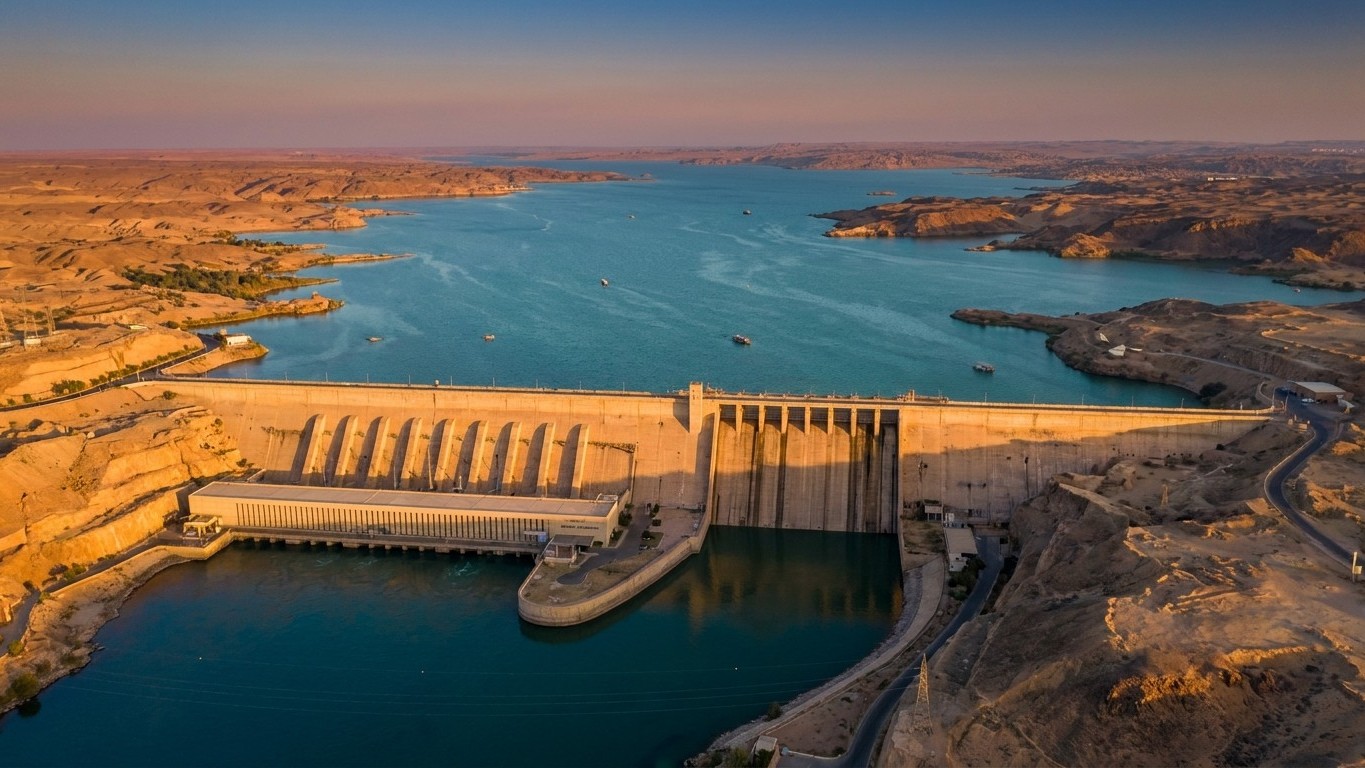
Standing 111 meters tall and 3.8 kilometers long, the Aswan High Dam, completed in 1970 after eleven years of construction, carved a new, concrete-driven rhythm into Egypt’s history—one that the country had known since the time of the pharaohs. Each year, from July to October, the Nile swelled due to the Ethiopian monsoon rains, overflowed the valley, and then withdrew, leaving behind a fine film of black silt. From July through October, the flood of the Blue Nile, which accounted for 80% of the river’s total flow in Egypt, inundated the valley and deposited a 1–2 centimeter layer of fertile sediments each year. This mechanism, repeated for millennia, spared the fellahs (peasants) from needing fertilizers. The dam ended the devastating floods. It also cut off this free flow that nourished the land.
The issue isn’t a lack of water: Lake Nasser, with a capacity of 169 billion cubic meters, stores more than enough. It isn’t a lack of land either: the Nile valley and its delta still cover the same expanses. What disappeared is what the river carried before it reached the dam. The structure traps 98% of the sediments, or about 240 million tonnes per year before 1970. A broader estimate places the historical range between 60 and 180 million tonnes annually. Whatever the figure, the scale is staggering: it amounts to tens of millions of freight trucks’ worth of sediment that no longer reach the fields each year.
Key takeaways
- The dam traps 98% of the sediments: about 60 million tonnes annually that will never reach the fields
- Smallholders indebted: chemical fertilizers cost Egypt hundreds of millions of dollars each year
- The delta is crumbling: land yields to the sea at 100–200 meters per year, threatening 124,000 hectares
Sediment Confined by Concrete
The sediment hasn’t ceased to exist. It simply continues its journey to the base of the dam, where it piles up with no other fate than to accumulate. The sediment keeps arriving, but it goes nowhere: it accumulates at the bottom of Lake Nasser, imprisoned by a wall of concrete and rock 111 meters high. A recent study estimates this trapped mass at sixty million tonnes per year, a stock that grows season after season at the reservoir’s bottom. The valley’s farmers, for their part, found themselves suddenly deprived of their natural fertilizer.
The shift toward chemical agriculture did not delay. The dam contributed to the decline in fertility of the downstream floodplains by trapping nutrient-rich sediments, which led to an increased reliance on artificial fertilizers. A more recent analysis notes that fertilizer use surged in the decade following the dam’s construction and continues to grow, costing Egypt hundreds of millions of dollars per year and requiring substantial investments in state-owned plants such as Abu Qir and Talkha. For smallholders, this dependence carries a social price documented by historians: some studies mention resorting to usurious loans, with interest rates between 15% and 25%, to finance the purchase of inputs now deemed essential. The river, once generous for free, became a nutrient-poor water supplier, leaving the bill for soil fertility to the farmers themselves.
The Delta Recedes, the Sea Advances
Farther downstream, along the Mediterranean shores, the absence of lime has produced a phenomenon almost inverse to the original fear: it is no longer the water threatening the land; it is the land giving way to the water. Historically, the influx of sediments toward the Nile delta offset the sediment loss caused by waves and currents along the delta’s edge; since the construction of the Aswan High Dam, the delta front erodes at a rate that can reach up to 100 meters per year. A report estimates about 124,000 hectares of agricultural lands and coastal zones being affected by this erosion, with annual losses projected between 100 and 200 million dollars.
Salt also enters the equation. Without the natural filter that the silt once provided, seawater penetrates deeper into the land, salts the soils, and drives the groundwater table upward in areas near the Mediterranean. An American academic source notes that this intrusion of saline water into the aquifer has been observed as far as thirty kilometers inland, a consequence of groundwater extraction and land subsidence. Researchers studying the phenomenon agree on one point: the delta is not simply impoverished; it is sinking and physically shrinking, a process rarely reversible on a human timescale.
A Faster River, a Riverbed that Sinks
Upstream from the delta, another, more subtle effect has gradually taken hold. Deprived of its sediment load, the Nile’s current has changed its physical behavior. The river now flows faster than before and erodes its bed at a rate of about 1.7 centimeters per year. Photographic surveys cited by some researchers describe scour of two to three meters in places, a sign of a bed carving out its own path for lack of material to carry on the surface. Scientists remain divided on the long-term magnitude of this phenomenon, but all note the same logic: a river that deposits nothing eventually reclaims its own bed for lack of material to move elsewhere.
In response to this finding, engineers and researchers, notably in American university studies dedicated to Nil delta restoration, have been working for years on scenarios of controlled sediment reinjection and calibrated water releases from Aswan, in an effort to artificially recreate part of the service once provided by the natural flood. None of these projects has yet been implemented on a large scale: the loam, for its part, continues to accumulate year after year at the bottom of Lake Nasser.
Sources: quebecnouvelles.com | fr.wikipedia.org
