
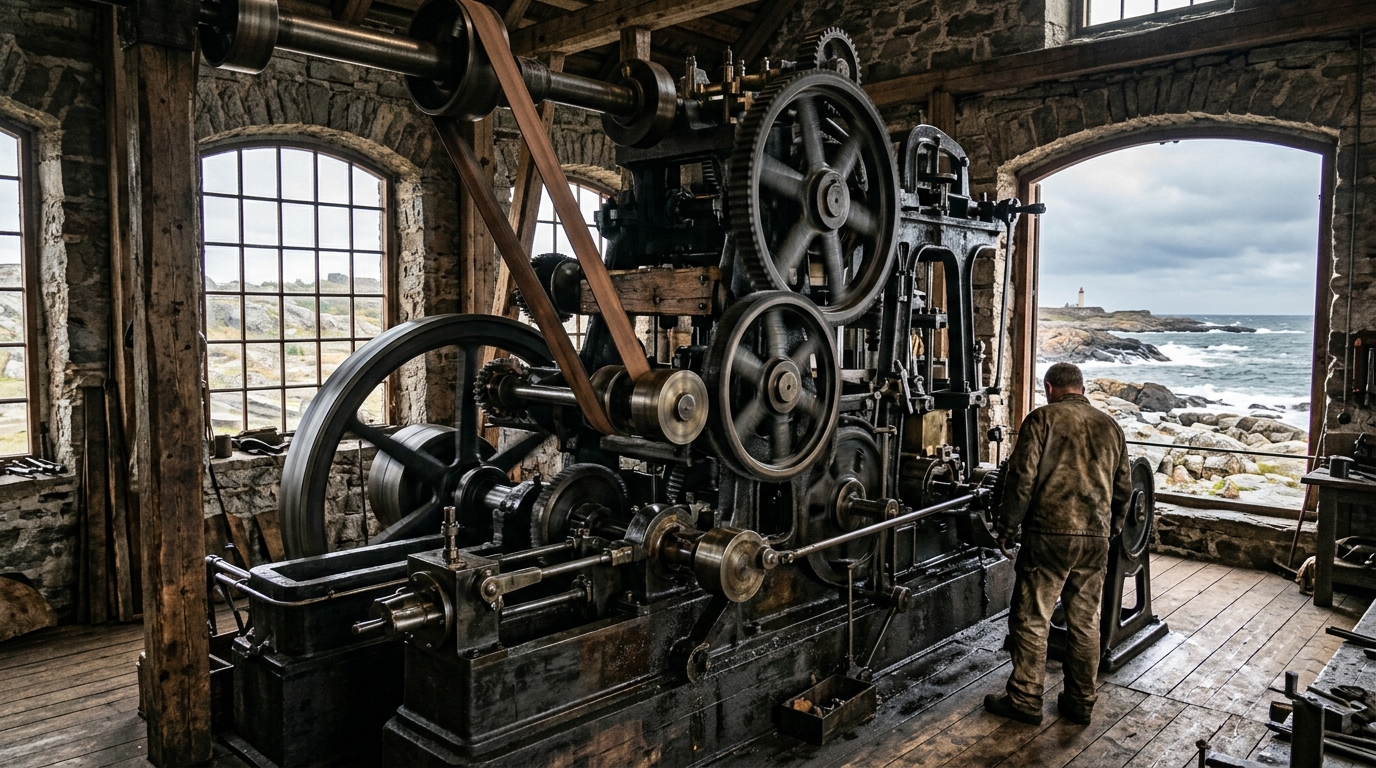
In Grimeton, on Sweden’s western coast, a two-ton machine has been running nonstop since 1924. No transistor, no integrated circuit has ever needed replacing it. The Alexanderson SAQ alternator remains to this day the only electromechanical radio transmitter still functional on Earth, and it continues to broadcast on the frequency of 17.2 kHz, with a reliability that even the era of total digitalization has never managed to match.
- The Alexanderson SAQ alternator, installed in Grimeton, Sweden, has been broadcasting since 1924 on 17.2 kHz thanks to a rotating metal disk pierced with multiple notches, with no electronic components involved.
- Its very low frequencies penetrate seawater to several meters in depth, which still makes it a reliable means of communicating with submerged submarines.
- Listed as a UNESCO World Heritage Site since 2004, the station remains fully operational and holds regular demonstrations where the alternator is brought back to life before visitors.
- When mechanics beat electronics at their own game
- Why no one has managed to retire it
- A UNESCO site that refuses to become a frozen museum
- Grimeton, or the proof that a centenarian machine can stay irreplaceable
Hard to believe in a world where the smallest device seems destined for obsolescence within a few years, but this mechanical relic continues to fascinate engineers, radio enthusiasts, and the curious who travel to this tip of Sweden’s western coast. How could such an ancient technology endure a full century without being dethroned by modern electronics? The answer lies as much in physics as in a strong streak of human stubbornness.
When mechanics beat electronics at their own game
To understand why this machine still stands, one must go back to how it works. The Alexanderson alternator, invented by Swedish-American engineer Ernst Alexanderson, does not generate its radio waves through electronic components but through a rotating metal disk, driven at very high speed and pierced with multiple notches. This mechanical motion directly produces electromagnetic waves in the very low-frequency range, without any semiconductor in sight.
This approach, now seen as almost prehistoric, offered a formidable advantage for its era: raw power. The very low frequencies allow the waves to penetrate seawater to several meters of depth, making it a preferred tool for transatlantic communications before satellites. Grimeton served as a bridge between Europe and the United States, transmitting messages that the nascent electronically-tubed radio of the time could not have carried so far.
Why no one has managed to retire it
With the rise of satellite links and fiber optics, one might assume this machine would have been dismantled long ago. Yet several factors have favored its survival. First, the very low frequencies it generates possess a rare quality: they can penetrate seawater to several meters, leaving it as one of the few reliable ways to communicate with submerged submarines even today.
Then there is resilience. Where modern electronics fear overvoltages, electromagnetic pulses, or simply wear and tear on miniaturized components, a rotating metal block hardly fears anything. This stark mechanical simplicity largely explains why no major breakdown has ever required its complete replacement in a hundred years of service. You repair, you maintain, but you do not reinvent the wheel, literally.
A UNESCO World Heritage Site that refuses to become a frozen museum
Since 2004, the Grimeton station has appeared on UNESCO’s World Heritage List, recognized as an exceptional testament to the early days of long-distance radiotelegraphy. But unlike many historical sites that lock themselves behind a display case, this one continues to operate in reality. The six pylons, each over 127 meters tall, still dominate the coastline, and the alternator continues to run during demonstrations.
This September, as tourist traffic along Sweden’s coast eases, the site still welcomes visitors who come to witness the machine in action, a nearly theatrical ritual where the rhythmic thud of the rotating disk echoes through the building. This living dimension of heritage, where people don’t merely observe but hear and feel the technology working, is exactly what sets Grimeton apart from a mere museum.
Grimeton, or the proof that a centenarian machine can stay irreplaceable
What makes this narrative so distinctive is the paradox it embodies. In a technology sector where planned obsolescence and constant renewal have become the norm, a machine born at the dawn of the 20th century still performs its original function, never requiring an electronic overhaul. The Alexanderson alternator is not kept merely for nostalgia: it operates still because it does in its narrow field what no modern technology does better or cheaper.
This longevity also prompts us to rethink our relationship with innovation. We often equate progress with miniaturization and increased complexity, yet Grimeton demonstrates the opposite: sometimes the simplest, most robust solution endures the longest. A lesson that resonates far beyond the world of radiotelegraphy.
As we watch this iron machine continue turning faithfully after a century, we cannot help but wonder how many of our current connected devices, saturated with sophisticated electronics, will still have a practical use in a hundred years. Grimeton, for its part, keeps buzzing mechanically, indifferent to the fashion of technologies that have come and gone around it.
