
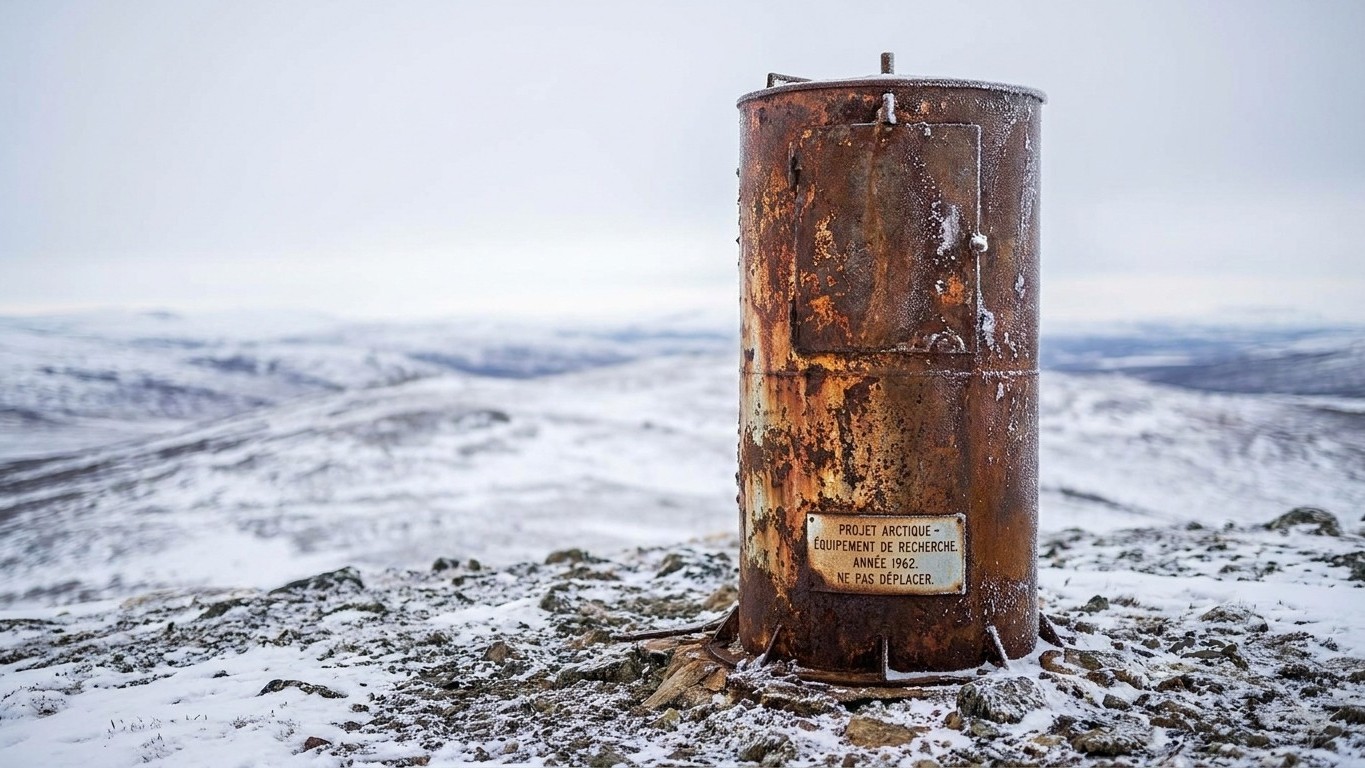
An American weather station operated for weeks on Canadian soil during World War II, unseen by any Allied soldier. The revelation of the secret, decades later, nearly borders on archival chance: not a patrol, not a reconnaissance aircraft, but a retired engineer combing through old archives and a scientist who happened upon it while strolling a hill in Labrador.
Key takeaways
- A German submarine secretly landed an entirely automatic weather station on the Canadian coast in 1943
- The Germans camouflaged their installation with a fake Canadian logo and empty cigarette packs — but the gamble was risky
- No one uncovered this military secret for more than 30 years, and not for reasons one might expect
A discreet landing on the Labrador coast
On September 18, 1943, U-537, commanded by Kapitänleutnant Peter Schrewe, departed Kiel in Germany for its first combat patrol, carrying the weather station WFL-26 nicknamed “Kurt,” meteorologist Kurt Sommermeyer and his assistant Walter Hildebrant. The submarine crossed the Atlantic under perilous conditions: caught in a storm, it sustained significant damage, including hull leaks and the loss of its quadruple anti-aircraft gun, leaving it unable to dive and defenseless against Allied aircraft.
Nevertheless, the crew reached their destination. On October 22, U-537 arrived at Martin Bay, in the north of Labrador. The sailors then transferred the equipment ashore. For 48 hours, the crew handled the 220-pound drums along with a tripod and a mast, hauling them to the rubber boats and then to land, installing the station 400 yards inland on a 170-foot hill. The operation was executed with precision: barely landed, the team camouflaged their installation with almost theatrical care.
The device itself was no trivial thing. Kurt was part of 26 land-based automatic weather stations built by Siemens, a simple assembly of ten one-meter-tall cylinders: one housed the meteorological instruments and the radio transmitter, from which extended a ten-meter antenna and a wind vane, while the others contained nickel-cadmium batteries weighing 220 pounds each, designed to power a two-minute transmission every three hours for six months. It was, for its time, an engineering feat intended to operate without human intervention in cold conditions capable of destroying ordinary electronic equipment.
An almost comic camouflage, but terribly effective
The Germans knew that a solitary radio post would inevitably attract attention sooner or later. Their remedy was to disguise the entire setup as Canadian civilian equipment. The Kurt station bore a logo and the name of a fictitious company, the “Canadian Meteor Service,” and empty American cigarette packs were scattered around the site to lend credibility to the ruse. A humorous detail: the name itself carried a misspelling, being an incorrect rendering of “Canadian Meteorological Service,” an agency that, under that exact name, never existed.
The Germans’ gambit was calculated with a certain cynicism. At the time, civilians were kept strictly ignorant of military operations, which made the camouflaged installation seem plausible; the Germans had even anticipated that lower-ranking military personnel, baffled, would prefer to leave the station alone rather than ask too many questions. Barely twenty-eight hours after stepping onto North American soil, the crew departed, leaving Kurt transmitting alone in the Labrador’s quiet. The station ceased transmissions after only a few weeks, likely the victim of the cold or a technical fault, with no Allied observer ever detecting any suspicious signal.
What ultimately betrayed the station: neither a soldier nor an aircraft
Here is the twist that makes this story so tasty: Kurt’s discovery had nothing to do with any military surveillance. In July 1977, geomorphologist Peter Johnson happened upon an old weather station in northern Labrador, which turned out to be a covert automated post installed by a German submarine crew in 1943 to allow Germany to anticipate meteorological developments. There was no armed patrol, no radar detector: a researcher studying something else simply stumbled upon rusting metal carcasses perched atop a hill.
But the formal identification of the site required archival work far from the battlefield. The story resurfaced toward the late 1970s when an engineer named Franz Selinger, after retiring from Siemens, decided to write a history of the German weather service and found among Dr. Sommermeyer’s papers photographs of a weather station and a submarine that did not correspond to any of the known eastern Arctic installations. Selinger pushed his research further. He identified the Labrador coast, but neither Canadian nor American authorities could provide proof; it was by contacting Jürgen Rohwer and the son of Dr. Sommermeyer that he managed to identify U-537 and locate its logbook in the Fribourg archives. That document would seal the mystery: not a radar, not a ground squad, but an old logbook and the memory of a scientist’s son.
This intersection between the chance discovery by a field geomorphologist and the meticulous archival work of a Siemens retiree in German records finally enabled an official expedition. Canadian military historian Alec Douglas travelled to the site to authenticate and document it, confirming that this modest cluster of rusting cylinders is indeed the only German military installation ever erected on North American soil during the entire conflict. The Kurt remains, restored, are now on display at the Canadian War Museum in Ottawa, a few kilometers from the places where the country’s major decisions are made daily, the country that Kurt once spied on from the shadows.
Sources: uboat.net | missedhistory.com
