
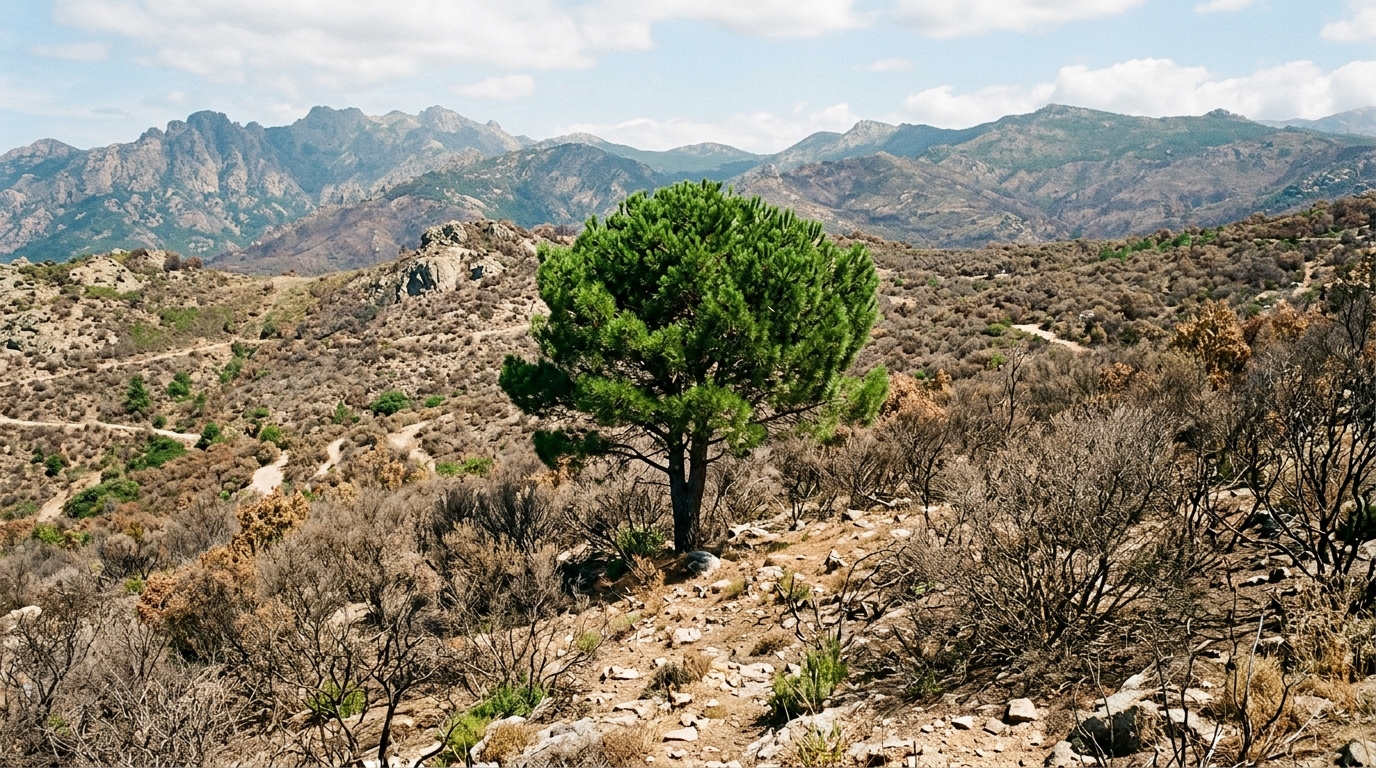
People often tend to believe that fire, no matter how destructive, acts as a natural “cleaner” that pushes invasive species away and, afterwards, gives way to more resilient vegetation. It is even one of the arguments regularly heard in late summer, when flames sweep across the Corsican scrub. Yet, on the heights of the island of Beauty, this idea meets a troubling counterexample. For over a century, an tree from Australia has found in fires not an enemy, but a formidable ally. Introduced in 1900 to stabilize fragile soils, it now occupies nearly 3 000 hectares of maquis, and each fire season seems, paradoxically, to strengthen its grip rather than diminish it.
- Introduit en Corse en 1900 pour stabiliser les sols, l’Acacia dealbata (mimosa) contient des huiles inflammables qui le font brûler plus fort et plus vite que la végétation méditerranéenne.
- Ses graines à enveloppe dure restent dormantes des années et germent en masse déclenchées par la chaleur du feu, qui agit comme un starter biologique favorisant sa reproduction.
- Cette dynamique remplace la mosaïque végétale du maquis par des peuplements monospécifiques de mimosa, réduisant la biodiversité, un phénomène également observé au Portugal et en Espagne avec l’acacia et l’eucalyptus.
- Un arbre à huile qui carbure aux flammes
- Le feu qui devait le tuer le fait renaître plus vite
- Quand une seule espèce remplace toute une forêt
- Un scénario qui se répète déjà ailleurs en Méditerranée
An oil-bearing tree that fuels on flames
The Acacia dealbata, better known as mimosa, is far from a discreet intruder. Native to southeastern Australia, this fast-growing tree with bright yellow blossoms was planted in Corsica at the turn of the twentieth century for two precise reasons: to beautify gardens and to stabilize unstable soils, especially on slopes prone to erosion. At the time, no one imagined that it would one day redraw vast swaths of the island’s landscape.
What early-century botanists had not anticipated was the tree’s chemical make-up. Its leaves and wood contain highly flammable essential oils, somewhat akin to eucalyptus, another Australian import infamous for feeding fires. Concretely, this means that a stand of mimosas does not simply burn: it burns hotter and faster than traditional Mediterranean vegetation, turning every fire front into an especially intense blaze.
The fire that was meant to kill it makes it regrow faster
This is where the mechanism becomes truly fascinating, and somewhat unsettling. For most Mediterranean species, such as the holm oak or the strawberry tree, fire is a test of endurance: some survive thanks to thick bark, others resprout from damaged stumps. Mimosa, by contrast, has developed an entirely inverse strategy. Its seeds, protected by a very hard shell, stay buried in the soil for years, sometimes decades, awaiting a precise signal: the intense heat of fire.
When flames pass, they literally shatter these dormant seeds and trigger mass germination. The result is almost immediate: a few weeks after a blaze, where one would expect bare, charred ground, hundreds of mimosa seedlings emerge simultaneously. The fire, intended to eliminate the plant, actually acts as a biological starter that synchronizes and accelerates its reproduction. The more the area burns, the more the species prospers.
When a single species replaces an entire forest
This dynamic has noticeable consequences for the maquis’s plant diversity. Where once there were rockroses, myrtles, heathers, and young evergreen oaks tangled in Corsican garrigue, there are now monospecific stands, that is, vast stretches where mimosa has ousted all other species. Its rapid growth allows it to capture light before native plants, slower to establish, can take root, and its roots alter the soil’s chemical makeup in a way that further disadvantages its competitors.
The resulting landscape bears little resemblance to the traditional maquis. It loses its mosaic of species, its refuges for local fauna, and above all its natural capacity to limit fire spread. In short, each fire cycle slightly diminishes Corsican biodiversity while solidifying the grip of this introduced tree.
A scenario that repeats itself already elsewhere in the Mediterranean
Corsica is unfortunately not an isolated case. The same process—an invasive species taking advantage of fire to spread at the expense of native flora—has been observed in other parts of the Mediterranean basin, notably along certain coasts of Portugal and Spain where acacia and eucalyptus were introduced for similar forestry or ornamental reasons. The Mediterranean climate, with hot, dry summers conducive to fire starts, provides ideal conditions for this kind of vicious circle.
This recurrence of the phenomenon from one shore of the Mediterranean to the other invites reflection on how species were introduced—often without ill intent at first—that would later disrupt ecosystems shaped for millennia. At the end of summer, when fires again dominate the news on the island, the mimosa question illustrates how a decision made more than a century ago can still weigh heavily on the landscape and on current forest management strategies.
Faced with a tree that turns every fire into a springboard rather than a threat, traditional methods of fighting invasive species show their limits. Pulling out or cutting down is not enough, as dormant seeds wait patiently for their next opportunity to germinate. The question then extends far beyond Corsica: how should Mediterranean fire and forest management be reimagined when nature itself has learned to turn our prevention tools against us?
