
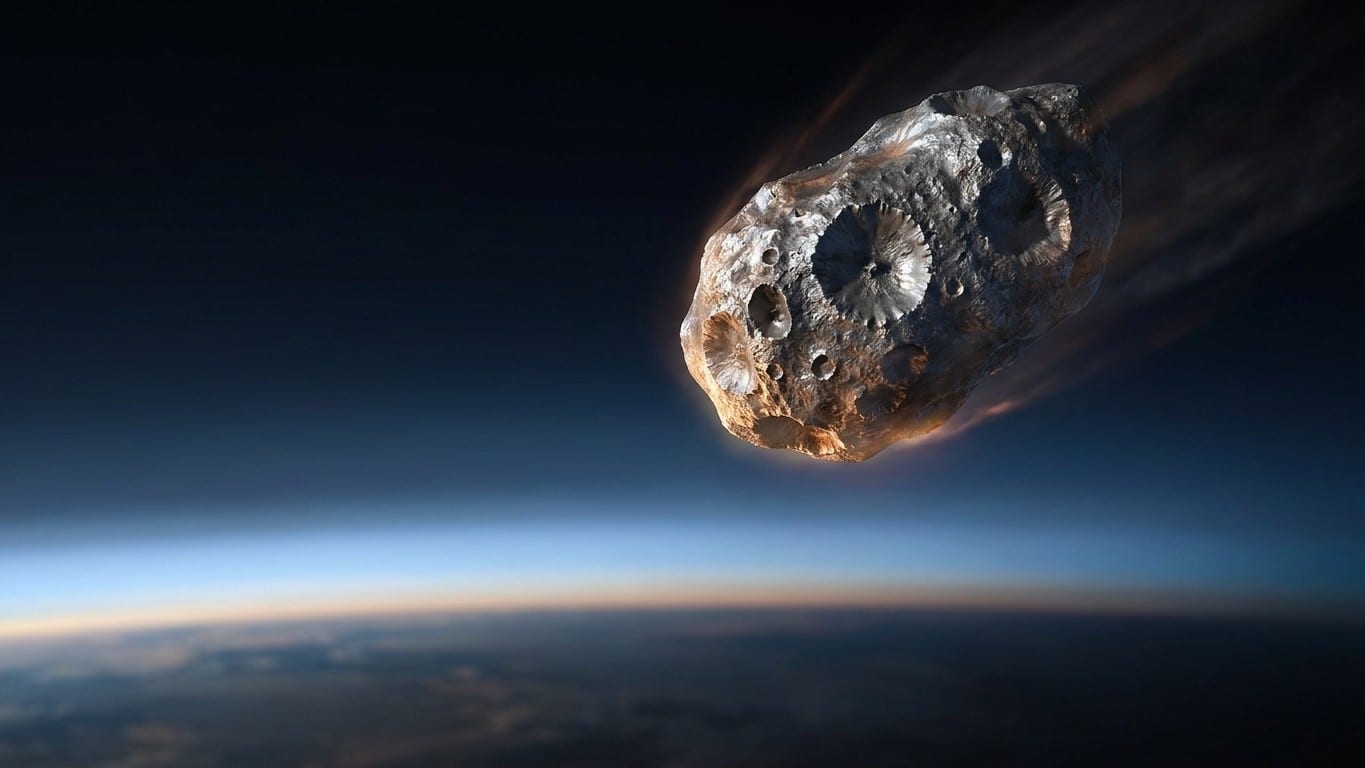
Sixty degrees. That is the precise angle at which a 10 to 15-kilometer-wide asteroid struck Earth 66 million years ago, according to three-dimensional simulations published in 2020 in Nature Communications. Not a grazing hit, nor a vertical plunge: an intermediate trajectory, and it is precisely this that made the collision so devastating. A few degrees more or less, and the story of life on Earth could have followed a completely different path.
The team led by Gareth Collins, from Imperial College London, digitally reconstructed the Chicxulub impact by leveraging geophysical data gathered from beneath the crater’s surface, located under the Yucatán Peninsula in Mexico. Comparing the 3D numerical simulations with geophysical observations suggests that the Chicxulub crater formed from an oblique impact at 45 to 60° relative to the horizontal, coming from the northeast. A narrowed range achieved after testing several scenarios: the researchers evaluated four possible impact angles—90, 60, 45 and 30 degrees—and two speeds, 12 and 20 kilometers per second. The result? The best alignment with the crater data corresponded to a 60-degree angle.
Takeaways
- A precise 60-degree angle: the worst-case scenario for the dinosaurs
- Why a vertical or near-vertical impact would have been less catastrophic
- How the composition of the Yucatán’s ground amplified the destruction
Why this exact angle changes everything
Intuition might suggest that a frontal, vertical impact would be the most destructive. It was the opposite that occurred. A strongly inclined impact yields a nearly symmetric distribution of blasted rock and releases more greenhouse gases per unit of impactor mass than a grazing or near-vertical impact. The 45–60° angle represents a kind of grim balance: steep enough to propel a maximum amount of material vaporized into the upper atmosphere, but not so steep as to concentrate energy in a deeper crater at the expense of debris dispersion.
Gareth Collins summed it up plainly in statements to AFP: “Sixty degrees is a more lethal impact angle because it ejects a larger quantity of material quickly enough to engulf the planet.” An almost vertical impact, by contrast, would have carved a broader crater but would launch debris more slowly, so most of it wouldn’t travel as far; conversely, a very grazing impact would not generate as much debris. Two scenarios, two potentially less catastrophic outcomes for the era’s biodiversity.
What makes these findings particularly robust is their methodology. They are the first fully three-dimensional numerical simulations to replicate the entire impact event—from the collision to the final crater’s formation. A computational feat made possible by the power of Britain’s DiRAC high-performance computing platform. Previous attempts often limited themselves to the early phases of the impact, unable to follow the dramatic rebound of rock that occurs after the collision, a process that unfolds within minutes beneath Earth’s crust.
A sulfur rain that altered the global climate
The subsurface of the Yucatán is no ordinary terrain. The upper crust around the Chicxulub crater contains abundant water as well as porous carbonate and evaporitic rocks. Heating and pulverization by the shock caused these rocks to break down, blasting enormous quantities of carbon dioxide, sulfur, and water vapor into the atmosphere. Sulfur, in particular, proved devastating: it rapidly forms aerosols—tiny particles that block sunlight, stalling photosynthesis and triggering a brutal climate cooling.
Scientists describe this scenario as a planetary nuclear winter, where the sky’s dimming preceded the collapse of food chains. It is this precise mechanism, coupled with the impact angle, that explains why non-avian dinosaurs had no chance to adapt: the climate change happened too rapidly, too violently, to leave room for any evolutionary resilience.
The co-author Thomas Davison emphasized the rarity of this geological formation: “Large craters like Chicxulub form in a matter of minutes, and entail a spectacular rebound of rock beneath the crater.” That rebound left a signature that could be read decades later, etched into the crater’s subterranean structure, which geophysicists were able to decipher as one reads tree rings.
The catastrophe scenario that indeed unfolded
Gareth Collins did not mince his words about this confluence of factors: “For the dinosaurs, the worst possible scenario is exactly what happened.” A statement nearly cruel in its bluntness, underscoring the role of chance in this mass extinction. The simulations provide compelling evidence that the asteroid struck at a sharp angle—perhaps 60 degrees above the horizon—from the northeast, one of the most lethal scenarios for the impact’s lethality because it projected more dangerous debris into the upper atmosphere.
What matters to remember is that the margin was narrow. An impact at 30 degrees, almost grazing, or at 90 degrees, perfectly vertical, would have released markedly less greenhouse gases and sulfur-rich particles into the stratosphere, according to the same work. It is even possible the non-avian dinosaurs survived, or at least experienced a slower decline, under those alternate conditions. A notable nuance added by more recent research, published in 2025 in Nature Communications, suggests the amount of sulfur released by the impact would be about five times lower than earlier numerical estimates, inviting a downward revision of the exact severity of this impact winter—without, however, calling into question the decisive role of the collision’s angle in triggering the catastrophe.
Sources: nature.com | dirac.ac.uk
