
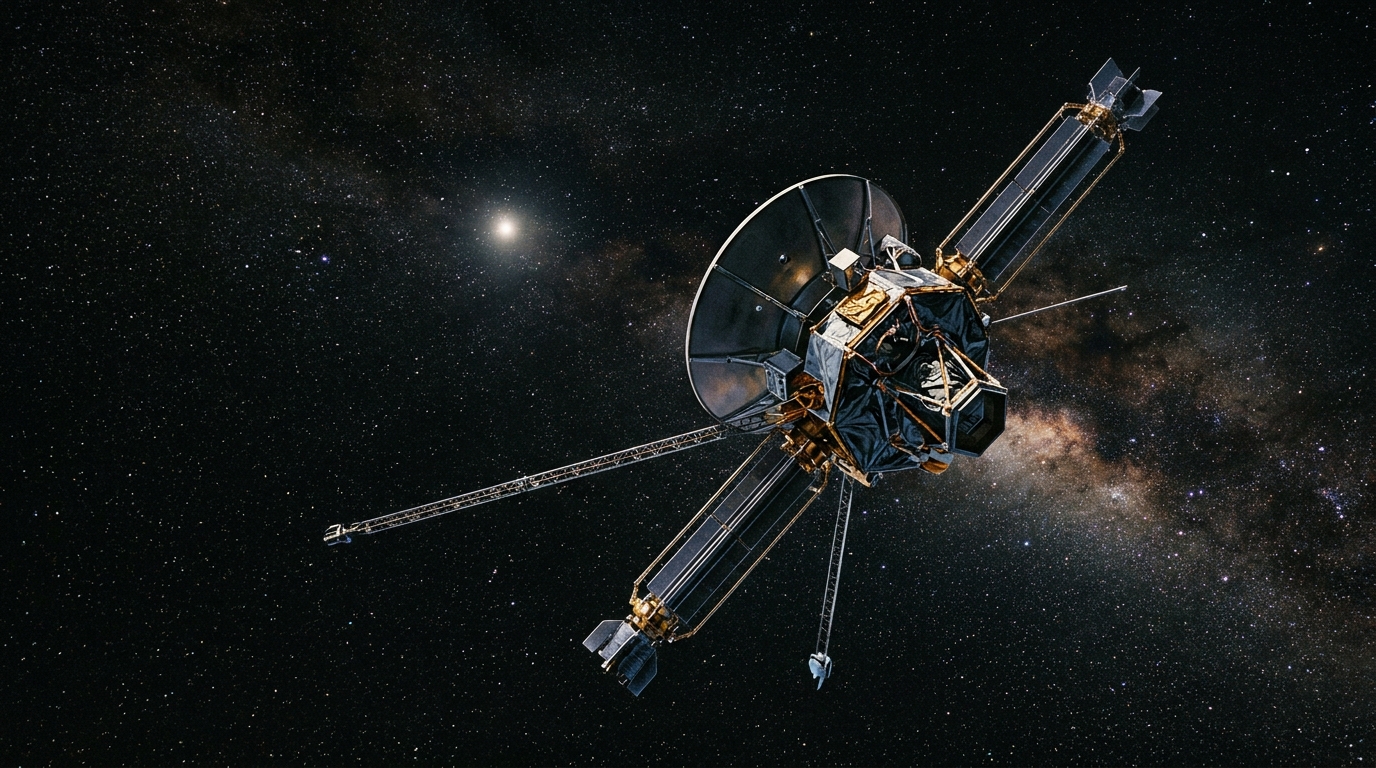
A probe that many long believed to be definitively mute for years nonetheless reacted to a signal sent well before it faded into silence. The story may read like science fiction, and yet it is entirely real: Pioneer 10, this solar-system explorer launched at a time when detailed observations of Jupiter were only just beginning, kept communicating with Earth long after the public had forgotten it. A radio call transmitted in 1972 eventually found its answer decades later, under circumstances that are almost dizzying. Here’s a look back at a space odyssey where patience and technology pushed the boundaries of what we thought possible.
- Launched in 1972, Pioneer 10 continued to emit signals long after 1997, a date often cited as the mission’s end.
- The last signal received, on January 23, 2003, came from a transmitter of only 8 watts located roughly 12 billion kilometers from Earth.
- Since that final contact, the probe has continued its silent journey toward the Taurus constellation, carrying its plaque meant for potential extraterrestrial civilizations.
- Pioneer 10 never really stopped talking
- 1972, NASA sends out a call into empty space
- An 8-watt whisper travels 12 billion kilometers
- What Pioneer 10’s silence still tells us today
Pioneer 10 Never Really Stopped Talking
In the collective imagination, Pioneer 10 belongs to the bygone era of space exploration. Many suppose the probe fell silent in 1997, the year when the last scientifically useful data stopped being transmitted reliably. That date circulated for a long time as the official end of the mission, reinforcing the notion that the craft drifted through space in silence, cut off from Earth.
Yet reality proved far more surprising. Rather than ending abruptly, Pioneer 10 continued to emit faint signals for several additional years, like an old telephone that still rings now and then even when the line is almost severed. This technical persistence, almost unheard of for a device designed in the 1960s, would enable one of the most captivating chapters in space history: a delayed response to a call sent long before the probe truly left our solar system.
1972, NASA Broadcasts into the Vacuum of Space
Let’s go back to 1972. NASA launched Pioneer 10 with an ambitious mission for the era: to become the first probe to cross the asteroid belt and to approach Jupiter, the solar system’s gas giant. On board, a modestly sized radio system was designed to function for a duration far shorter than what would eventually unfold.
What makes this mission special is the way it was conceived as a continuous dialogue between ground engineers and the machine launched into the void. Each command sent from Earth was a leap of faith: would the probe receive the instruction, process it correctly, and return a usable response, even as it drifted farther from our planet with every passing second? It is precisely this communication system, robust despite its age, that would later enable an unforeseen technical achievement.
An 8-Watt Whisper Travels 12 Billion Kilometers
Here lies the heart of this extraordinary tale. The last signal ever received from Pioneer 10 occurred on January 23, 2003, a full 31 years after its launch. At that moment, the probe was at an immense distance, its location estimated to be around 12 billion kilometers from Earth, a figure almost impossible to grasp in practical terms.
What stands out is the minuscule power of the transmitter that made this communication possible: barely 8 watts, energy comparable to that of a small bedside lamp. Imagine it: this electronic whisper, only a breath louder, managed to traverse an unimaginable distance to be picked up by the Deep Space Network’s immense antennas, a network of ground stations dedicated to listening to the far reaches of space. This stark contrast between a feeble signal and vast distance illustrates how the onboard technology, though decades old, had been designed with remarkable rigor.
After that final exchange, no further signal was ever detected. The probe had definitively fallen silent, yet that last radio breath remains to this day a reference point in long-distance space communication.
What Pioneer 10’s Silence Still Tells Us Today
Since that last contact, Pioneer 10 has continued its quiet trek toward the Taurus constellation, carrying with it the famous plaque engraved for potential extraterrestrial civilizations. It drifts on, without fuel, without enough energy, but still faithful to its initial trajectory, like a message in a bottle cast into an endless sea.
This story resonates especially today, as space missions multiply toward Mars or toward the outer edges of the solar system. It reminds us that space exploration is not limited to flashy launches, but also rests on the reliability of technologies designed to endure far beyond their original lifespans. The Pioneer 10 case proves that a device conceived more than fifty years ago can still surprise contemporary engineers with its longevity and resilience.
This adventure invites us to rethink our relationship with time and distance in space exploration. While new generations of probes carry far more sophisticated technologies, the tale of this 8-watt transmitter, capable of crossing billions of kilometers to deliver a final message, continues to captivate. And could future space missions also yield late surprises, decades after launch?
