
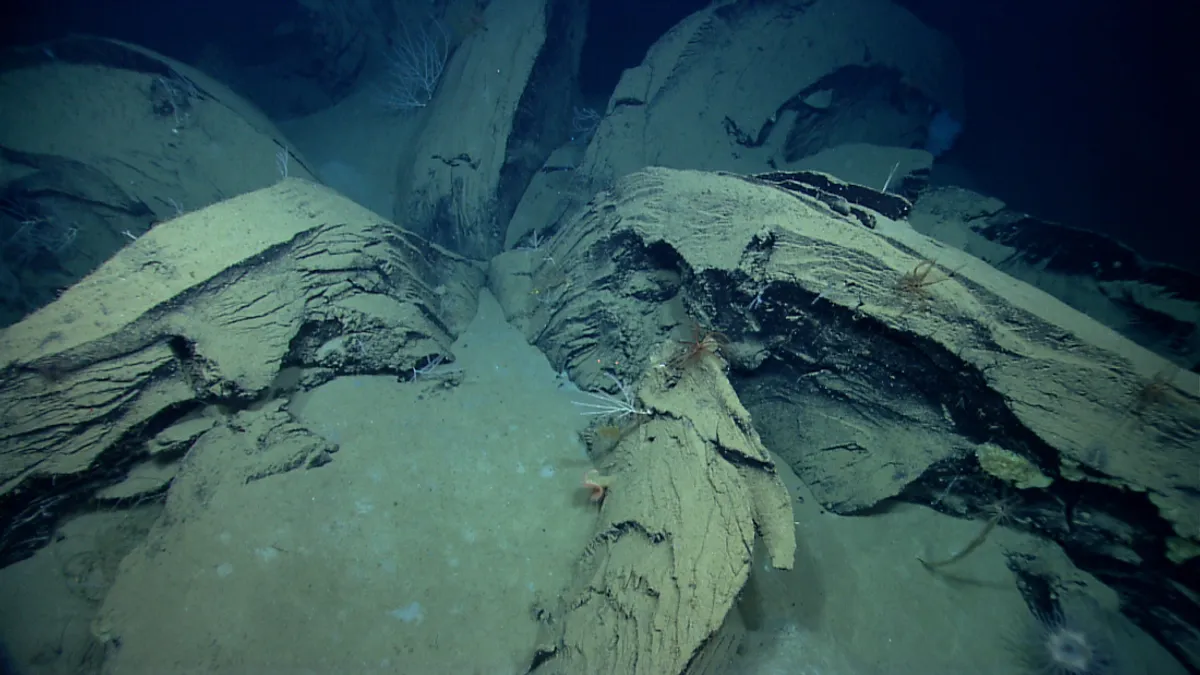
And what if, while searching for a sunken wreck, you stumbled upon an even stranger natural sculpture? That is precisely what happened to a team of NOAA researchers, the U.S. agency responsible for ocean observation among other duties, during an expedition into the depths of the Gulf of Mexico. Their initial mission seemed straightforward: locate the remains of a missing ship. But at nearly 1,900 meters below the surface, the sonar revealed something no one expected, a formation so singular that it immediately eclipsed the dive’s original objective. A look back at a discovery that blends geology, marine biology, and a hint of archaeological mystery.
- While searching for a wreck, NOAA researchers discovered by sonar a hardened asphalt formation shaped like a flower, nicknamed “tar lily,” at a depth of 1,900 meters in the Gulf of Mexico
- This mineral structure hosts a rich chemosynthetic ecosystem, with tubeworms, shrimp, anemones, sponges, corals and lobsters
- The wreck being sought was eventually found along with a rare early 19th-century chronometer, and the expedition also revealed enigmatic fossil burrows as well as a dumbo octopus adopting an unprecedented posture
- A stone flower born from oil and cold
- Life clings where no one expected it
- The recovered wreck hid an object almost impossible to date
- Burrows as old as the enigma and a dumbo octopus inventing a posture
A Stone Flower Born from Oil and Cold
It all begins with a standard sonar sweep, a technique used to map the seafloor and detect potential wrecks. In 2014, NOAA scientists detected a massive structure completely unknown to existing charts, tucked about 1,900 meters deep in the Gulf of Mexico. The most logical hypothesis was a sunken ship. Once underwater cameras were deployed, the reality proved far more surprising.
What the team found was not rusted metal, but a flower-shaped rock formation, nicknamed tar lily, literally “tar lily.” This natural sculpture is made of hardened asphalt, a material that forms when oil migrates from underground reservoirs through the fissures of the seafloor. In contact with the cold water of the deep sea, this material gradually solidifies, shaping over millennia petals frozen in rock. The size of the structure, and the fact that such a formation had never been observed in this particular Gulf zone, left a lasting impression on the researchers.
Life Clings Where No One Expected It
Far from being a mere inert mineral block, this tar flower proved to be a real miniature ecosystem. Its presence indicated active hydrocarbon seepage, a phenomenon that enables the development of chemosynthetic organisms, capable of deriving their energy from chemical compounds rather than sunlight. On site, researchers observed tubeworms, microbial mats, and shrimp, all signatures of these extreme environments typically found around hydrothermal vents.
Even more surprisingly, the hardened petals of the structure literally served as a living substrate for attached fauna. Anemones, sponges, barnacles and octocorals, including bamboo corals and sea pens, had taken up residence on this mineral architecture. Square lobsters also roamed in the vicinity. This stone flower, born of oil and cold, paradoxically acted as an oasis for underwater life.
The Recovered Wreck Hid an Object Almost Impossible to Date
If the tar flower stole the show, the expedition did not miss its original objective. Researchers eventually laid hands on a genuine wreck, hidden in the Gulf of Mexico depths. Among the remains found was a chronometer. Its presence aboard is a particularly valuable detail, as such an object remains rare on a ship dating from the early 19th century.
This kind of discovery offers a fascinating glimpse into the technologies aboard at the time. Finding such an object, preserved despite decades spent in the marine depths, reminds us how these extreme environments can surprise us with what they preserve.
Burrows as Old as the Enigma and a Dumbo Octopus Inventing a Posture
The expedition, however, was not done with surprises. In Keathley Canyon, located not far from the main site, scientists spotted fossil burrows called Paleodictyon. These network-shaped structures, observed on cliffs as well as on other deep-sea floors around the world, continue to intrigue the scientific community. Their exact origin remains unknown despite decades of observations and hypotheses.
Another striking moment of this dive was the sighting of a dumbo octopus adopting a body posture never before documented in cirrate octopuses. This group of cephalopods, generally considered less agile than their incirrates, delivered a novel behavior in front of the cameras. A finding that, in its own way, perfectly illustrates the spirit of the expedition: aiming for one precise objective, the researchers ended up accumulating unexpected discoveries, each opening new questions rather than providing definitive answers.
From the tar flower sculpted by time to the enigmatic burrows of Keathley Canyon, passing by a chronometer miraculously preserved and a dumbo octopus with an innovator’s flair, this Gulf of Mexico dive reminds us of one obvious truth too often forgotten: the oceans remain one of the least explored regions of our planet. How many other improbable formations still wait, lurking in the darkness of the deep, to be someday illuminated by the beam of a submarine light?
Source: Ocean Exploration
