
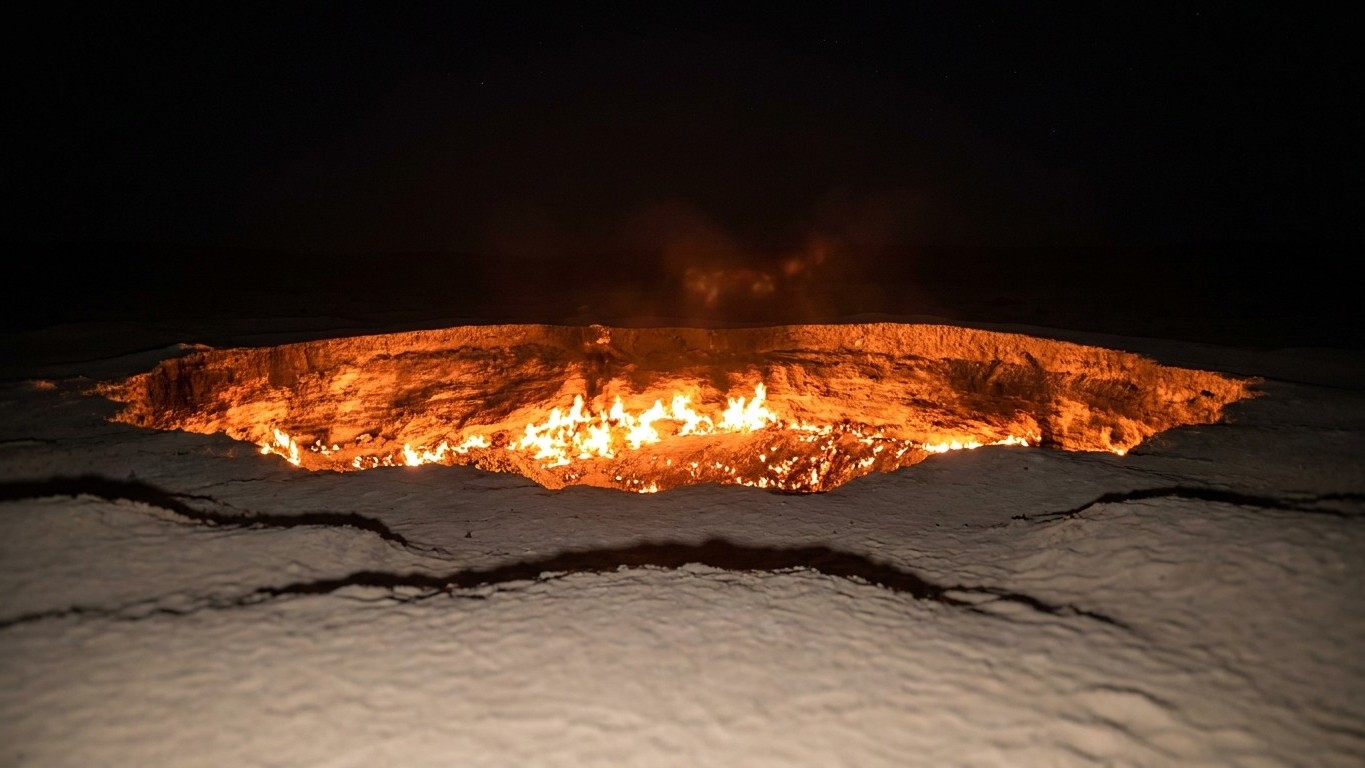
In the middle of the Karakum Desert, in Turkmenistan, a crater about sixty meters in diameter has been burning since 1971, a sight that no one at the time could have imagined would span more than fifty years of history. Located roughly 270 kilometers north of Ashgabat, the crater measures around 60 meters across and 20 meters deep. The Soviets who lit it believed they would get rid of it in a few weeks. The fire, however, never got the memo.
Key takeaways
- A failed Soviet borehole triggered an underground fire that no one has managed to stop for fifty years
- The crater’s flames are visible from several kilometers away at night, but official records remain mysteriously silent
- Turkmenistan has finally found a way to curb the flames, yet the mystery persists: why does this fire refuse to go out?
A failed borehole that lit the fuse
The crater results from the collapse of an exploratory gas well drilled by Soviet teams seeking new fields in this remote region of Central Asia. The official version, echoed by several media outlets, holds that a drilling rig collapsed beneath itself, swallowing equipment into an underground chamber filled with methane. The danger was real: the gas, invisible and poisonous, threatened nearby populations and livestock. To prevent methane from harming people and local wildlife, scientists set the gas alight, expecting the fire would die out within days. Yet the blaze has never ceased.
There is no precise official archive of this incident. The village that once bordered the site was evacuated, erasing part of the physical evidence of the initial event. This lack of documentation, rather than undermining the legend, fed it: difficult to verify a story when all direct witnesses have disappeared or been relocated elsewhere in the desert.
What is found at the edge of the crater
At night, the spectacle is striking. Dozens, sometimes hundreds, of orange flames once licked the crater walls, visible for miles around in the Karakum’s darkness. In summer, temperatures there can reach up to 50 degrees, and gusts of hot air continually emanate from the crater. The surrounding intense heat has gradually displaced certain animal and plant species that once lived in close proximity to the site.
The site, which Turkmen authorities officially call the “Karakum Glow,” draws an ever-growing number of curious visitors each year. Neither bars nor protective fencing stop visitors from potentially dangerous collapses, as the sandy ground could give way at any moment. Tourists who make the trip, often after hours of off-road travel from Ashgabat, camp in yurts set up a few hundred meters from the rim and return to watch the flames at dawn, when the oblique light heightens the contrast between the crater’s glow and the desert’s pale sand.
Extinguishing attempts that have dragged on for fifteen years
The Turkmen government has never truly abandoned its effort to extinguish its most famous crater. As early as April 2010, the Turkmen president announced a plan to finally put out the fire, arguing that it jeopardized the exploitation of regional gas reserves. That pledge went unfulfilled. In January 2022, he again vowed to extinguish the flames, contending that the country was wasting valuable natural gas. Several options were studied: filling the crater with sand or clay, sealing it with a heat-resistant dome, triggering controlled explosions to collapse the walls, or drilling new wells to redirect the gas. The latter option gradually emerged as the most realistic.
Engineers from the State Turkmen Institute of Gas Research, part of the state-owned Turkmengaz, ultimately chose the approach of drilling a nearby operational well to capture the gas before it could feed the blaze. By 2024, the Turkmen government had succeeded in drilling a diversion well near the crater, significantly reducing emissions, and satellite imagery confirmed that the flames were less intense than before. Data from Capterio, cross-checked with on-site observations, even indicated a substantial decrease in combustion—more than half of the previous intensity.
Researchers presenting their work at a conference devoted to hydrocarbons corroborated the trend: flames had diminished to roughly one third of their original size, and the fires at the crater were now visible only up close, whereas before they could be seen from miles away. By late 2025, Ashgabat had formalized the approach with a complete technical plan to extinguish the site definitively, though no precise timetable was given. Authorities now claim that flame activity has fallen by a factor of three since 2022, thanks to these capture wells gradually redirecting gas into the commercial network.
The calculation is not solely ecological. Turkmenistan’s economy remains heavily dependent on natural gas exports, and the enduring blaze is now seen as both a financial loss and an environmental image problem for a country ranked among the world’s top methane emitters. Yet the crater continues to glow every night in the Karakum Desert: visitors who still go there observe isolated, discreet tongues of fire—real, tangible remnants of a blaze that no one in 1971 could have imagined lasting more than half a century.
Sources: tameteo.com | le-voyage-autrement.com
