
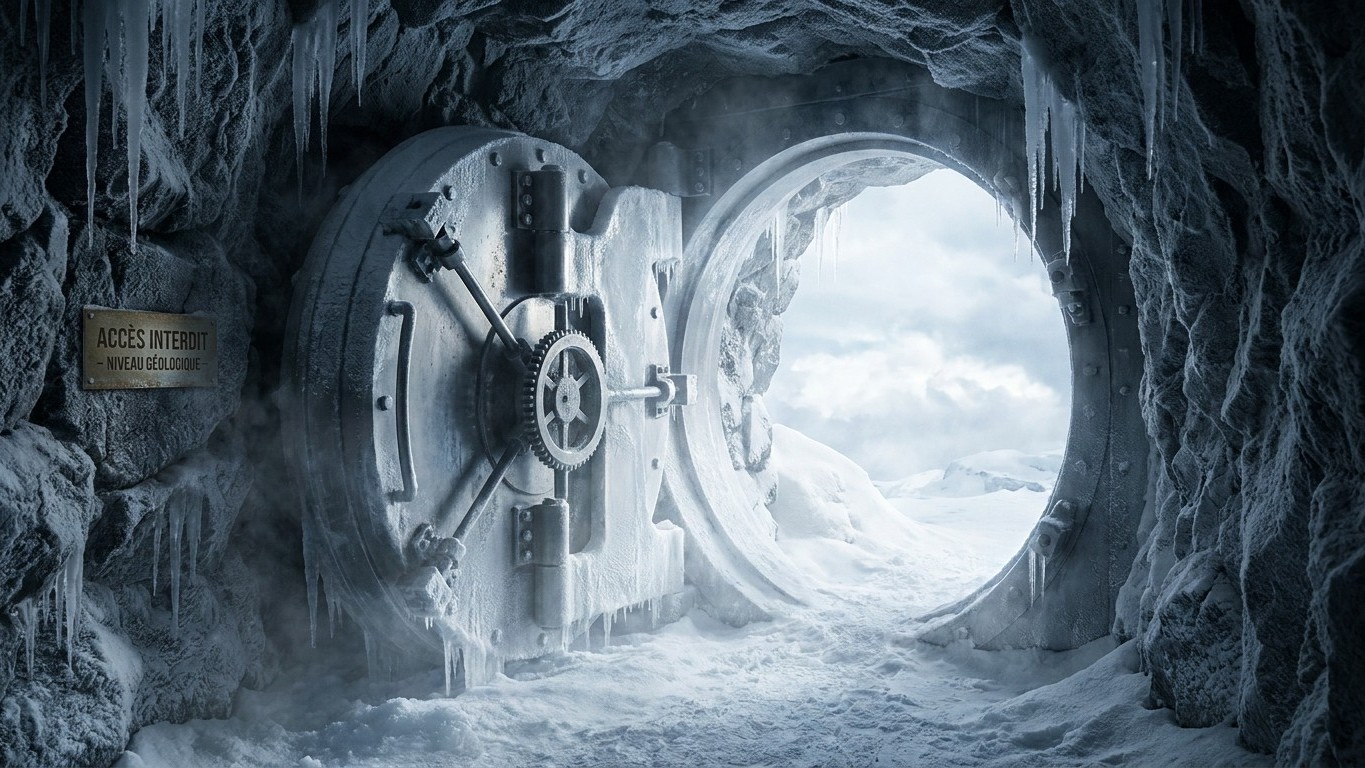
A hundred-meter tunnel carved into Arctic rock, more than a million seed samples stored like books on a shelf, and a door that let water in. On the Norwegian archipelago of Svalbard, less than 1,500 kilometers from the North Pole, the Global Seed Vault was designed to endure all imaginable catastrophes: war, earthquakes, widespread power outages. In October 2016, however, it was a far more mundane phenomenon, warming, that tested this fortress believed to be infallible.
Key takeaways
- An Arctic fortress supposed to be impregnable was compromised by a banal meteorological event
- Permafrost thaw infiltrated the access tunnel, threatening a million seed samples
- This vault has enabled one major rescue: the rebuilding of the Aleppo Syrian collection destroyed by war
A vault designed to operate without human intervention
The Svalbard Global Seed Vault opened its doors in 2008 on the Norwegian island of Spitsbergen, in a region so remote that it sits roughly 800 miles from the North Pole, where the ground remains permanently frozen. The idea behind the project could be summed up in one sentence: build a shelter that does not require anyone to operate it. The remoteness is considered a strength of the site: the mountain rock and the permanent permafrost should keep the seeds cold even if humanity can no longer supply electricity to the facility. In practical terms, if the generators failed tomorrow, the natural cold of the mountain would take over automatically.
This system works because the storage chamber is kept at a chillingly constant temperature. Inside, temperatures are maintained below minus 18 degrees Celsius, cold enough to preserve seed samples for at least 200 years, even without backup power. The site isn’t a mere national warehouse: it acts as a backup for seed banks around the world, which deposit duplicates of their collections there in case the originals are destroyed back home. Today there are close to a million seed packets stored there, a number that becomes dizzying when you realize that each packet can contain hundreds of seeds from a single variety of wheat, rice, or beans.
October 2016: when the thaw enters the tunnel
The vault’s passive security rested on a simple assumption: permafrost stays frozen year-round, end of story. But 2016 was a year of record global temperatures, and the Arctic did not stay exempt. The incident occurred on October 15, 2016, described as a water intrusion tied to extreme weather, with heavy rainfall and high temperatures. The result: meltwater seeped directly into the entrance of the access tunnel, where it was least expected.
The water did not reach the chamber where the seeds lie. In October 2016, the warmest year ever recorded, the permafrost thaw caused water infiltration for about 15 meters at the entrance of a 100-meter tunnel leading to the vault. The water then froze on the spot, forming a sheet of ice that the teams had to remove by hand, piece by piece. No samples were lost nor touched by moisture: none of the seeds were damaged, kept at the required storage temperature of minus 18 degrees Celsius inside the vault. But the image of a site marketed as impregnable, overwhelmed by water it was supposed to forever keep at bay, circulated worldwide and forced Norway to rethink its approach.
The Norwegian authorities did not delay. Substantial sealing work was undertaken, with a budget that speaks to the scale of the issue: about 1.7 million dollars were allocated to improvements of the vault. The project targeted several fronts at once. It included removing heat sources from the access tunnel, constructing drainage ditches on the mountainside to prevent meltwater from pooling near the entrance, erecting watertight walls inside the tunnel, and considering alternatives for a new access tunnel. What was meant to be a maintenance-free infrastructure is now continually monitored, corrected, and tinkered with, a paradox for a site marketed as humanity’s last line of defense.
Aleppo, the only withdrawal in the site’s history
Since opening, the vault has experienced only one instance where a seed bank had to recover what it had deposited there. The origin of the problem was neither an earthquake nor a flood, but war. The International Center for Agricultural Research in the Dry Areas (ICARDA), headquartered near Aleppo, Syria, had deposited most of its collection at Svalbard before the conflict rendered their own facility inaccessible. Although the 141,000 accessions comprising ICARDA’s active gene bank in Aleppo, amid war, were stored safely, they could no longer be regenerated or distributed to researchers and breeders.
The recovery happened in several waves. The institute carried out three seed withdrawals: the first in September 2015, the second in 2017, and the last in August 2019. The seeds retrieved were not simply stored elsewhere: they formed the starting point for rebuilding, seed by seed, a collection that had been lost on site. The seeds brought back allowed the establishment of new gene-bank facilities at ICARDA’s units in Terbol, Lebanon, and Rabat, Morocco. In total, the magnitude of the rescue gives an idea of what its loss would have signified: the Aleppo deposit from 2008 to 2014 comprised 116,484 seed samples, all now safely returned.
The Svalbard thus fulfilled, for the first and only time in its history, the function for which it was dug: to serve as a safety net when everything else collapses elsewhere. The Aleppo collection continues to be regenerated year after year at its new Lebanese and Moroccan sites, proof that a seed frozen in the Arctic can become a wheat field thousands of kilometers away, years later.
Sources: isaaa.org | archdaily.com
