
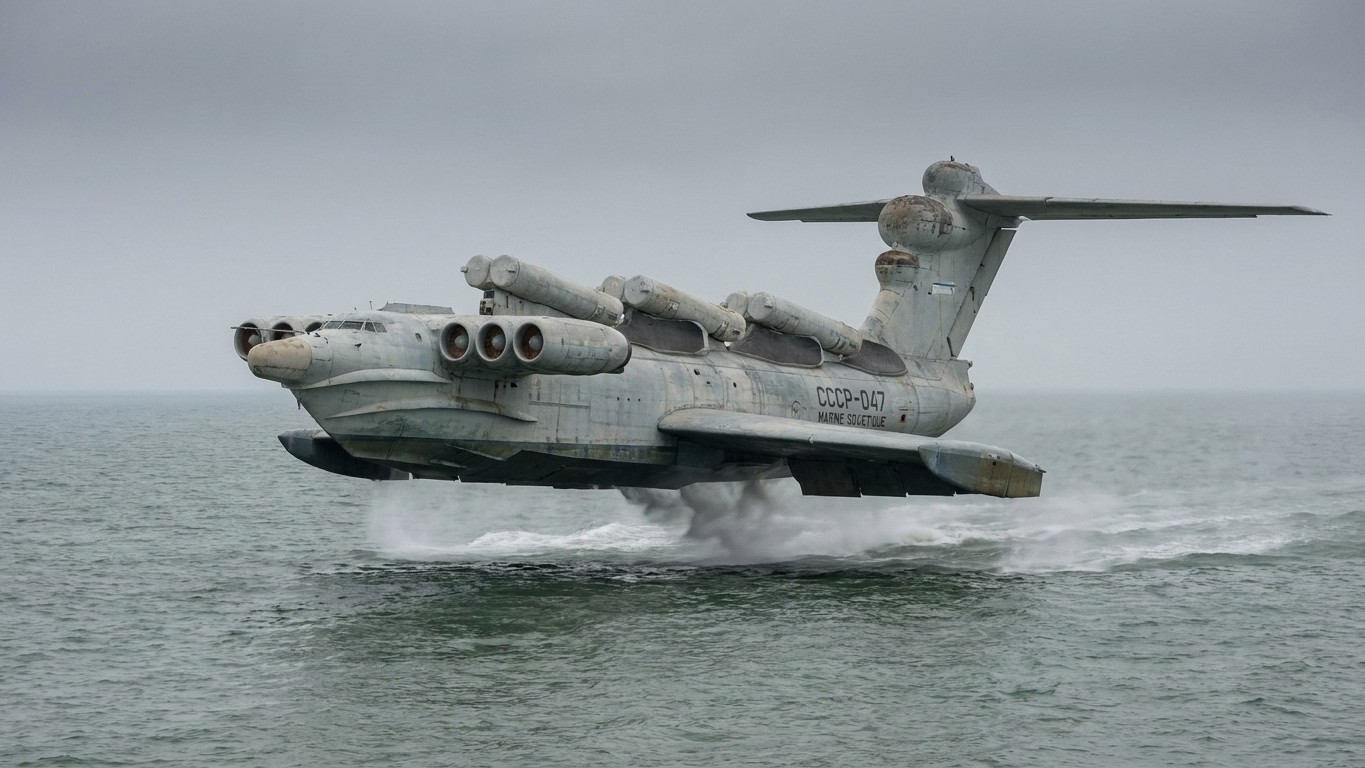
A 544-ton behemoth that could take off from less than 14 meters above the waves, driven by ten fighter-jet engines: this isn’t science fiction, it’s the Soviet KM, the heaviest craft ever built to fly before the Antonov An-225. Named “Korabl Maket” (literally “ship-model”) by its designers, it terrified American intelligence services for nearly twenty years before, one December day in 1980, it sank to the depths of the Caspian Sea.
To Know
- A Soviet engineer managed to lift a 544-ton vessel off the water by exploiting an obscure physical principle
- The Americans initially believed it was a secret Soviet weapon before understanding what they were watching
- The machine vanished to the Caspian depths, but its technical legacy lived on through later programs
An engineer’s bet that became a state obsession
Everything begins in the design offices of Gorki, today known as Nizhny Novgorod, where Rostislav Alexeyev—a hydrofoil virtuoso from the Central Hydrofoil Design Bureau—harnesses the “ground effect”: a cushion of high-pressure air trapped between a wing and the surface beneath it. The idea can be boiled down to a single sentence: fly extremely close to the water, within a wingspan’s distance, to minimize drag while maximizing lift, enabling the transport of colossal payloads at jet speeds with remarkably frugal fuel use. Drawn by the military potential of a craft that could skim under radar and dodge mines and torpedoes, the Kremlin opened the purse strings wide.
The product of this vision was the KM. It could reach about 544 tonnes at takeoff and stretched nearly 100 meters in length, longer than a Boeing 747. To lift off the water, engineers lined up ten Dobrynin VD-7 turbojets—two mounted at the back and eight at the front in a canard arrangement; the eight forward engines were shut down after liftoff, leaving the two rear engines to propel the machine in cruise flight. That layout explains the deafening roar heard by the handful of witnesses who observed its tests from the shore.
The KM’s first flight occurred on October 16, 1966, and it bore a rare mark in Soviet aviation: Alexeyev himself piloted the inaugural flight of his creation. A designer taking the controls of his own invention deserves noting. Even before this airborne baptism, the craft had been ferried under cover of night along the Volga to testing grounds near Kaspiysk, wrapped in tarps to escape prying eyes.
Not quite a ship, not quite a plane
Even the Soviet authorities didn’t know quite where to file this beast. Officially registered as a vessel, and before its first flight a bottle of champagne was shattered against its prow. It carried the flag of the Soviet Navy and was attached to the Fleet, simply because the ground effect works only within a few meters of the surface. A cargo ship in disguise, in a sense, but entrusted to pilots from the air force.
From above, the machine resembled a passenger airliner with the outer portions of its wings removed. That paradox is what perplexed American analysts. The United States first spotted the Caspian Sea Monster via spy-satellite imagery, which stirred some alarm: at the outset they had no idea what it was or what function it served. The CIA eventually dubbed it the “Caspian Sea Monster,” while KM stood for nothing more ominous than a “prototype of a vessel.” For years, narratives circulating in Western intelligence about this gigantic machine were often dismissed as exaggerated Soviet propaganda, given how unlikely a 544-ton craft could move at 500 km/h.
On paper, however, the capabilities were genuine. It could reach a top speed of 500 km/h, cruise at about 430 km/h, and cover roughly 1,500 kilometers, operating at a ground-effect altitude between 4 and 14 meters. Skimming the waves at that height, it remained almost invisible to the radars of the era, effectively a stealth freighter before the word “stealth” entered military vocabulary.
December 1980: the ending in the fog
Over fifteen years, the KM carried on with tests on the Caspian, undergoing eight modifications across various test campaigns. But in December 1980, everything changed during a takeoff maneuver. The aircraft crashed into the Caspian Sea while attempting to lift off with insufficient power. A seemingly mundane human error, but fatal for a craft of such mass operating at such a low altitude: the slightest deviation in pitch was enough to make a wing or hull kiss the water.
Fortunately there were no casualties. Yet the giant was lost. A salvage attempt was made, but the airframe broke apart during lifting operations. Too heavy, too fragile once damaged, it could not be hoisted from the water without further dismantling. It sank and has rested there ever since, somewhere in the Caspian, at a location that even the most persistent researchers have never been able to pinpoint with certainty due to the absence of accessible archives.
The KM never produced a direct successor, but its technical heritage fed the Lun-class—a ground-effect ekranoplan armed with anti-ship missiles—of which the sole operational example served first in the Soviet, then the Russian, navy before being decommissioned in the late 1990s. Today, stranded on a Dagestan beach and repurposed as an odd tourist attraction, this successor serves as a reminder that a period existed when the USSR believed it could make ships fly along the waves. The dream never truly took off on a large scale, but one of aviation history’s most extraordinary hulls lies at the bottom of the Caspian Sea.
Sources: defenceaviation.com | cnn.com
