
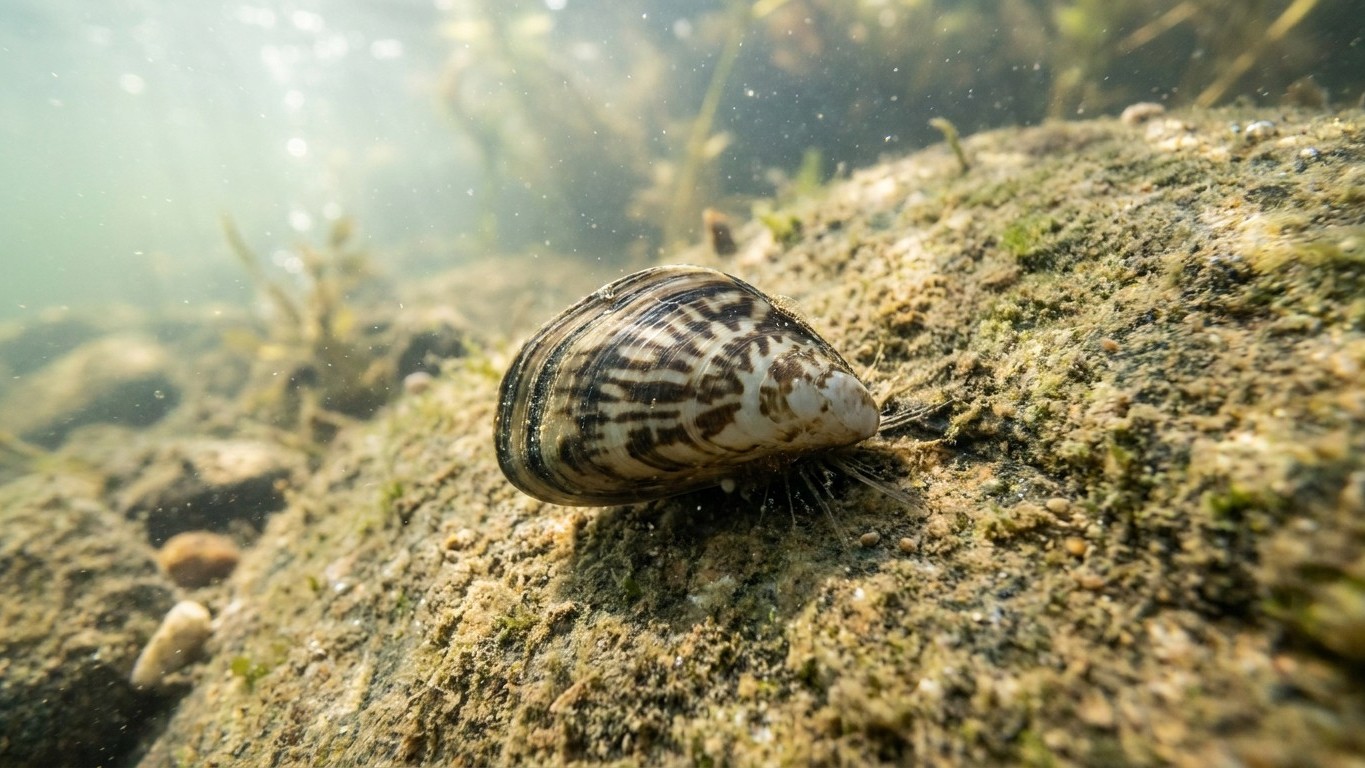
One million eggs per female, an ability to cling to any hard surface, and a handful of cargo ships from Europe: that was all it took to upend the ecosystem of North America’s Great Lakes. The story begins quietly in 1988, when transoceanic vessels discharge ballast water into these freshwater waters. The species entered North America in the early 1980s and was officially recorded in the Great Lakes in 1988. It is called the zebra mussel, and it originates from far away, hailing from the Black Sea and the Caspian Sea.
Key Takeaways
- Can a microscopic stowaway riding in ballast water truly transform an entire ecosystem?
- Does the crystal-clear water of the Great Lakes mask an invisible ecological disaster?
- Why have the Great Lakes’ infrastructures become a perpetual battle against a microscopic creature?
A Stowaway Aboard Ballast Water
The mechanism is brutally simple. When ships reach their destinations and discharge their ballast tanks, they release exotic plants, crustaceans, worms, bacteria, and other organisms into local waters. An American biologist, Jim Carlton, had already theorized the phenomenon three years earlier: a landmark 1985 study described how ballast water discharges served as a powerful vehicle for biological invasions. No one paid attention in time.
The ensuing years resembled a population explosion worthy of a disaster movie. Quickly, striped bivalves covered the hard surfaces of the lakes and stranded on shorelines, injuring the bare feet of swimmers. Authorities responded, but belatedly and with glaring gaps. The United States began regulating ballast water management in 1990, but ships that claimed they had no ballast water to pump aboard did not have to drain and refill their tanks with clean seawater mid-voyage. The result: organisms continued to slip through the breach. It would take until 2006 for the United States and Canada to require, after thorough studies, that ships rinse their tanks.
Water Turns Crystal Clear… and an Ecological Trap
Here lies the paradox that makes this story so fascinating: the zebra mussel has visibly cleaned the water of the Great Lakes, while quietly starving underwater life. In Lake Erie, the change was dramatic. Since the mussel’s establishment, water clarity rose from about 15 centimeters to as much as 9 meters in some zones. In Lake Michigan, the effect was no less impressive: clarity doubled in certain areas, to the point that tourists and boaters could suddenly see to the bottom.
The mechanism is purely mechanical: each mollusk acts as a tiny individual treatment plant. Each zebra mussel can filter about a liter of water per day, removing almost all microscopic plankton, both animal and plant. Multiplied by colonies reaching dizzying densities, the cumulative effect literally empties the water column of its base food. In Lake Michigan, phytoplankton levels have fallen by 90% since the mollusks arrived.
The problem is that this plankton nourished everyone higher up the food chain. By filtering plankton, the mussels starved the base of the food web, and native species that depended on it, including fish larvae and plankton-eaters, saw their food supply collapse. The basin’s commercial fisheries bore the consequences directly. And the clearer water has another perverse effect: it allows light to penetrate deeper, promoting the growth of filamentous algae like Cladophora on the bottom, a plant that consumes oxygen and can harbor bacteria responsible for botulism in piscivorous birds.
Clogged Pipelines, Power Plants Under Pressure
As the ecosystem reconfigures itself at depth, another front opens on the surface: the infrastructures. The zebra mussel does not target only fish; it colonizes pipes as well. Zebra mussels clogged the intake pipes of drinking-water treatment plants, power stations, fire hydrants, and even nuclear reactors, dangerously reducing water pressure and driving up repair costs.
The bill is staggering. The costs of monitoring and damages to systems, just in the United States, are estimated at about one billion dollars per year. Some patents filed in the 1990s already painted an even gloomier picture, with an invasion potentially costing between 2 and 5 billion dollars over ten years. On the Canadian side, a single Ontario electric utility spent up to 10 million dollars merely on chlorine to keep the mollusks away from its plant intakes.
How Operators Keep Their Pipes Open Today
Nearly four decades after the invasion, the zebra mussel has never been eradicated from the Great Lakes; it has become a permanent resident with which daily life must cope. The most common method remains chemical: chlorine is regarded as the most effective and widely used chemical control, injected into pipes during the breeding season to kill larvae before they settle. But this solution has limits, as chlorine is a powerful oxidant increasingly regulated by environmental rules.
Other approaches, borrowed from European experience, focus on infrastructure design itself. European plants use short, double-entry pipes that can be alternately shut down for cleaning, and keep water moving rapidly to prevent larvae from attaching to walls. Filtration, ultraviolet treatment, anti-adhesive coatings, and mechanical cleaning complete today the toolkit of North American operators, who alternate continuous monitoring with targeted interventions as soon as colonies exceed a critical threshold.
The fight is far from over, and it has even spread to new territories: the zebra mussel is now recorded in the waterways of 32 U.S. states, the quagga mussel in 19 others, and a cousin from Asia, the golden mussel, was spotted in California in late 2024. In response to this progression, the U.S. federal agency in charge of large dams launched an innovation contest worth 200,000 dollars to find new countermeasures. One thing is certain: along the shores of the Great Lakes, the water has never been clearer, and maintenance crews have never had so much work.
Sources : theconversation.com | canada.ca
