
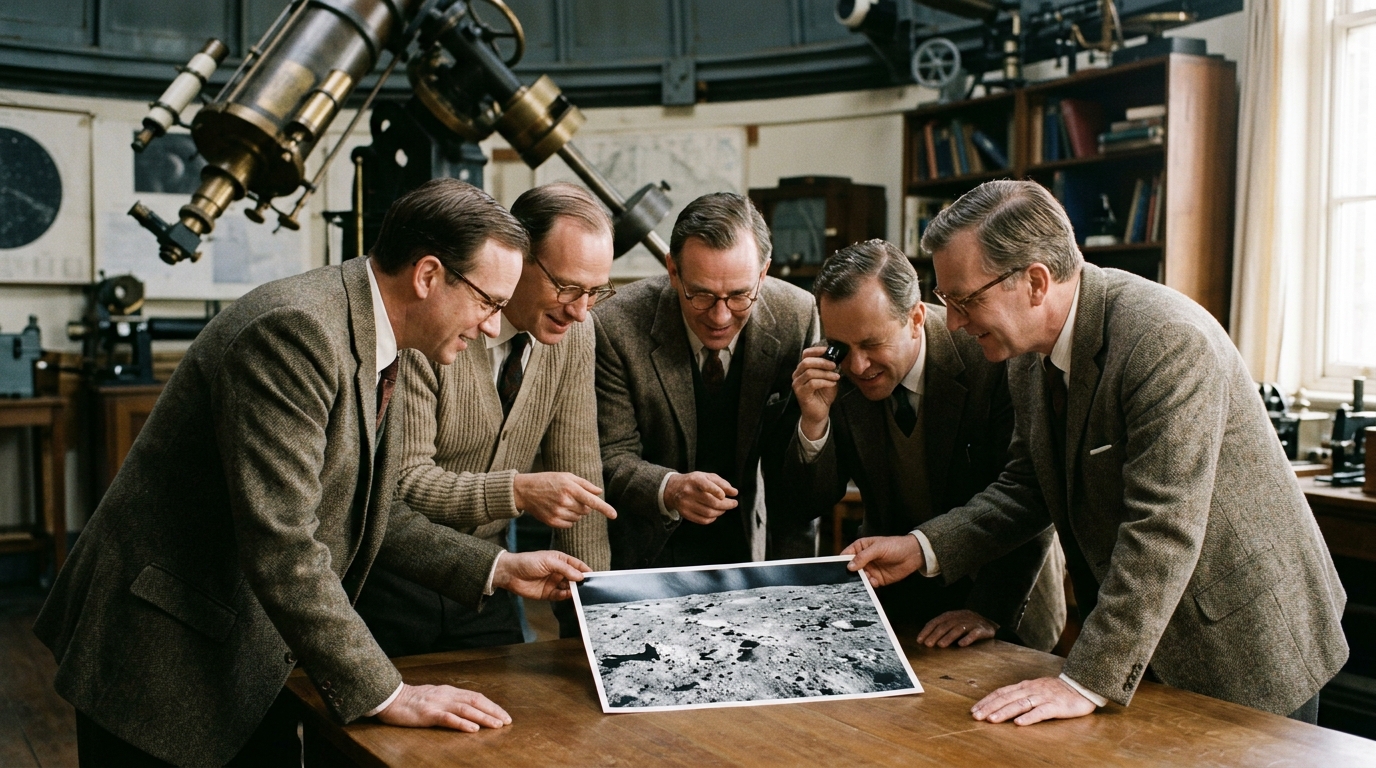
Missing this Moon landing would have risked overturning years of effort and the secrets carefully guarded by the Soviet space program. After a series of high-profile failures on the Moon, another setback could have given the Americans a psychological opening in this race that began with the launch of Sputnik. Yet in February 1966, the USSR finally pulled off the feat: a probe landed safely on the lunar surface and began transmitting. The technical achievement is undeniable. But history remembers most vividly an unforeseen twist: the first Moon images were not published in Moscow, but in London, just hours before the Kremlin could relish its victory in private.
Key takeaways
- In February 1966, the Soviet Luna 9 mission achieves the first soft landing and begins transmitting data from the lunar surface.
- The British Jodrell Bank Observatory captures this signal and, using a press fax decoder, reconstructs the images before their official publication in the USSR.
- These images are published by the British press before Moscow reveals its own pictures, highlighting the strategic importance of controlling information during the space race.
- Jodrell Bank, the discreet ear that spied Luna 9
- A press fax against a space signal: improvised decoding
- London publishes, Moscow fumes: the race for first images
- What this episode reveals about the space Cold War
Jodrell Bank, the discreet ear that spied Luna 9
At the time, a British observatory named Jodrell Bank, tucked away in the Cheshire countryside, housed one of Europe’s most powerful radio telescopes. Its official mission was to survey the universe, but its teams also kept a close eye on Soviet space activities, in a climate of Cold War vigilance where every rocket launch was scrutinized. When the Luna 9 probe landed on the Moon, British scientists immediately pointed their giant antenna toward the signal source, without waiting for any formal authorization or announcement from Moscow.
What they captured was far from trivial: a stream of radio data, subtle yet real, that seemed to correspond to an image transmission. The researchers quickly understood they might be looking at something the Soviets hadn’t planned to share immediately. The affair took on a nearly spy-novel twist, where technology became the silent weapon in a much larger rivalry.
A press fax against a space signal: improvised decoding
The real stroke of genius did not come from high-tech space equipment, but from an almost artisanal shortcut. The engineers at Jodrell Bank noticed that the format of the captured signal bore a striking resemblance to the press fax machines of the day, used to relay photographs to the British press rooms. The idea quickly formed: what if they tried to decode this Soviet stream with nothing more than everyday equipment designed for an entirely different purpose?
The gamble paid off. In moments, a grainy but recognizable image began to emerge: the lunar surface, with its rocks and desolate horizon, appearing on the fax paper. This makeshift technical fix, almost comical in its simplicity, allowed British scientists to glimpse the Moon’s surface before Soviet officials had officially released any photograph. The achievement owed as much to ingenuity as to chance, but it radically altered the course of events.
London publishes, Moscow fumes: the race for first images
Faced with this improvised visual treasure, the Jodrell Bank team did not hesitate. The images were sent to the British press, which published them without awaiting anyone’s approval. The result was immediate: London newspapers splashed on their front pages unprecedented views of the lunar surface, while Moscow, for its part, had not yet decided when or how to unveil its own photographs to the world.
The Soviet reaction was swift, albeit officially guarded. They downplayed the incident, questioned the legitimacy of images captured without authorization. But in practice the damage was done: the USSR, which had achieved a major scientific milestone, found itself deprived of control over its own communications. This episode illustrates how, in that era, information could be almost as valuable as the technical achievement itself.
What this episode reveals about the space Cold War
This anecdote, seemingly minor, highlights a deeper reality of space conquest during the Cold War: every technological advance was watched, monitored, and sometimes even diverted by third powers. The United Kingdom, without launching a single rocket toward the Moon, found itself at the heart of a historic moment simply thanks to its strength in radio astronomy and a healthy dose of audacity.
The episode also reminds us that information control was a strategic stake. The Soviets had achieved a flawlessly executed lunar landing, a definitive world first, but they lost the information war to a simple radio telescope and a press fax. A striking contrast between the scale of the scientific achievement and the fragility of controlling its narrative.
Hard not to view this story as a symbol of an era when space became the arena of total rivalry, even in how its feats were told. Today, as new lunar missions are being planned around the globe, this British anecdote invites reflection on who, this time, will best master the narrative of the next great lunar adventure.
