
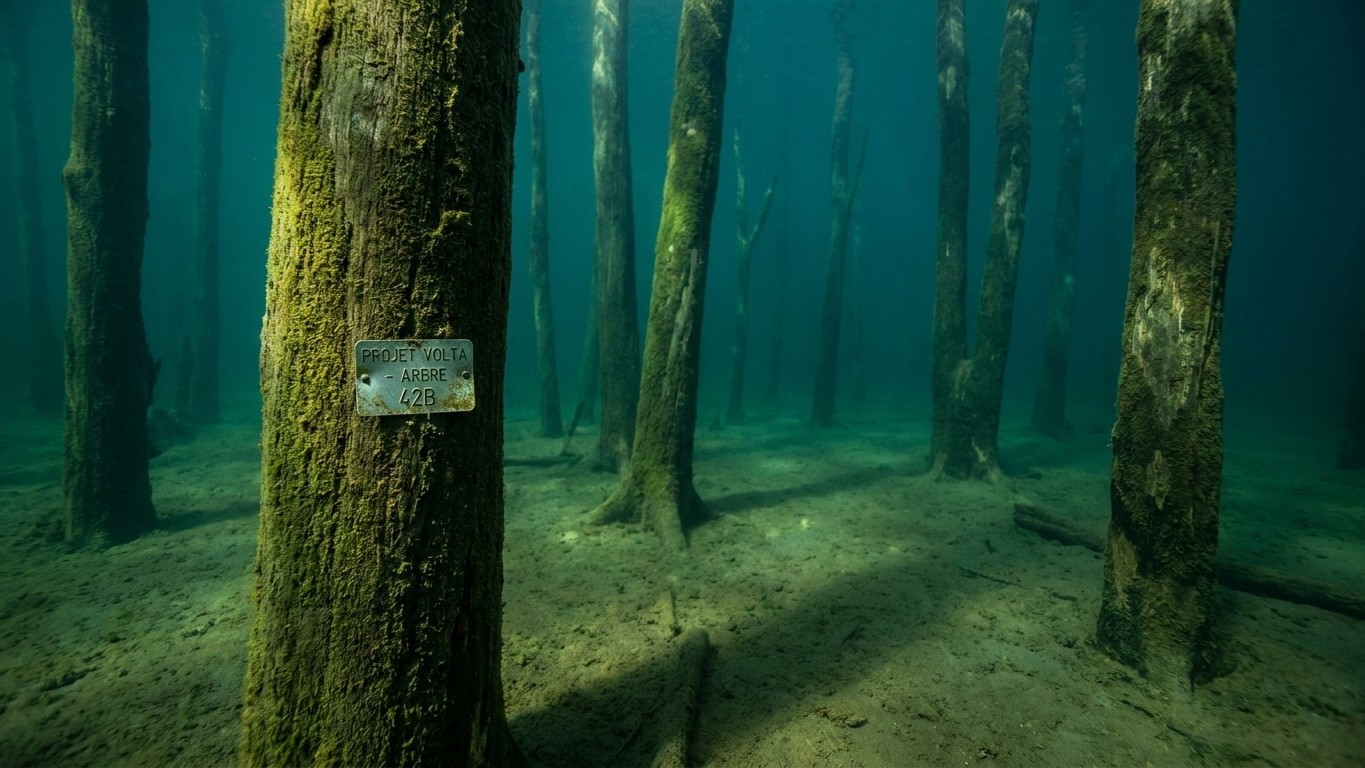
A dam on the Volta River was completed in 1965, and 8,500 square kilometers of forest disappeared beneath the rising waters within a few months. There was no prior logging, no systematic clearing: the trees remained standing, roots anchored in the soil, trunks pitched toward a surface that climbed inexorably. Six decades on, this submerged timber has not rotted; it has even become one of the most sought‑after deposits of tropical wood on the African continent.
The story begins with Ghana’s independence and a colossal industrial gamble. The Akosombo Dam is a vast hydroelectric project on the Volta, built by the Ghanaian government between 1961 and 1965, shortly after the country gained independence. Its construction flooded the Volta basin, creating the world’s largest artificial lake. The priority was not to preserve a landscape but to provide electricity: the dam’s primary function was to supply power to the aluminum industry. A choice that reveals the era: build quickly, prioritize industry over forest heritage.
Key Takeaways
- An entire forest remains perfectly preserved beneath 60 years of stagnant, oxygen‑deprived water
- The exploitation of this sunken wood could be worth billions, but at what ecological cost?
- Local fishers worry about impacts on the lacustrine ecosystem and their livelihoods
78,000 Lives Displaced for a Lake
Beyond the surface-area figures lies a sweeping human displacement. When the dam was completed in 1965, it forced the relocation of 78,000 people, along with 200,000 of their animals, while about 120 structures and countless small dwellings were destroyed. Entire villages had to be rebuilt on higher banks, away from valleys where families had grown up. Some sources place the figure at 80,000 displaced, the equivalent of a mid‑sized French city erased from the map and reconstructed elsewhere, with little meaningful consultation about what would happen to the lands now submerged.
The lake that emerged is far from trivial for the country. The Volta Lake covers 3.6% of Ghana’s total land area, and the dam quickly proved its usefulness beyond the aluminum smelter: in general, the project benefited industrial and economic activities, opening new navigable channels and boosting the yield of fishing and aquaculture. Yet beneath this placid surface, an entire landscape waited, immobilized, for someone to rediscover it.
Why the Wood Does Not Degrade
The decomposition of timber requires oxygen and the activity of fungi or wood‑eating insects. Deprived of air, a submerged forest enters a form of chemical hibernation. When reservoirs and artificial lakes are created, vast swaths of forest are flooded; even though the trees die, the wood is often preserved. On Volta Lake, the phenomenon is unprecedented in scale: today the lake hosts a vast underwater forest housing millions of submerged trees across its 8,500 square kilometers.
The result even astounds local scientists. A recent Ghanaian study notes that thousands of large tropical hardwoods, with densities comparable to oak, are preserved underwater, the anaerobic conditions and peatland acidity having prevented decay and reinforcing their solidity. Wood that spent half a century submerged and sometimes emerges even more durable than before. It is hard to find a stronger argument against the idea that submerged timber is always doomed timber.
The Plunge Saw: An Industry Born Fifty Years Later
It took until the 2000s for someone to seriously investigate the value of this sunken treasure. In 2010, a Canadian company, Clark Sustainable Resources Development (CSRD), was authorized by the Ghanaian government to harvest the submerged timber from the lake. The agreement is not new: Triton/CSRD secured rights over 350,000 hectares for 25 years, a deal ratified by Parliament at the end of 2010.
On the ground, the technique employed is high‑precision rather than a simple manual sawing operation. The SHARC technology preserves tree roots to avoid disturbing the lakebed or kicking up pollutants. In practice, aided by video and sonar, the device can maneuver independently of boats and anchors, locate, cut, and retrieve the trees with a telescopic arm—faster and deeper than traditional operations conducted by divers. A submarine robot, in essence, carrying out the work that no logger could perform safely at such depths.
The trees retrieved are not just any firewood. SHARC operators have identified sizes, qualities, and mixes of species with promising potential, including odum, ebony, and mahogany—woods that have become rare or threatened in Africa’s living forests. The economic value is dizzying: estimates place these submerged timbers among the world’s most valuable sawlog resources, with conservative estimates of gross value ranging from 1 to 2 billion dollars, and some projections going as high as three billion. A figure that surpasses the annual budgets of several Ghanaian ministries combined, for wood that nobody had intended to exploit.
A Resource That Does Not Make Everyone Happy
All is not peaceful beneath Volta Lake’s surface. Local fishermen fear the consequences of large‑scale extraction. Some fishermen around the lake worry that underwater logging will disrupt fish habitats and degrade water quality, undermining their ability to earn a living. A recent university study goes further, describing the project as primarily benefiting corporations and the state: the extraction of lake timber has restricted fishermen’s access to the lake in pursuit of livelihoods, while the state and extractive companies accumulate profits at the expense of fishermen and landowners.
Yet there is a tangible and rarely contested benefit: navigational safety. Those submerged trees, invisible beneath the surface, have long posed a real hazard to vessels crossing the lake. Removing the trunks closest to the surface also prevents fishermen from colliding with a petrified treetop at night, after six decades underwater.
One question remains, one that few reports address head‑on: what happens to the ecosystem that developed around these dead trees over half a century? On other dammed lakes, such as in French Guiana, the companies harvesting submerged timber first convert the canopies into artificial reefs before extracting the trunks, a way to avoid abruptly depriving fish and birds of habitat they have occupied for generations. On Volta Lake, this coexistence between commercial exploitation and the aquatic ecosystem remains the real challenge for the coming decades, far more than simply how many billions lie sleeping beneath the water.
Sources: reporterre.net | directtriphub.com
