
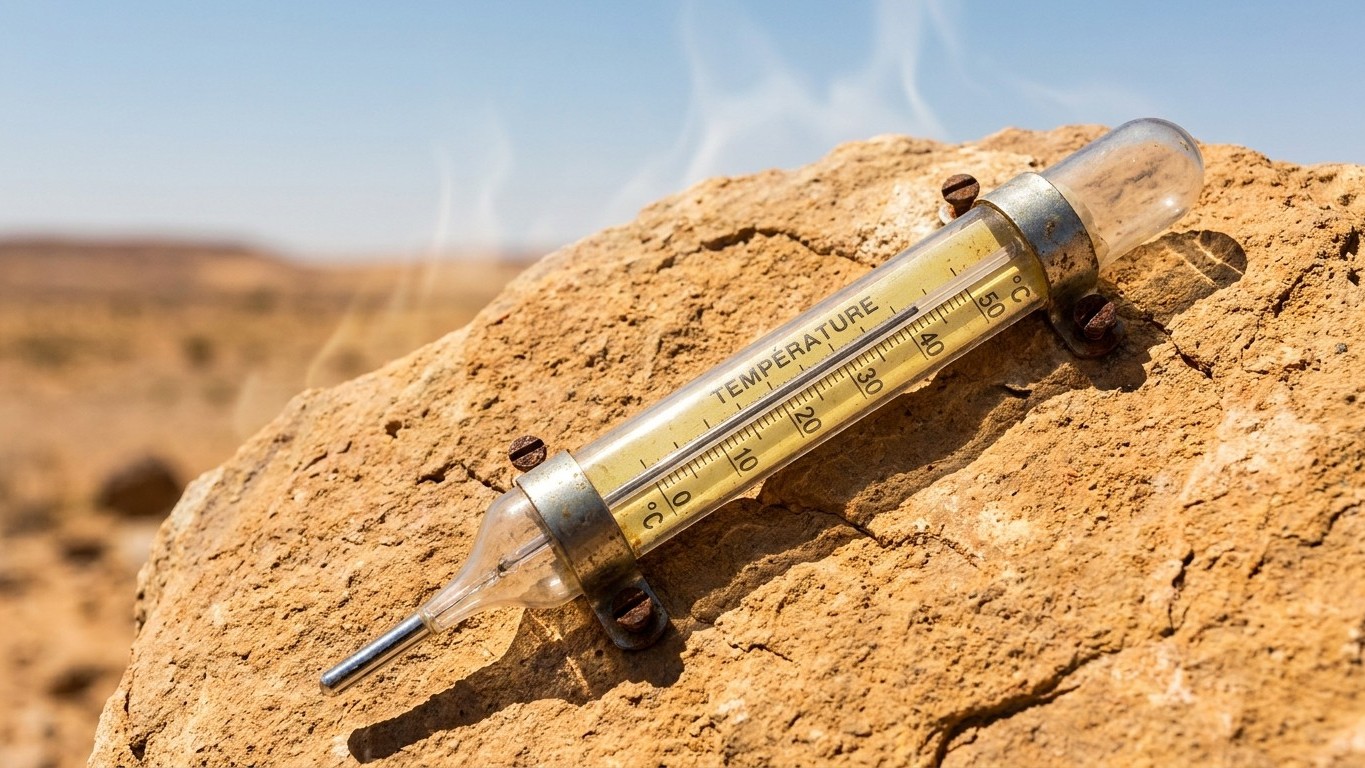
The figure still looms in the official records: 56.7 °C, logged on July 10, 1913 at Greenland Ranch in Death Valley. A world record that has never been beaten since, nor ever officially withdrawn, yet nearly all climatologists who have studied it today regard it as fraudulent. What is wrong with this story is not the reliability of the hottest desert in North America, nor a poorly calibrated thermometer. It is a human being, a scorching day, and a weather station that produced numbers that nothing around it corroborates.
Key Takeaways
- An inexperienced observer recorded the planetary temperature record without any cross-checks
- Nearby stations completely dispute the day’s weather conditions
- A recent study estimates the true figure would have been about 14 degrees Fahrenheit lower
A Lone Observer Against a Thermometer
The Greenland Ranch station had only recently come into use when the heat wave struck. A weather station had been established there under the United States Weather Bureau in June 1911, named “Greenland Ranch.” Two years later, it was the ranch keeper, Oscar Denton, who kept the daily readings. He collected the record measurement during a week of brutal heat in the summer of 1913, when the temperature reached 127 °F each day and exceeded 130 °F on three occasions. The climatologist William Reid, who has spent decades poring over this dossier, does not mince words: he describes Denton as a relatively inexperienced observer, more interested in accolades than in scientific rigor, going so far as to say he seems to have invented the data. A week later, this man alone, with no cross-check possible on site, had signed the measurement as the most extreme record ever recorded on Earth.
Nearby Stations Tell a Different Story
An isolated record happens. A record that does not align with any other data in the region is more troubling. The investigation led by meteorologist Christopher Burt (who himself sat on the team of the World Meteorological Organization tasked with reviewing such records) showed that the temperatures recorded at Greenland Ranch in July 1913 were not coherent with the region’s other weather conditions, with no evidence of an extraordinary heat wave in the American Southwest at that time. That day would have required a localized and brutal phenomenon to justify such a discrepancy, and nothing supports this. The most telling detail comes from the raw numbers: the monthly peak at Greenland Ranch exceeded its July average by 18 °F, while nearby stations displayed only 7–11 °F deviations. The measurements simply did not match the surrounding weather. And since then? No other station within 150 miles has shown unusually high readings during that period, and Death Valley has not recorded a 130 °F day in over a century.
A Recent Study Reopens the Case
The matter could have remained a curiosity for a weather blog. It took a more serious turn recently. A study published in the Bulletin of the American Meteorological Society cast doubt on the veracity of those observations, concluding, after analyzing broader weather conditions and nearby stations, that the first two weeks of July 1913 were “artificially warm” at the Death Valley observation site. The researchers, including scientists from the University of Alabama in Huntsville associated with William Reid, went so far as to quantify the gap: the actual peak that day would have been around 120 °F, roughly 14 °F lower than what the record claims. Fourteen degrees Fahrenheit is not a margin of miscalibrated equipment. It is the difference between a brutal desert afternoon and a physical impossibility given what we know about the atmosphere.
Why the Record Still Stands
Here lies the paradox. The World Meteorological Organization did not hesitate to settle a similar case: in 2012, it officially invalidated what had long been considered the hottest temperature ever measured on Earth, a reading of 58.0 °C (136.4 °F) at El Azizia, Libya, on September 13, 1922. It is precisely this annulment that propelled Death Valley to the top of the list: with the Libyan record withdrawn, the Greenland Ranch reading of 134 °F (56.7 °C) on July 10, 1913 became the highest air temperature recorded on the planet by default. A disputed record inherited the crown from another record already debunked for nearly identical reasons: an inexperienced observer, questionable equipment, and a temperature out of step with the surrounding environment. Yet no official procedure has ever formally removed the 1913 figure from the global tables. It remains, like an old file never closed, cited in textbooks and infographics even as those who studied it more closely call it “essentially impossible meteorologically,” in the words of William Reid.
The Death Valley area has not approached that level since. The highest officially recorded temperatures since 1913 top out several times at 129 °F (53.9 °C), observed in July 1960, then in 1998, 2005, 2007, and June 2013. A five-degree Fahrenheit gap that has never closed over more than a century of measurements, despite documented climate warming. The back-to-school period of this year promises long, summery skies across much of the country, and another late-summer heat episode is foreseen for early September, though no precise figures have yet been established. A reminder, once again, that a temperature reading, however spectacular, is only as good as the rigor of the person wielding the pen.
Sources: stormbruiser.com | pvtimes.com
