
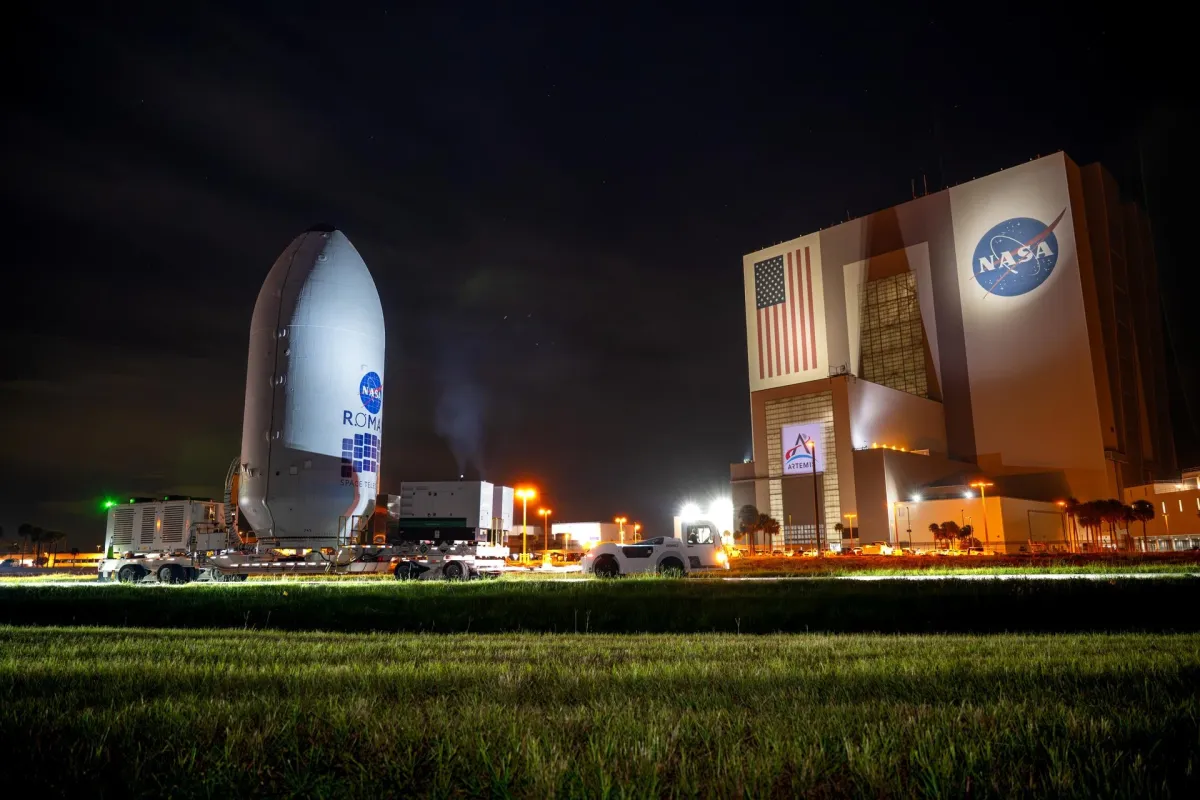
A few days ago, NASA successfully launched its brand-new astronomical observatory, namely the Nancy Grace Roman Space Telescope. On the program: to pierce the secrets of dark energy, study dark matter, and detect numerous exoplanets. What technologies does this new telescope carry onboard?
On the Way to the L2 Lagrange Point
According to an official press release, the Nancy Grace Roman Space Telescope (formerly WFIRST) lifted off smoothly on August 30, 2026, aboard SpaceX’s Falcon Heavy rocket. It is currently en route to its final orbit at the L2 Lagrange point, which lies about 1.5 million kilometers from Earth. This marks NASA’s new flagship astronomical observatory.
On August 21, the agency had given the green light for the preparation of the final launch steps. Mission managers had then reviewed the telescope, the rocket, and the launch facilities before granting their approval for the next steps. The day before, operators had carried out a full simulation of the operations planned for Day One, including steps such as powering up the satellite and refueling, among others.
What Are the Telescope’s Objectives?
According to NASA, the telescope’s main objective will be to pierce the secrets of dark energy, through the study of supernovae and baryon acoustic oscillations (BAO). It will also map dark matter to better understand how its gravity shapes visible matter. Finally, the device will aim to census thousands of new exoplanets.
« Roman is about to undertake revolutionary surveys that will impact all fields of astronomy. We will conduct an extraordinary census of planets around other stars and will be able to confirm current hints suggesting that our standard model of the universe is flawed, thereby setting us on the path to discovering the correct model. », said Julie McEnery, the project’s principal investigator, during a July 2026 presentation, as reported by Space News.
Unprecedented Capabilities
To be precise, the Nancy Grace Roman telescope boasts a revolutionary field of view. In fact, while its primary mirror matches the size of Hubble’s—2.4 meters in diameter—its technology delivers an unprecedented level of observational power. In practice, each captured image will cover a field of view a hundred times larger, with the same level of sharpness. The new telescope will also be able to map the sky a thousand times faster than its predecessor.
The instrument carries the Wide-Field Instrument (WFI), capable of measuring the position and shape of billions of galaxies and tracking thousands of supernovae. It also includes the Coronagraph Instrument (CGI), a technology-demonstration tool designed to block starlight. In other words, it will be possible to directly photograph exoplanets that are typically hidden by the glare of their star. The telescope will notably employ gravitational microlensing. When one star passes directly in front of a more distant star, the gravity of the foreground star acts as a lens and magnifies the light of the background star. If the foreground star hosts a planet, it produces a small, distinct blip in brightness.
Finally, current observatories like Kepler or the Transiting Exoplanet Survey Satellite (TESS) mainly detect planets very close to their star. By contrast, the Nancy Grace Roman will be able to detect planets situated far from their sun. It will also be capable of finding rogue planets—planets wandering through space without a host star.
