
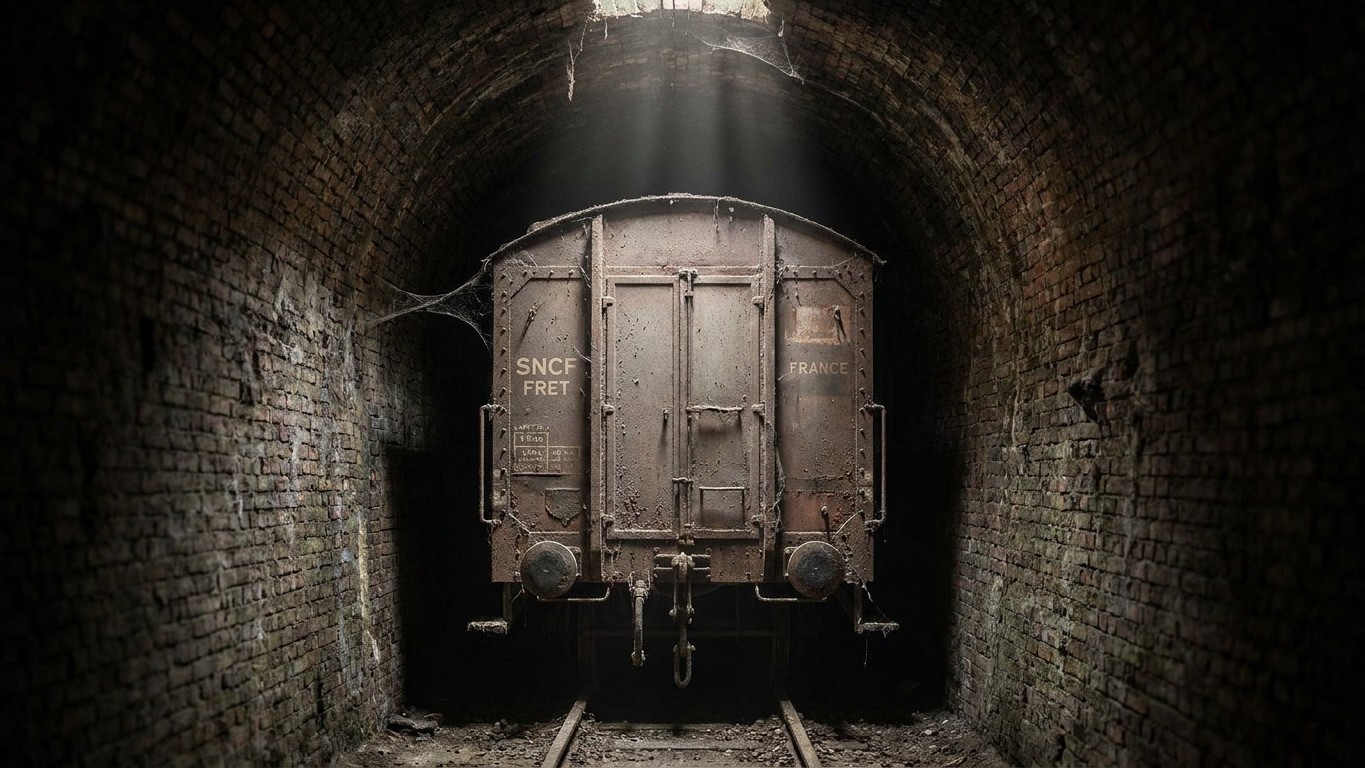
Under the Waldorf Astoria in New York, a secret rail siding has slept for decades, directly connected to Grand Central’s network. At the end of this forgotten track, an old wagon has stood motionless for decades, in the darkness of a tunnel that almost no one has ever seen with their own eyes. What this setup admitted into the hotel wasn’t trunks or freight shipments: it was men who wished to vanish, for the duration of a journey, from public view.
Key Takeaways
- A secret rail line beneath the Waldorf Astoria allowed VIPs to enter the hotel discreetly without public view
- The wagon legendary associated with Roosevelt was, in reality, just an industrial equipment baggage car
- This forgotten place hosted presidents, generals, and even an underground party before becoming a holy grail for urban explorers
A Platform Built for Industry, Diverted for Luxury
Track 61 is a storage spur adjacent to a private Metro-North Railroad rail yard, located beneath the Waldorf Astoria New York in an underground courtyard northeast of Grand Central Terminal. It is part of a much larger complex: Lex Yard, a twelve-track storage court beneath the hotel, where Track 61 shares its platform with Track 63. Originally, nothing in this place suggested it would welcome presidents. Tracks 61 and 63 were first built to haul freight and serve as the loading dock for a steam plant that powered Grand Central and the surrounding buildings.
Everything changed in 1929. When the Waldorf Astoria acquired the air rights above these tracks, it also inherited the lower rail. The New York press quickly picked up the story: the future hotel would boast a private rail line beneath the building, allowing guests with their own wagons to have them hauled directly to an elevator that would take them to their suites. The logic was simple, and terribly exclusive: why confront the crowds of a train station when you could step off your wagon directly beneath your hotel?
Pershing, Roosevelt, and the Art of Not Being Seen
The first name linked to this platform isn’t a president, but a general. General John J. Pershing is said to have been the very first to use this secret entrance in 1938, after suffering a heart attack and needing to spare himself unnecessary effort. But it is Franklin D. Roosevelt whose Track 61 entered legend. The president, who endured the effects of polio, would have used this hidden entry partly to conceal his disability from the public.
The installation impresses with its scale. The elevator, nearly two meters wide, was designed to receive an armored car weighing about 2,700 kilograms. According to a former Metro-North spokesperson, Dan Brucker, everything was sized so that Roosevelt’s armored Pierce-Arrow limousine could descend from the train, roll to the platform, and then enter directly into the freight elevator. The image is captivating: a presidential car swallowed by an elevator, somewhere beneath the kitchens and drawing rooms of one of the world’s most photographed hotels. Historians have, however, documented only a single certain occasion on which Roosevelt is believed to have used Track 61, on October 21, 1944, during a campaign trip to New York.
The Myth Shatters: A Wagon, but Not the One We Believed
Here the story takes an unexpected turn. For years, the wagon abandoned at the end of the track was billed as Roosevelt’s personal vehicle. An investigation conducted after the vehicle’s relocation dispelled this belief. After being moved to the Danbury Railway Museum in Connecticut, the wagon was identified as New York Central Baggage Car No. 002, not a vehicle that had belonged to Roosevelt, contrary to what a former Metro-North historian had long claimed. The oversized doors presumed to have permitted the presidential limousine to pass through turned out to be standard-sized for the era, and the car would, in any case, never have managed the turn needed to enter the wagon. In reality, this baggage car had been used to carry rigging equipment for a hundred-ton electric crane employed in Grand Central’s tunnels, before being left abandoned on Track 61. The Danbury museum estimates the wagon remained motionless beneath Grand Central for twenty to thirty years.
The relocation of the vehicle in 2019 made this revision possible. On May 31, 2019, the baggage car was hauled by a locomotive to the Highbridge shop in the Bronx for inspection and restoration. The legend of the presidential car thus does not fully withstand the careful scrutiny of railroad archives, even though the idea of discreet passage for notable figures remains perfectly valid.
A Relic Still Off-Limits to the Public
Roosevelt was not the only VIP to take advantage of this shortcut. Every American president from Herbert Hoover in 1931 through Barack Obama has stayed in the Waldorf Astoria’s presidential suite, and Track 61 long served to quietly transport presidents and senior military or governmental officials to the hotel. A spokesperson cited by the press even noted that Track 61 is regarded as an important evacuation route should a president need to leave New York urgently.
The site has also seen more surprising uses. Andy Warhol is said to have organized, in 1965, a party dubbed “Underground Party,” turning this industrial platform for a night into a stage for New York’s counterculture. Then the place faded back into obscurity: by 1978, the platform was among Grand Central’s spots where squatters lived. Today, the platform remains closed to the public and continues to fascinate urban explorers as a true New York “grail.”
The most astonishing, in the end, isn’t that the legend of the presidential car proved false. It’s that the truth is almost as remarkable: a banal baggage car, left in the dark for twenty to thirty years beneath one of the world’s most iconic hotels, simply because no one had bothered to pull it out from there.
Sources: untappedcities.com | 6sqft.com
