
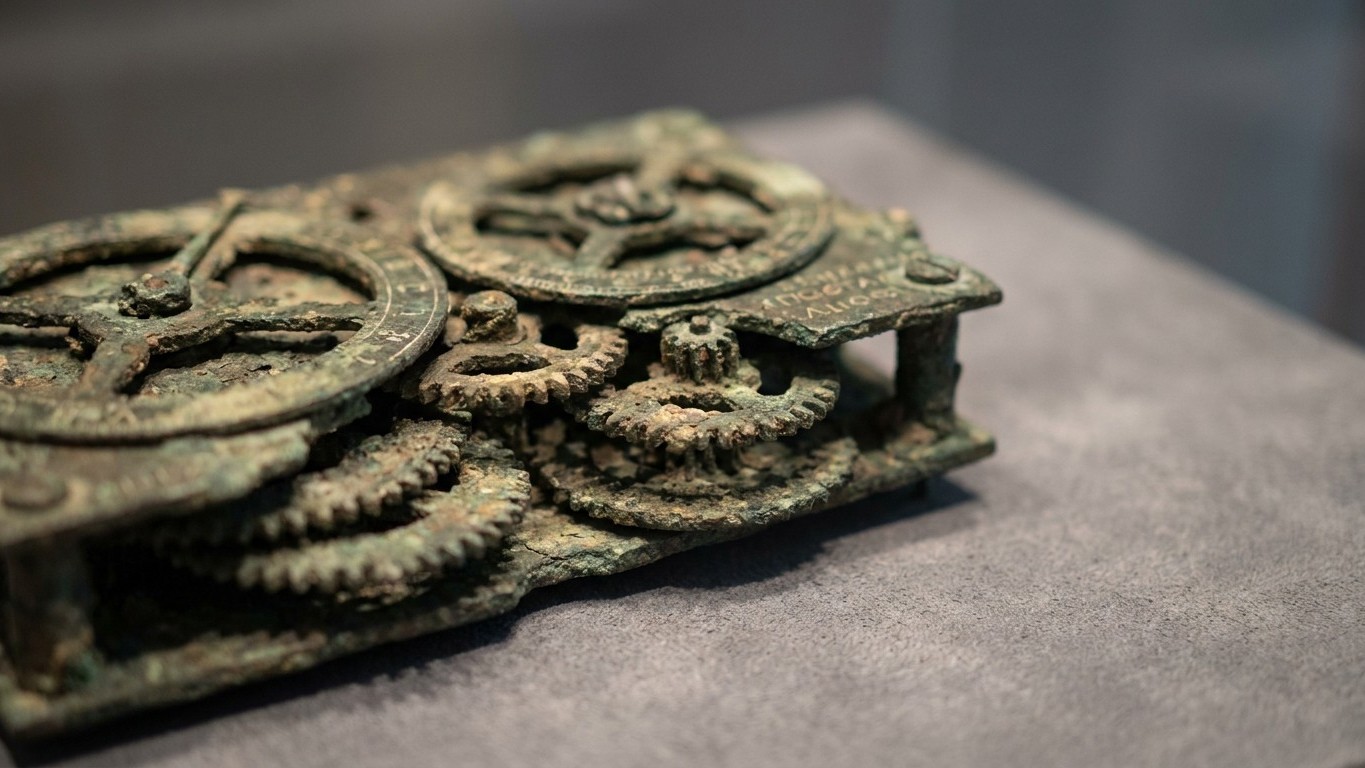
Neither a magnifying glass nor the discerning eye of an archaeologist cracked the enigma of the Antikythera mechanism. It is a device weighing eight tons, built specifically for the occasion: an X-ray tomograph capable of examining corroded metal to a tenth of a millimeter. To study such a small object, it was necessary to build an X-ray scanner, in fact a tomograph of both very high resolution and 450 kilovolts so that the beam could pass through the object along its length, weighing, with its console, more than eight tons. A technical feat that took a full century to come to light, in order to decipher an object that had remained silent since Antiquity.
Key takeaways
- A mysterious bronze block remained misunderstood for more than a century after its discovery
- A revolutionary technology finally unveils the secrets of an intact ancient mechanism
- Modern researchers wonder whether this marvel ever truly worked
A wreck, sponges, a bronze block almost discarded
The story begins with a sponge-diving expedition off a small Aegean island. In 1901, a group of sponge divers discovered, off the Greek island of Antikythera, the remains of a Roman wreck. Among amphorae and statues they found a corroded block of bronze and wood that no one for years could really interpret. It was stored in a museum, listed among curiosities. Nothing suggested that it was the oldest geared mechanism known to the world, dating to before 87 BCE according to the oldest datings.
Decades would pass before the scientific community could truly grasp the object. British physicist Derek de Solla Price paved the way in the 1970s by publishing Gears from the Greek, but the technology of his era only allowed him to skim the surface of the mechanism’s complexity. Commander Cousteau also explored the wreck in 1976, bringing back statuettes and assorted objects, without the machine itself yielding any deeper secrets. The problem was simple: the fragments of the machine cannot be “cut” without permanently damaging them. It was impossible to open the box to see what lay inside.
The scanner that succeeded where a century of curiosity had failed
The turning point came in the autumn of 2005. A multidisciplinary team bringing together specialized companies, astronomers, physicists, palaeographers and archaeologists, formed with the Universities of Cardiff, Athens and Thessaloniki, tackled the problem from a radically different angle. Rather than breaking the bronze block to inspect it, they subjected it to X-rays. The tomograph could produce three‑dimensional images with a resolution of 50 micrometers, enabling reading through the two thousand years of corrosion accumulated in seawater.
The result exceeded all expectations. These scans suggested that the mechanism possessed 37 nested bronze gears, allowing it to track the movements of the Moon and the Sun across the zodiac, to predict eclipses and to model the Moon’s irregular orbit. A Greek researcher associated with the program even managed to decipher nearly 2,000 characters engraved previously invisible to the naked eye, etched in tiny letters on surfaces as small as a fingernail. The results were presented at a conference in Athens in late 2006, and then published in the journal Nature. For the first time since its ascent from the depths of the Aegean, the machine spoke. Or rather, it was finally read.
A second life thanks to gravitational waves
What makes this story particularly delectable is that it does not end in 2006. Twenty years later, physicists who routinely hunt for ripples in spacetime reopen the inquiry. Techniques developed to analyze spacetime ripples detected by one of the most sensitive scientific instruments of the twenty-first century have shed new light on how this oldest known analog computer might have operated: the same statistical tools used to detect the mergers of black holes across billions of light‑years were repurposed to count the tiny holes punched into a broken calendar ring.
The result of this Glasgow-led study is clear: analysis of the Antikythera calendar ring shows with what precision the device tracked time, with researchers concluding in 2024 that the ring probably contained 354 to 355 holes, a near‑exact match to the lunar year. A mechanism designed two centuries before our era, able to align with the real lunar cycle to within a few days: this places the object in a category far removed from a mere antique engineering bauble.
Did it really function, or was it too beautiful to operate?
Not all recent findings point toward pure wonder. Simulations conducted by researchers Tony Freeth and Alexander Jones highlighted an embarrassing flaw: the Mars position indicator could deviate by as much as 38 degrees, a margin of error that the researchers attribute not to fabrication faults but to the limits of Greek astronomy of the time. A newer study goes even further, suggesting that even the slightest manufacturing error could have caused the mechanism to jam or slip, reopening the question of whether the device ever truly operated or if, in practice, it was more of a cumbersome luxury than a useful instrument. A doubt that does not detract from the project’s sophistication, but it reminds us that Greek artisans worked without modern fabrication tolerances, wielding rudimentary tools against calculations of vertiginous complexity.
What stands out in retrospect is the diversity of disciplines mobilized to make this bronze block speak: industrial radiography engineers, palaeographers, astrophysicists, and now gravitational-wave specialists. A century and a quarter after its recovery from the sea floor, the Antikythera mechanism continues to recruit experts from fields its designers could never have envisioned. It is today housed in the National Archaeological Museum of Athens, where only a portion of its 82 known fragments may still await rereading with technologies that do not yet exist.
Sources: techno-science.net | ncbi.nlm.nih.gov | carnouxprogres.wordpress.com
