
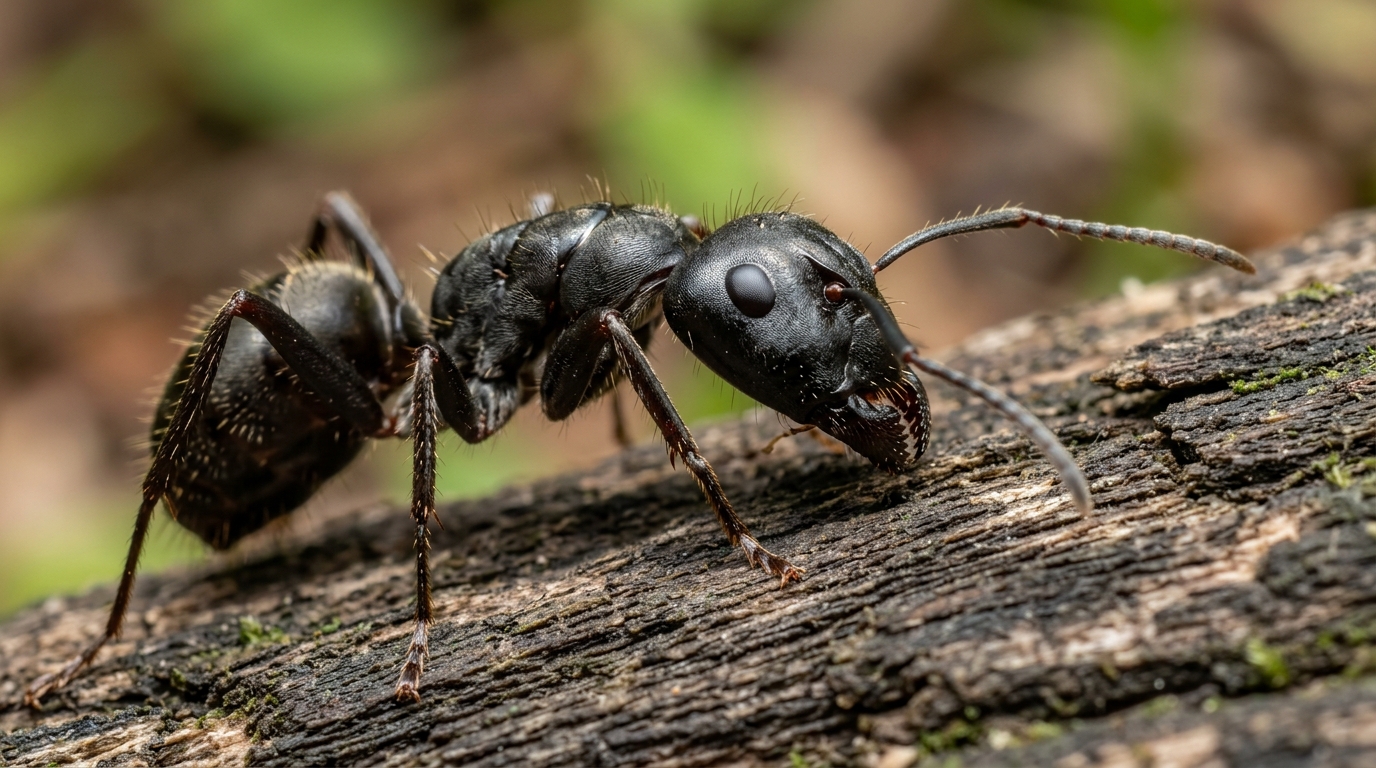
On one side, the elephant, the blue whale, the tiger: giants that embody our idea of animal power all by themselves. On the other, a creature weighing only a few milligrams, capable of slipping under a door or disappearing into a crack in the pavement. And yet, it is this second category that wins when masses are added up on a planetary scale. As autumn settles in and the last summer picnics give way to forest strolls, it is not uncommon to encounter a busy line of ants on a path, without suspecting that what you are observing is a fragment of an empire whose total weight surpasses that of entire kingdoms of life.
Twelve million tonnes: the unexpected heft of a tiny empire
The figure is enough to induce vertigo: the global biomass of ants would amount to 12 million tonnes of carbon. To place this mass in perspective, it must be compared with the other major groups of terrestrial animals. In fact, this estimate exceeds the combined biomass of all wild mammals and all wild birds on the planet put together. In other words, if you laid on a gigantic scale the entire populations of foxes, deer, bears, sparrows and eagles on one side, and all existing ants on the other, the insect side would sink the scale even more.
This result is not the product of a rough estimate scribbled in the margins. It rests on a global synthesis, integrating surveys conducted across continents in environments as diverse as tropical forests, arid steppes, and urban zones. The conclusion is unequivocal: ants, long seen as the background hum of biodiversity, are in fact a heavyweight on a planetary scale.
How a milligram-scale insect surpasses whales and tigers on the planetary scale
A worker ant weighs on average between 1 and 5 milligrams. By comparison, a blue whale can exceed 150 tonnes, which is the equivalent of an unfathomable number of ants. Taken individually, the insect seems feather-light. But biomass calculations do not operate through averages of individuals: they sum masses, and that is precisely where the logic flips.
It is estimated that there are on Earth several quadrillions of ants, dispersed across colonies ranging from a few dozen to several million individuals. It is these astronomical figures that empower a tiny species to rival, and then surpass, the cumulative mass of much larger animals such as big cats, deer, or birds of prey. Nature does not compare the size of giants in isolation; it compares populations, and in this game the ant plays in a league of its own.
The secret of this supremacy: numbers, density and ubiquity
Three factors explain this quiet domination. First, the numbers: ants reproduce rapidly and form organized societies where each queen can give birth to generations of workers within weeks. Next, the density: in some tropical ecosystems, there can be thousands of ants per square meter of soil, a concentration few other animal groups reach. Finally, the geographic ubiquity: ants inhabit nearly all terrestrial habitats, from urban gardens to equatorial forests, including prairies and certain semi-desert zones.
This combination makes ants a quiet but essential pillar of ecosystem functioning. They contribute to soil aeration, seed dispersal, and the regulation of other insect populations, playing the role of ecological engineers that is too often attributed to large mammals or earthworms.
What the true hierarchy of life reveals
This discovery invites us to rethink how we measure the importance of species. For a long time, we judged the power of an animal kingdom by the size of its most spectacular representatives. But biomass tells a different story: a critical mass that matters more than individual stature. Ants, invisible in our collective imagination beside lions or elephants, turn out to be major actors in the planet’s balance.
This observation aligns with a broader trend in the study of life: insects, as a whole, represent a staggering share of terrestrial animal biomass, far ahead of vertebrates that nevertheless dominate media and science attention. Ants stand out as the most striking example, because their modest presence contrasts with their weight in the balance of life.
The next time a line of ants crosses your path on a autumn stroll, chances are your view of them will be different. Behind this tiny bustle lies a collective power that, in tonnes, exceeds those kingdoms we once believed unbeatable. A humbling lesson from a world we tread on every day, reminding us that grandeur in nature does not always measure itself by size.
