
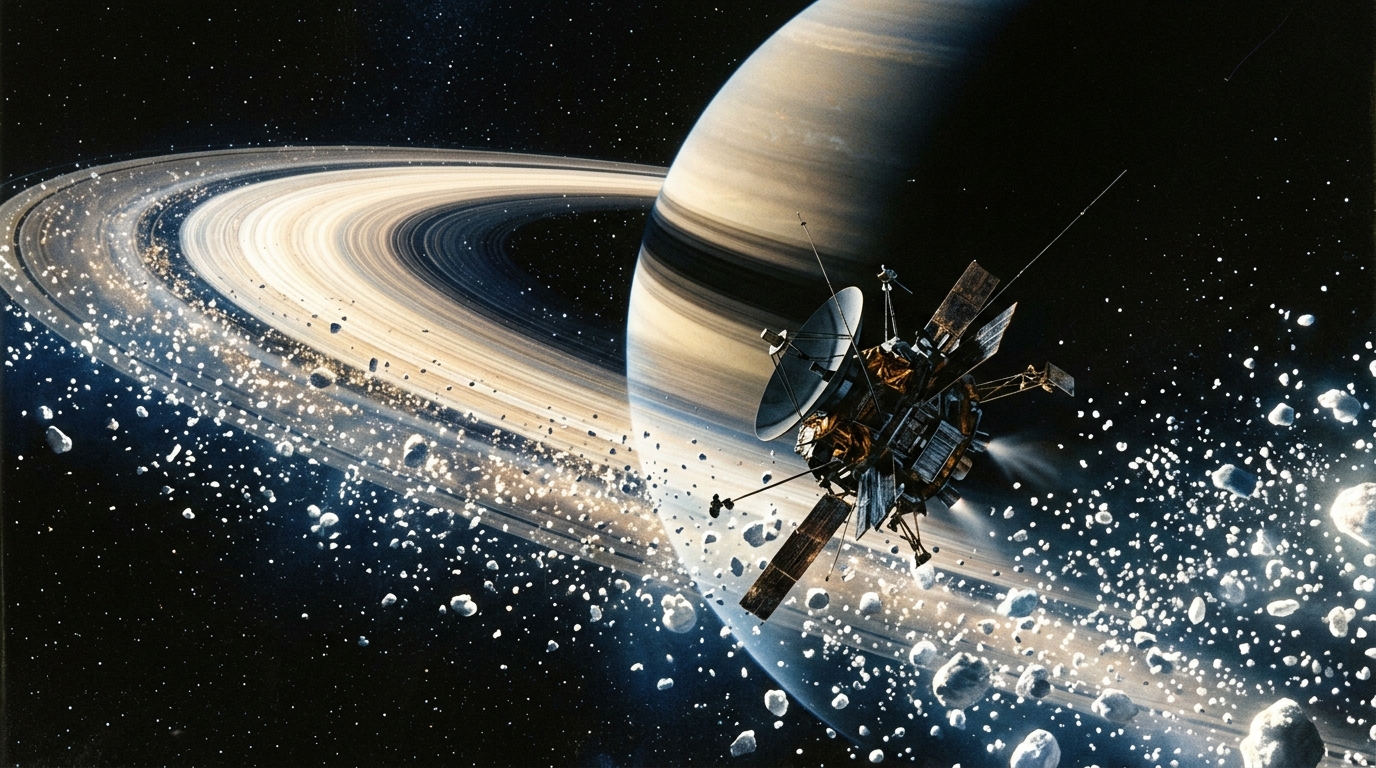
A probe weighing less than a ton, launched in the 1970s with technology that our current smartphones would far surpass, ventured one day to where no one had ever dared go: right into the heart of Saturn’s rings. On that day, NASA engineers had no certainty about the outcome of the maneuver. They only knew they were about to sacrifice, or not, years of work on the altar of discovery. This perilous crossing would nonetheless become one of the most decisive moments in the history of space exploration, because its result would directly shape the future of the famous Voyager probes, still on their way at that time.
The day NASA rolled the dice with Pioneer 11
We are September 1, 1979. The probe Pioneer 11, launched six years earlier, is approaching Saturn after a long voyage across the solar system. Contrary to what one might imagine, this mission was not a mere scientific formality: it represented a real-world test on which the survival of two much more ambitious craft, the probes Voyager 1 and Voyager 2, already launched and speeding toward the far reaches of the solar system, depended. No one at the time knew with precision what actually lay within the structure of Saturn’s rings.
The teams on the ground held their breath. Pioneer 11 was not merely an explorer; it had become, albeit unwillingly, a true space guinea pig. Its role: to verify whether a spacecraft could traverse the ring region without being shredded by the debris that composed it. A catastrophe scenario would have meant the outright cancellation of the Voyager itinerary, forcing NASA to rethink its entire strategy for exploring the outer planets.
An unknown trajectory, a high-stakes gamble
At the time, observations of Saturn from Earth remained limited. Ground-based telescopes could not reveal the exact density of particles making up the rings, nor their precise distribution in space. Scientists knew there were gaps between certain rings, but they did not know whether these corridors were truly passable for a craft moving at tens of thousands of kilometers per hour.
The slightest miscalculation could have been fatal. A dust grain large enough, struck at that speed, would act as a projectile capable of piercing the spacecraft’s hull. Engineers therefore had to choose a trajectory calculated with the utmost caution, relying on the partial data they had. This decision, made without a safety margin, perfectly illustrates the pioneering spirit that drove space missions of that era: progress often meant venturing into the unknown, guided as much by scientific intuition as by calculations.
The crossing of the rings: seven minutes of radio silence
The critical moment arrives as Pioneer 11 penetrates the ring plane, at a distance of about 21,000 kilometers above Saturn’s cloud tops. During this phase, the probe loses all contact with Earth. A total silence then settles in the control rooms, a silence that lasts several long minutes, each seeming to stretch out indefinitely for the teams on site.
This brief interval, however short in the grand scheme of a mission spanning years, contains the core of the mission’s scientific and human stakes. When the radio signal finally reappears, confirming that the probe survived the crossing without major damage, it brings immense relief to the NASA teams. Pioneer 11 has just demonstrated, by its mere intact presence, that a spacecraft could cross this dreaded zone without being destroyed.
The discovery that rewrote Voyager’s plans
Beyond merely validating a passage route, Pioneer 11 also allowed the collection of valuable data on the rings’ composition, their real thickness, and the density of the particles that constitute them. This information, transmitted to Earth in the days following the flyby, was immediately analyzed by the teams preparing Voyager 1’s upcoming arrival, planned a few months later.
Thanks to these unprecedented data, engineers were able to adjust Voyager 1’s trajectory to take a safer path, drawing on the lessons learned from its predecessor’s passage. Without this successful experience, mission officials might have opted for a much more cautious approach, or even abandoned certain close flybys, greatly limiting the scientific richness of the observations obtained thereafter.
What Pioneer 11 changed for Solar System exploration
The legacy of this crossing extends far beyond the Saturn mission itself. By proving that it was possible to navigate through the rings of a gas giant, Pioneer 11 opened the door to more ambitious exploration of the outer solar system. The data gathered helped refine our understanding of ring dynamics, a topic that remains at the heart of much astronomy research today.
This mission also strengthened scientists’ confidence in the ability of autonomous probes to venture into extremely harsh environments without direct human intervention. A principle that continues to guide the design of current space missions, whether it is to explore Jupiter’s icy moons or the mysterious outskirts of our solar system.
Reflecting on this bold crossing makes one realize how space exploration rests on a delicate blend of rigorous calculations and assumed risks. Pioneer 11, often eclipsed by the fame of the Voyager probes, deserves a place in history as the true trailblazer that enabled its successors to continue their journey toward infinity. One question remains: how many other major discoveries rest, somewhere in the history of science, on the quiet courage of a pioneer who stayed in the shadows?
