
You followed the instructions to the letter, kept to the application time indicated on the bottle, and yet, a week later, your child was scratching their head again in front of their bowl of cereal. This scenario, millions of French parents experience each year at the start of the school year, convinced they had misjudged the product or rushed the application. Yet the truth lies elsewhere, and it is far more surprising: it is not our actions that failed, but the lice themselves that have changed in nature. These tiny insects, present on human scalps for millennia, have developed a genuine biological armor against the most common chemical treatments. Understanding this mechanism radically changes the way we approach the problem.
À retenir
- Head lice resist conventional insecticides thanks to genetic mutations (kdr) that modify their sodium channels, rendering traditional shampoos ineffective even when used correctly.
- Dimethicone, unlike chemical insecticides, acts mechanically by suffocating the louse with an occlusive film, a method that genetic resistance cannot bypass.
- Fine-tooth combing on wet hair, repeated every 3–4 days for two weeks, remains essential to eliminate the nits that escaped treatment.
Table of Contents
- Lice have mutated, not our washing habits
- The blocked sodium channel: anatomy of a chemical resistance
- Dimethicone, the weapon that leaves no biological chance
- What really has to change in your lice treatment protocol
Lice Have Mutated, Not Our Washing Habits
For a long time, treatment failures were attributed to improper use of the product: insufficient quantity, hair not damp enough, or contact time shortened by a lack of patience. This comforting explanation has long masked a more troubling reality. Head lice are no longer the same as they were twenty years ago. Under the constant pressure of chemical treatments used in homes and schools, natural selection has occurred at an impressive speed. The individuals most sensitive to insecticides have disappeared, giving rise to entire lineages of lice that are naturally resistant, which pass this trait from generation to generation.
This phenomenon is not anecdotal. In many regions of France, a significant portion of lice populations today exhibit this resistance, rendering certain shampoos virtually ineffective even when applied exactly as directed. The problem is therefore not behavioral; it is genetic.
The Blocked Sodium Channel: Anatomy of a Chemical Resistance
To understand this resistance, one must look at how the most widely used insecticides in lice treatments, the pyrethroids, work. These substances typically disrupt the functioning of sodium channels present in the insect’s nervous system. Put plainly, they block nerve signal transmission, causing paralysis and then death of the parasite. It is a remarkably effective mechanism, provided that the sodium channel remains sensitive to the chemical molecule.
But it is precisely at this point that the lice have found their escape. Some of them carry mutations known as kdr, for knock-down resistance, which slightly modify the structure of this sodium channel. This alteration, almost invisible at the molecular level, is enough to prevent the insecticide molecule from binding properly. The louse becomes literally unresponsive to the chemical attack, like a lock whose shape has been subtly altered so that no standard key can fit. The shampoo is still applied, the contact time is respected, but the insect simply survives because its biology has changed.
Dimethicone, the Weapon That Leaves No Biological Chance
Facing this reality, another approach has proven effective, not by trying to bypass genetic resistance, but by simply avoiding the chemical route altogether. Dimethicone, a silicone-based compound, does not target the louse’s nervous system. It works purely mechanically, by coating the insect with an occlusive film that blocks its airways. The louse suffocates, starved of oxygen, with its genetics playing no role in the equation.
This fundamental difference explains why kdr mutations, as effective as they may be against traditional insecticides, remain completely powerless against this type of treatment. You cannot develop resistance to asphyxiation in the same way you develop resistance to a specific chemical molecule. It’s a bit like comparing a reinforced lock facing a burglar who has decided, not to force the door, but to cut off the air supply to the entire house.
What Really Has to Change in Your Lice Treatment Protocol
Concretely, this discovery prompts a deep rethinking of treatment habits, especially during back-to-school season when interactions among children facilitate spread. Rather than multiplying doses or extending the contact time of an ineffective product, it becomes wiser to favor dimethicone-based treatments, whose mechanical action remains constant regardless of the genetics of the targeted louse.
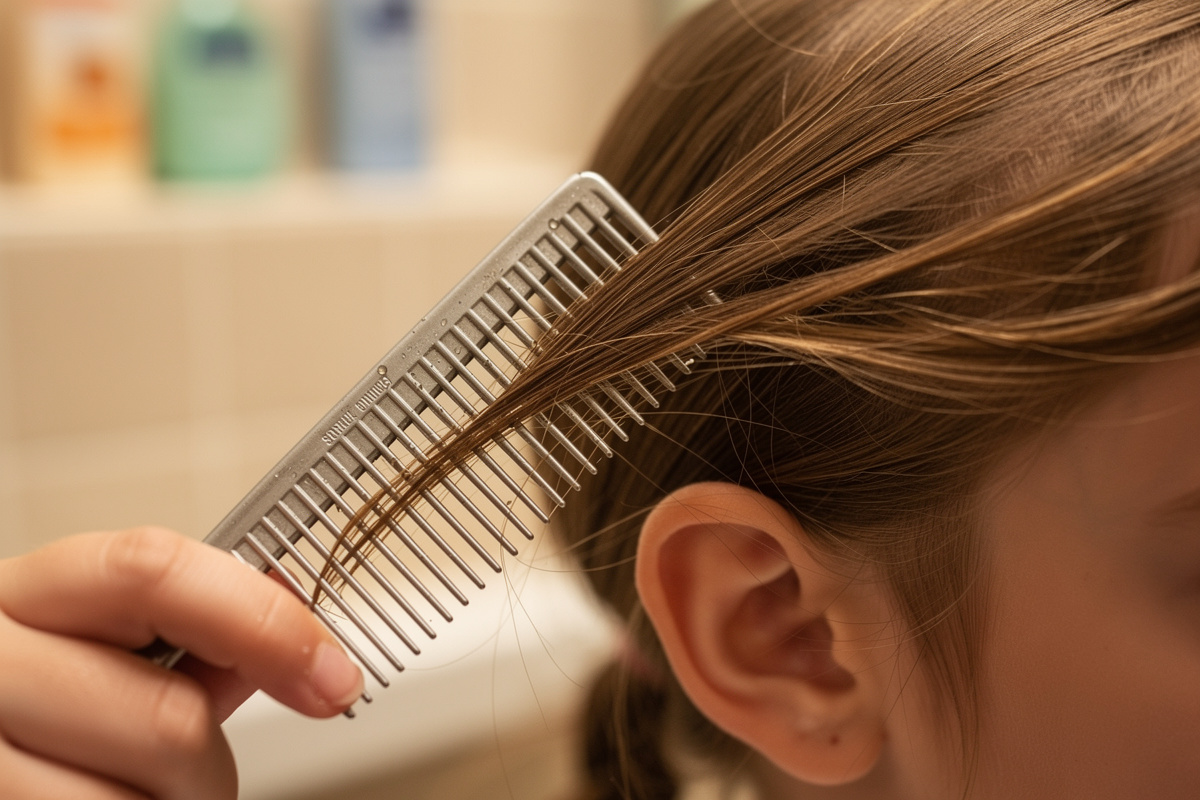
Meticulous combing with a fine comb, performed on wet hair and repeated every three to four days for two weeks, also remains an indispensable complement, as it mechanically removes nits that escaped the treatment. Finally, it is worth recalling that scalp hygiene has never been the determining factor in the presence of lice: these parasites thrive just as well on clean hair as on dirty hair, contrary to a widely held yet persistent belief.
Thus, the battle against lice is no longer a matter of dosage or patience, but of understanding the biological terrain on which it plays out. By choosing a weapon that genetic resistance cannot circumvent, we finally regain a tangible advantage over a parasite that already has several steps ahead of our habits. It remains to be seen how long dimethicone will retain this formidable effectiveness as well.
