
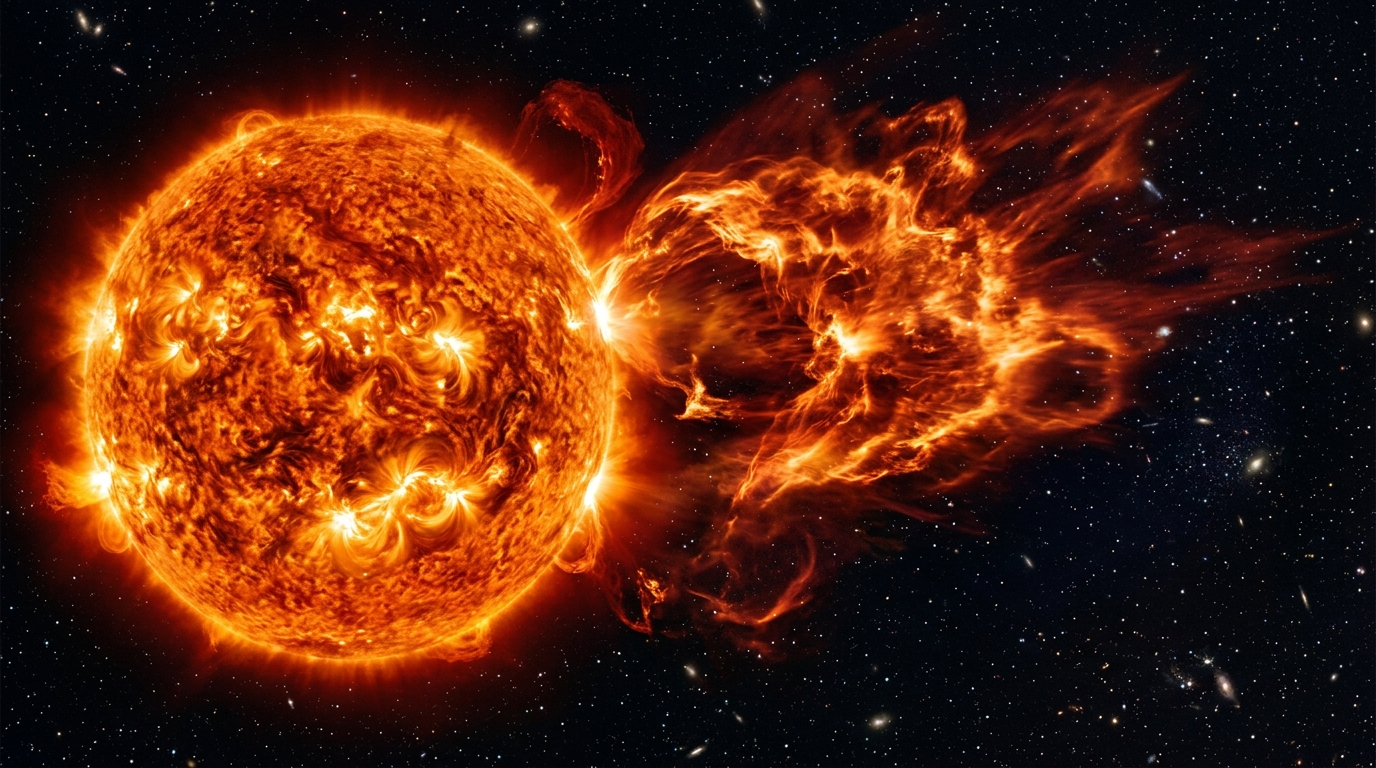
People often confuse a solar storm with a simple solar flare, even though these two phenomena are not at all the same. The former designates a sudden burst of activity on the surface of our star—a kind of cosmic sneeze visible from Earth as sunspots or bright flashes. The latter, by contrast, refers to the shock wave that strikes our planet when that eruption is accompanied by a massive ejection of charged matter. It is this nuance, long ignored by the general public, that helps explain why an event that happened more than a century and a half ago continues to haunt engineers who study our modern electrical grids. Because if the Sun now seems, as we move into September, like a benevolent and predictable presence, it once showed a capacity for disruption that few would have imagined in the early days of the industrial era.
A Simple Point of Light Changes Everything: Richard Carrington Looks at the Sun and Sees the Impossible
On that day, the British amateur astronomer Richard Carrington is observing the Sun from his private observatory, as he did almost every day. Nothing forebodes that this session will enter the annals of astrophysics. Suddenly, during a projection of the solar image onto his screen, he notices two points of blinding whiteness appearing at the center of an already impressive group of sunspots. The intensity of this flash is so astonishing that he remains dumbfounded, fully aware that he is witnessing something that the science of his time cannot yet name with precision.
What Carrington has just observed, though he may not have realized it at the moment, is a solar eruption of colossal power, today regarded as one of the most violent solar events ever documented. It was the very first time a human consciously witnessed this type of phenomenon and took the time to describe it with the scientific rigor necessary for the observation to endure through the centuries.
When Solar Light Hits Us Full on in Eight Minutes, and the Storm Follows
What makes this episode so fascinating is the temporal lag between the observation and the real, tangible consequences on Earth. The visible light from the eruption reaches our planet in eight minutes or so, just like any ordinary solar ray. But the eruption is accompanied by a coronal mass ejection, a gigantic cloud of charged particles propelled into space at incredible speeds. That cloud, much slower than light, takes roughly 17 hours to travel the distance from the Sun to the Earth—a remarkably short delay for this kind of journey.
This unusual speed signals the extraordinary violence of the event. When this cloud of particles finally smashes into the Earth’s magnetic field, it triggers a geomagnetic storm of an intensity never before measured, capable of deeply disturbing the planet’s electromagnetic balance.
From Northern Lights to Jamaica, and Telegraphs That Spark on Their Own
The visible consequences of this storm surpass anything imagined at the time. Auroras, typically confined to polar regions, illuminate skies as far as tropical zones like the Caribbean, offering a spectacle so intense that some witnesses can read their newspaper in the middle of the night by the glow of the sky. This dramatic display, as beautiful as it is, masks a harsher reality for the nascent technological infrastructure of the era.
The global telegraph network, then the pride of the industrial revolution and a symbol of modern communication, bears the brunt of the storm’s effects. Cables, running currents induced by the storm, behave erratically. Some operators report electric shocks while handling their equipment, while sparks shoot from devices, sometimes causing actual fires in telegraph offices. More troubling still, some telegraphs continue to operate even when disconnected from their power source, the energy induced by the storm enough on its own to carry messages.
Why a New Carrington Event Would Upset Our Digital Civilization in Minutes
If this episode belongs to history, it remains highly relevant for our era, if anything more so. In 1859, humanity had a modest telegraph network that was largely independent. Today, our civilization relies on interconnected electrical grids, communication satellites, geolocation systems, and digital infrastructures of unparalleled complexity. An event of Carrington’s magnitude would affect far more than a few telegraph offices.
High-voltage transformers—the backbone of our energy networks—would be particularly vulnerable to currents induced at such strength. A geomagnetic storm of comparable magnitude could trigger widespread power outages lasting days, or even weeks in some regions, while it takes time to replace equipment whose manufacture and delivery cannot be expedited in hours. Satellites, essential for GPS and global communications, would also face major malfunctions or outright destruction of sensitive electronic components.
This scenario is far from a classroom hypothesis; it fuels today’s extensive reflections on the resilience of our critical infrastructures against the caprices of our star.
The 1859 episode powerfully reminds us that the Sun, despite its seeming regularity and reassuring daily presence, remains a source of energy capable of sudden, spectacular upheavals. From auroras visible as far as the tropics to telegraphs sparking without obvious cause, this event offered humanity a stark glimpse of our vulnerability in the face of our star’s moods. At a moment when our societies depend almost entirely on technologies sensitive to electromagnetic disturbances, the question may no longer be whether a new Carrington event will occur, but when it will occur and whether we will be prepared to respond.
