
Yes, there truly exists a spot in the solar system where terrestrial creatures still rest today, left to their own devices for more than five years, without anyone ever having attempted to retrieve them. This place isn’t an isolated island nor a forgotten cave, but the very surface of the Moon itself. It all began with a mission meant to mark Israeli space history, one that ended in a cloud of lunar dust, carrying with it a cargo as discreet as it is extraordinary. Since then, a question remains unresolved, almost philosophical: has earthly life managed to take root, even in dormancy, on a body where nothing should be able to survive?
Key takeaways
- In April 2019, the Israeli probe Beresheet crashed on the Moon carrying thousands of dehydrated tardigrades concealed within the Lunar Library.
- Researchers at the University of Kent estimated in 2021 that the impact velocity of the probe likely exceeded the tardigrades’ known survival threshold, making their survival unlikely.
- No mission has ever returned to the crash site to verify this hypothesis, leaving the question without a scientifically confirmed answer to this day.
Table of Contents
- Beresheet, the probe that was supposed to write history differently
- Tardigrades in space: the hardiest life on Earth
- A crash that changes everything: what did they really become?
- Why does no one go looking for them (and what it reveals about our relationship with the Moon)
Beresheet, the probe that was supposed to write history differently
In April 2019, the Beresheet probe, designed by the Israeli organization SpaceIL in collaboration with Israel Aerospace Industries, was poised to become the first privately funded craft to land softly on the lunar surface. The ambition was immense for a country that had never attempted such a feat, and the craft approached its target with a precision that seemed to herald a historic success. But just minutes from the objective, a gyroscope failed and blocked the main engine. The device, expected to slow gradually, continued to hurtle at around 500 kilometers per hour while it was only about 150 meters above the surface.
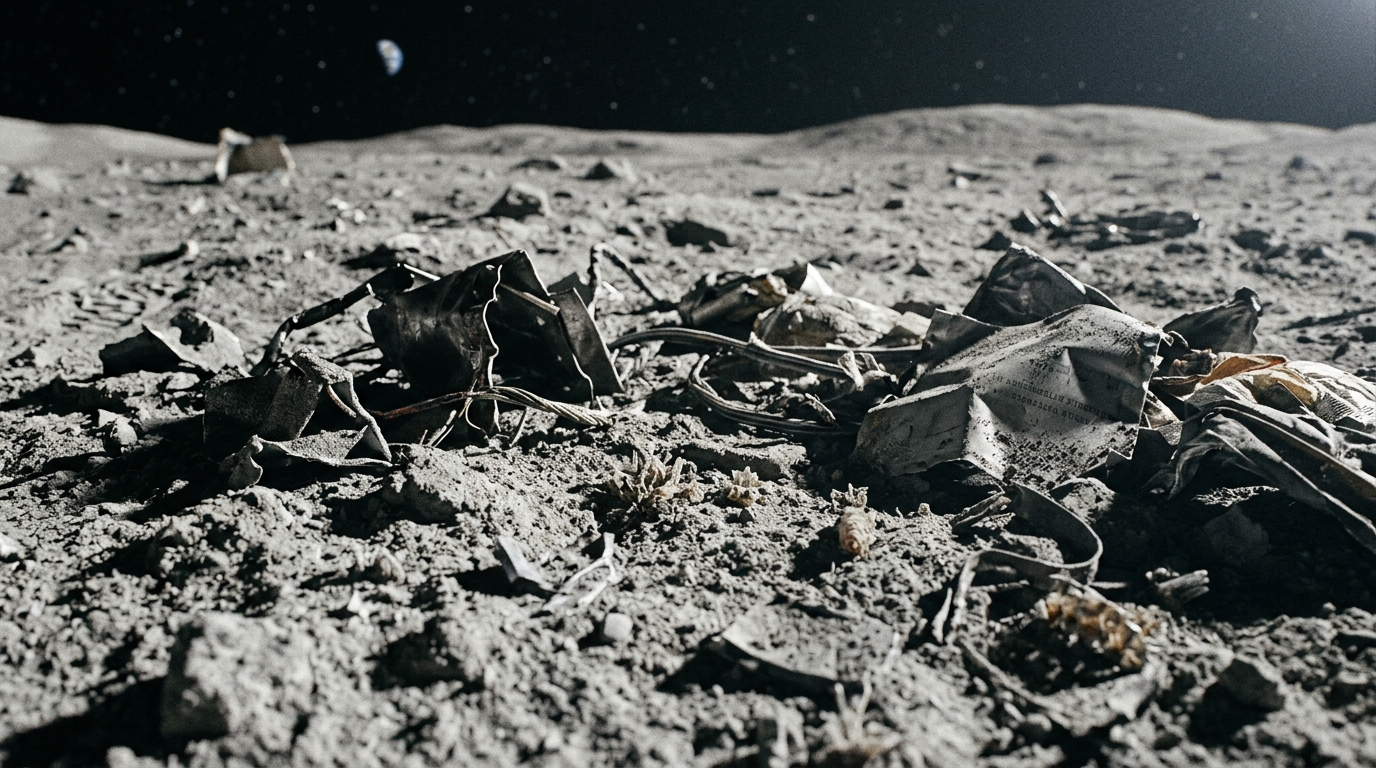
The outcome was inevitable. Beresheet crashed and disintegrated, scattering debris over roughly a hundred square meters of the lunar surface. The failure was resounding, but it concealed information that few people still know today: the probe was not carrying merely scientific instruments and national symbols. It also housed a living cargo, tiny yet incredibly resilient.
Tardigrades in space: the hardiest life on Earth
At the heart of Beresheet lay a device named the Lunar Library, a genuine library of human knowledge imagined by the Arch Mission Foundation, a American organization that aspires to preserve humanity’s knowledge, whatever may happen to our planet. Concretely, it was a disc the size of a DVD, but composed of thin layers of nickel capable of withstanding extreme conditions, and containing about 30 million pages of text and images.
Only a few weeks before launch, project leaders quietly decided to add a sample of human DNA as well as thousands of dehydrated tardigrades. These microscopic organisms, often nicknamed the hardiest creatures on the planet, have the ability to enter a state called anhydrobiosis. In plain terms, they expel their water, slow their metabolism to near zero, and can thus endure for years, even decades, before rehydrating and resuming normal activity. We have seen them withstand the vacuum of space, intense radiation, and extreme temperatures, which made them almost logical candidates for such a journey.
A crash that changes everything: what did they really become?
Immediately after the accident, Nova Spivack, the founder of the Arch Mission Foundation, hinted that their payload could ultimately be the only thing to survive the crash, given how robust these organisms seemed to defy logic. A statement that captured the imagination, but rested more on hope than on scientific certainty.
Two years later, researchers from the University of Kent sought to test this assumption by examining, in a laboratory setting, the impact speeds that tardigrades can actually withstand. The results, published in the journal Astrobiology, established a survival threshold around 0.9 kilometers per second, corresponding to a shock pressure of about 1.14 gigapascals. Yet the final speed estimated for Beresheet at impact hovered dangerously close to this limit. In other words, according to these studies, the tardigrades aboard would very likely not have survived the shock. But the keyword remains likely, because no mission has ever returned to the crash site to confirm or refute this hypothesis.
Why does no one go looking for them (and what it reveals about our relationship with the Moon)
This absence of verification is not by chance. Sending a mission dedicated solely to analyzing a crash site would entail a substantial cost for an objective deemed secondary by space agencies, which are more focused on exploration, the exploitation of lunar resources, or the preparation of future inhabited bases. The Beresheet site therefore remains, for now, a footnote in space history, a place we know but have never returned to.
This incident raises, however, a larger question, that of planetary protection. Space agencies typically apply strict protocols to avoid any biological contamination of other celestial bodies, especially when it comes to searching for potential extraterrestrial life. Yet here, a private organization added living organisms to a probe at the last minute, without triggering any special checks. Beresheet’s crash thus illustrates, almost inadvertently, the limits of real control over the payloads of private missions, and poses the question of what we are willing to scatter on other worlds, sometimes without even realizing it.
Ultimately, the mystery of Beresheet’s tardigrades tells as much a story of biological resilience as a tale of technological forgetfulness. Whether or not these organisms survived the impact, they embody an involuntary experiment that no one has ever had the chance to observe to its conclusion. And as long as no mission returns to tread this corner of the Moon, the answer will remain suspended between two worlds: that of verified science and that of mere hypothesis. Perhaps one day, a curious rover will finally scratch away this gray dust to tell us.
